

Israelis fight over framing of West Bank attacks. But settler violence is an Israeli strategy
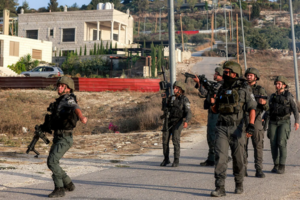
Israeli Border Police officers patrolling the West Bank village of Tell in the occupied West Bank on 25 July, one day after the deadly clash
Dahlia Scheindlin writes in Haaretz on 28 July 2026:
Of all the Israeli terror attacks and pogroms against West Bank Palestinians, few expose Israel’s de facto strategy as clearly as the events on Friday in the West Bank village of Tell.
Even fewer incidents in which a Palestinian killed Israelis have generated such heated debate about Israel’s responsibility. Usually, it’s easier for Israelis to collectively blame of all Palestinians.
When settlers descended on the Palestinian village, leading to clashes in which four Palestinians and two Israelis were killed, the incident just couldn’t be spun within Israel’s comfortable tale of murderous Palestinian terrorists killing Jews.
Israeli Prime Minister Benjamin Netanyahu, other political leaders and mainstream media reports tried to maintain that framing, and to be sure, many Israelis will leave it at that. But for others, it was hard not to see who brought the weapons, who barged into whose village, who drove a rifle butt into the face of an unarmed Palestinian man seeking to fend them off.
One of the Palestinians, apparently Farouk Ramadan, grabbed the gun and shot Benayahu Mellet, a member of the nearby settlement’s rapid response security team, before being shot dead himself along with three of his cousins. Another soldier was wounded and later died, as a series of revenge attacks by the IDF soldiers and settlers against Palestinian targets broke out over the next few days. It’s not yet clear, but the soldier might have been killed by Israeli fire.
With footage of the incidents racing around mainstream and social media, the story generated a maelstrom of competing interpretations. What follows is my curated list of what I see as the most important takeaways about both the attack and how Israelis are responding.
First, Mickey Gitzin, the acting CEO of the New Israel Fund, wrote: “Let’s be honest, the reason we’re all talking about what happened on Friday is because two Jews were killed. If these guys had … ‘felt threatened’ and killed four Palestinians, it wouldn’t even make the news.”
This is not necessarily representative of how mainstream Israeli Jews saw the events, but it is the terrible truth. The unchecked surge of settler violence is a side issue unless Israeli Jews are harmed. A whole Palestinian family mowed down in March barely broke through most Hebrew-language media. Israelis tend to lock their hearts and their screens to daily attacks on Palestinians by settlers or the army, whether they involve sexual assault, or the 68-to-one ratio of Palestinian to Israeli deaths in the West Bank this year alone, prior to Friday.
Second, some Israelis trained their anger on the settlers, and not only from the far left. The Middle East expert Elizabeth Tsurkov pointed out that many within the mainstream left, which too often panders politically to the center, treated the incident as the settler-generated provocation it is. Even Yair Golan, the Democrats party leader who pandered perfectly at first, later turned the conversation to where it belongs, sort of – to the government’s encouragement of settler violence.
Third, in this context, some Israelis even questioned the holy grail of “Palestinian terrorists.” I sensed that Prime Minister Netanyahu’s description of a “murderous terrorist attack” didn’t carry the usual punch. Most mainstream outlets did reflexively use the word “terrorists.” But even Avi Issacharoff, one of the most influential journalists in Israel and the creator of “Fauda,” analyzed the events as settler-provoked and completely preventable.
Others noted that it’s harder to apply the usual “terrorist” designation to people who were unarmed, did not plan an attack, and the violence occurred near their very own village. At what point, exactly, did the man who shot Mellet stop being a villager – someone’s father or son, who ran down a hill unarmed to try to beat back the armed settlers and took a rifle butt to his face – turn into a “terrorist”?
This is the time to remind everyone that terrorism refers to attacks on civilians for political aims. Given that the Israelis were armed and initiated the confrontation, not the Palestinians, and IDF soldiers were present during the shooting, it’s not clear why the word applies at all.
Fourth, several prominent figures compared Mellet’s killing to another recent and painful incident. The IDF soldier Gur Kehati was killed in late 2024 in Lebanon. He had been assigned to accompany an older Israeli named Ze’ev Erlich, a self-styled archeological researcher and religious fundamentalist who apparently hoped to find traces of an ancient Jewish presence in Lebanon.
Hezbollah attacks killed both of them, leading to bitter accusations by Kehati’s family that Gur died for Erlich’s ideology, not for Israel. An IDF legal probe basically closed the case just a few weeks ago. Since Friday, many have shared a post attributed to Kehati’s grandfather – imagining a nightmare of yet another grandchild being killed for the wrong reasons, and covered up by the authorities with lies.
But the most important takeaway of all is what’s happening every day in the West Bank, before and after the incident on Friday. You can’t fudge this with “framing” debates, as prominent right-wing pundit Amit Segal tried to do. The Jewish Israelis who attacked Palestinians at Tell were everything: settlers, army, settlement “rapid response security teams,” who are backed by the Defense Ministry. What’s indisputable is that they barged into Areas A and B, those bits of territory nominally (but barely) governed by Palestinians; when the soldiers showed up, as always, they didn’t stop the guys with the guns
This shatters the foolish lie of wayward youth and spontaneous, isolated incidents. This is a plan: attack Palestinian areas deeper and deeper inside the West Bank, to force them to leave. One of the most infamous such settlers, Elisha Yered, boasted openly of this strategy on a podcast that also made the rounds in light of Friday’s attack.
The events let it all hang out: Yered is one link in a chain. Netanyahu is the next link, announcing after the killings that Israel would destroy the home of the Palestinian who shot Mellet and was then killed; crack down on Palestinian towns and weapons; and recognize and establish more outposts as official settlements – which encourage the very people committing these acts. His words are linked in turn to Bezalel Smotrich and Itamar Ben-Gvir, who named their long-term vision aloud: to do to the West Bank what Israel has done to Gaza. That was always their plan.
This article is reproduced in its entirety