

Tell killings: Does the right of self-defence apply only to Jews?
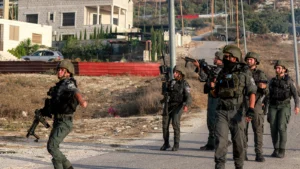
Israeli soldiers patrol the Palestinian village of Tell in the occupied West Bank on 25 July 2026, a day after 4 Palestinians and 2 Israeliswere killed during a settler attack on the village
Ahmad Tibi writes in Middle Est Eye on 27 July 2026:
There is something remarkably predictable about the way Israeli society tells itself stories. An incident occurs, and within minutes the roles are assigned: there is a victim and an attacker, the righteous and the guilty. Only later, if at all, are the facts carefully examined. By then, public opinion has already reached its verdict.
That is what happened on Friday in Tell, a Palestinian village southwest of Nablus in the occupied West Bank, where Israeli settlers and soldiers killed four Palestinians after dozens of armed settlers stormed homes and farmland on the village’s outskirts early in the morning. Two Israelis, a settlement security guard and an army officer, were also shot dead.
The initial Israeli headlines told of an “Israeli hiker” killed in a gunfight; the words “terror attack” and “terrorists” followed within hours. The entire village was effectively put on trial before any serious investigation had begun.
But the story did not begin with the deaths of two Israelis. According to eyewitnesses and video footage shared online, the armed settlers entered the village from the direction of Havat Gilad, an illegal Israeli settler outpost with a long history of confrontations and attacks against neighbouring Palestinian communities. One widely circulated video appears to show a settler drawing a firearm and threatening to shoot.
A struggle reportedly followed, escalating into fatal gunfire. Israeli authorities have presented a different version of events. The discrepancies between the accounts underscore the need for a thorough, independent investigation, rather than the immediate embrace of a single narrative.
Yet one obvious question has barely been asked: what were armed settlers doing inside a Palestinian village in the first place? That question challenges one of the most entrenched assumptions in Israeli public discourse: that Jewish settlers enjoy an almost unrestricted right to move through Palestinian communities, while Palestinians are expected to justify even their most basic right to live safely in their own villages.
The residents of Tell did not wake up looking for confrontation. They woke up to a reality now entrenched across the occupied West Bank, documented repeatedly by Israeli human rights organisations and international observers: armed settler groups encroaching on farmland, grazing areas and, at times, Palestinian villages themselves.
Yet whenever such violence ends in tragedy, the broader context disappears, and everything is reduced to a single word: terrorism. But terrorism is not an ethnic category. If armed civilians terrorise another civilian population through sustained intimidation, seeking to drive families from their land, what should that be called? Does the definition change simply because the perpetrators are Jewish?