

The new settler-led security doctrine driving Israel’s onslaught on the West Bank
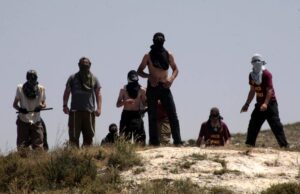
Settlers attack the Palestinian village of Urif outside Nablus, 30 April 2013
Qassam Muaddi writes in Mondoweiss on 30 July 2026:
Four Palestinians and two Israelis are dead after Palestinians confronted a group of invading Israeli settlers who had stormed the Palestinian village of Til, southeast of Nablus, earlier last week. The incident has become the pretext for Israel’s latest and most sweeping escalation in the West Bank, heralding a new phase in Israel’s assault on Palestinian existence in the territory. But underlying these developments is a deep ideological and social divide in Israeli politics and society that is driving a particular approach to dealing with the local Palestinian population, characterized by unleashing violent settler pogroms on Palestinian villages and towns.
In the wake of the events at Til, settler groups launched a renewed spree of attacks on Palestinian towns and villages across the West Bank, from the countryside of Nablus to the southern Hebron hills, torching cars and farmlands, damaging property, taking over houses, and opening fire on civilians. Meanwhile, the Israeli army raided the city of Nablus and several neighboring towns and villages in the northern West Bank, arresting hundreds of Palestinians and conducting field interrogations. In Jenin, Ramallah, and Hebron, the military also blocked roads and demolished properties.
The Israeli government immediately treated the incident at Til as a “terrorist attack,” issuing orders for the army to raid villages and announcing an impending large-scale offensive in the West Bank, although it was postponed to take place until after Israeli Prime Minister Benjamin Netanyahu returns from his visit to U.S. President Trump in Washington.
But this escalation isn’t just a response to Til. It exposes a deeper conflict inside Israel over how the state defines its own security. One camp, led by Netanyahu’s hardline allies, Finance Minister Bezalel Smotrich and National Securityu Minister Itamar Ben-Gvir, casts settlers as the frontline defenders of the state. The other, rooted in Israel’s more traditional security establishment, sees settler violence itself as the danger. The clash between these two currents, just three months ahead of the upcoming Israeli elections, will likely dictate a new security doctrine for how to deal with the Palestinians for years to come.
Netanyahu at a crossroads
In the background of the Israeli electoral race is the multi-layer internal political crisis of Netanyahu and his Likud party, including Netanyahu’s personal corruption cases, the ongoing crisis of the military draft for the ultra-Orthodox Haredi community, and the issue of accountability for October 7. Amid these crises, the polls indicate that Netanyahu will struggle to maintain a majority that would allow him to stay in power.
In addition, Netanyahu faces accountability for the diplomatic, economic, and social cost of the ongoing regional wars that Israel has launched since October 2023 — including in Syria, Lebanon, Yemen, and Iran — and the failures to achieve the main objectives of eradicating Hamas and Hezbollah and achieving regime change in Iran.
All these factors have contributed to Netanyahu’s loss of popularity. This is one of the more immediate factors that inform the current escalation in the West Bank, which serves a specific political purpose for Netanyahu.