

Gaza turned into death camp denser than Srebrenica, displacement under guise of voluntary emigration
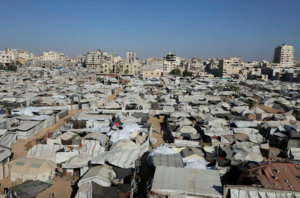
Tents housing displaced Palestinians stand amid summer heat in Gaza City, northern Gaza, on 20 June 2026
Euro-Med Human Rights Monitor writes on 6 July 2026:
Israel is legitimising and enforcing a systematic pattern of geographic siege on Gaza, extending beyond a comprehensive blockade to include forcible internal confinement. This traps Palestinians within a small, devastated area under conditions more severe and crowded than those in the Srebrenica enclave before its fall in 1995, when genocide occurred.
The Srebrenica genocide serves as a clear historical warning about the deadly impact of besieging civilians and depriving them of protection and essentials for life, particularly when these actions are part of systematic behaviour that is a core component of ongoing genocide, as seen in Gaza.
On the eve of Srebrenica’s fall in 1995, nearly 40,000 people were besieged within roughly 150 km². Meanwhile, for most of Gaza’s approximately 2.1 million residents, the remaining habitable area has shrunk to just about 128 km².
Geographically and demographically, Gaza is now limited to an area about 15 per cent smaller than Srebrenica, but with a population over 50 times larger and a density roughly 60 times higher, all amidst rubble, waste, and a severe lack of basic living conditions.
Israel is changing the demographic and military landscape of the Gaza Strip by increasing its de facto control and imposing severe restrictions on roughly 65 per cent of the enclave. This action deprives over two million residents of essential resources, prevents their return to their lands and homes, and makes large parts of Gaza prohibited zones under Israeli military control. These measures effectively amount to an unlawful annexation and seizure of land.
Israeli Prime Minister Benjamin Netanyahu’s announcement to expand military control over 70 per cent of Gaza highlights an aim to further settler colonialism and expel the area’s native Palestinians, as this plan would leave only about 109 km² for residents. If this occurs, the per capita share of the remaining space would decrease to approximately 52 m², and the population density would increase to about 19,300 people per km², which is roughly 72 times higher than the density in Srebrenica in 1995.