

Childhood on hold: How Gaza’s children spend a summer without play
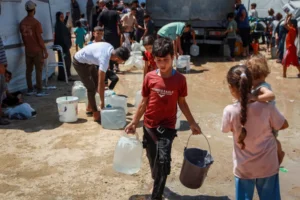
Because of the war, children in Gaza have been forced to shoulder responsibilities far beyond their years, including collecting water
Maram Humaid reports in Al Jazeera on 8 July 2026:
In a partially destroyed building in western Gaza City, Faten Nabhan sat, surrounded by her six school-age children, taking a brief rest after a morning spent filling water containers from the trucks that visit the camp. Faten, 35, tries to fill her children’s time with enjoyable or educational activities during their summer holidays, but she finds herself at a loss for where to even begin.
For the third consecutive year, ever since the beginning of Israel’s genocidal war on Gaza in October 2023, the summer holiday for children in the Palestinian enclave is nothing like it once was.
After Israel killed more than 73,000 people – including thousands of children – damaged or destroyed the majority of the enclave’s buildings, and displaced most of the population, Palestinians in Gaza are focused on survival.
Instead of looking forward to the summer camps, trips and games that once “defined” summer in Gaza, children begin their days by performing essential tasks: collecting water from trucks and distribution points, bringing food from communal kitchens and gathering firewood to light fires. “This is my children’s routine every day… this is all they do,” the mother said.
She added that her children, like other children in Gaza, have few means of self-expression, recreation, or psychological release during the summer. No activities, no camps, no drawing, no colours, nothing at all. All I can do is have them memorise a few parts of the Quran. That’s as much as I can manage,” she added.
“We have ideas… summer is a time for unleashing energy and developing children’s skills, but the resources simply don’t exist,” she said. “There are no resources, no supplies at all… no toys, no notebooks, no crayons… not even paper and a pen.”
**** ****
The problems Faten describes are part and parcel of a wider crisis documented by international organisations focused on children’s welfare.
An assessment published by UNICEF in May found that young children in Gaza lack “safe and stimulating environments essential for early development”, while older children suffer from “prolonged learning disruptions with limited prospects for recovery without targeted intervention” and a decline in social and psychological development opportunities.
Speaking in February, UNICEF’s chief of communications in Palestine, Jonathan Crickx, said that play was vital to children in Gaza, and “not a luxury”. “Play is how children reclaim what war stole from them,” Crickx said.