

UN reports severe chickenpox outbreak in Gaza Strip as displaced Palestinians crowd in tent cities
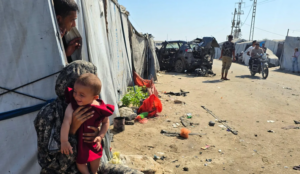
A mother and child in Gaza City, 6 July 2026
Nil Hasson reports in Haaretz on 7 July 2026:
A severe chickenpox outbreak has been recorded in the Gaza Strip in recent weeks, according to a report by the United Nations Office for the Coordination of Humanitarian Affairs published last week.
In just two weeks, 9,300 new cases of the highly contagious disease were diagnosed, according to data collected from some 130 clinics and medical facilities. More than half of the cases were reported in Khan Yunis, where most of the displaced population lives in tents. According to the report, over 1,600 tent camps are housing approximately 1.7 million people across the Gaza Strip.
Chickenpox is considered a highly contagious disease. A vaccine against the disease has been available in Israel for about 18 years, but it was not administered in Gaza even before the war – increasing the risk of its spread and transmission.
While the disease is usually resolved without the need for hospitalization, some complications can occur, especially among children, the elderly and pregnant women, which may lead to prolonged hospitalization and sometimes death.
The OCHA report details the camps’ poor hygiene and sanitation conditions, including sewage problems and waste accumulation, alongside a proliferation of pests – including mice, rats, stray dogs and lice – and the spread of viruses, bacteria and infections.
The report indicates that “inadequate access to drinking water, limited soap availability, insufficient solid waste management, and overcrowded living conditions, all of which increase the risk of communicable disease transmission.”
Dr. Michal Feldon, an Israeli pediatrician in contact with Gazan doctors, says that the risk of disease increases when the lesions develop a secondary infection or when the skin is already damaged or in poor condition. “In Gaza, after three years of war, no one has healthy skin. Everyone has wounds and itching, and the danger is much greater.”
The Global Health Cluster, a health response force coordinating humanitarian organizations operating in the Strip, “link this surge to deteriorating environmental conditions, overcrowding, sanitation and hygiene gaps, alongside the summer season.”
Among the steps taken by the organizations are increasing chlorine concentration in trucked water, intensifying disinfection efforts for latrines in displacement camps and establishing public information points, according to the report.
Humanitarian organizations have expressed frustration over the expansion of the area controlled by the Israeli military, which hinders their ability to address hygiene and sanitation issues.
In April, two drivers transporting water for the United Nations Children’s Fund were killed, and consequently, access to the central water point in Gaza City was halted, where a water pipeline from Israel, operated by the organization, connects.
Access to this facility was restored about a month ago, but other essential facilities, including waste disposal sites, wastewater treatment plants and water wells, remain beyond the Yellow Line and are inaccessible to humanitarian organizations. In addition, in recent weeks, the IDF has consistently expanded the area under its control westward.
Meanwhile, the healthcare system in the Strip continues to suffer from a severe shortage of materials. Dr. Ahmed al-Farra, head of the pediatric department at Nasser Hospital in southern Gaza’s Khan Yunis, told Haaretz that the hospital’s electrical system has supplied power to only about 70 percent of its facilities over the past two weeks, due to a failure in the main generator.
The Israeli military had rejected requests from humanitarian organizations to extract a generator left behind in the European Hospital in Rafah, which was closed and abandoned following IDF attacks, and transfer it to Nasser Hospital. The Coordinator of Government Activities in the Territories did not comment on the matter.
According to Dr. al-Farra, the hospital is also dealing with a shortage of tyres, which has led to the shutdown of buses transporting staff to the facility. “If this situation continues, we will not be able to transport staff, and the healthcare system will collapse,” he said.
The UN report stated that Al-Shifa Hospital is suffering from a shortage of sodium bicarbonate, a vital substance for operating dialysis machines. As a result, 25 out of 52 dialysis machines at the hospital have been shut down. Due to the shortage, dialysis treatments for 240 patients have also been reduced, from three times a week to only twice.
This article is reproduced in its entirety