

Israel police block Jerusalem’s Latin Patriarchate from Palm Sunday Mass at Church of the Holy Sepulchre
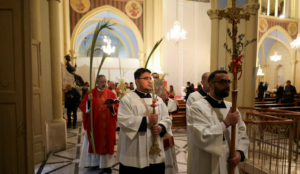
Cardinal Pierbattista Pizzaballa at a Latin Patriarchate ceremony in Jerusalem on 29 March 2026
Nir Hasson and Linda Dayan report in Haaretz on 29 March 2026:
Israel Police blocked the Latin Patriarch of Jerusalem from entering the Church of the Holy Sepulchre to celebrate Palm Sunday mass, in an unprecedented move, sparking condemnation from Christian officials in Jerusalem.
Israel Police said that the order was issued in accordance with Home Front Command guidelines, which have been in place since the start of Israel’s war with Iran, as police in Jerusalem have been enforcing a government-ordered closure of all holy sites in the Old City.
The Latin Patriarchate of Jerusalem and the Custody of the Holy Land said in a joint statement that the arrival of Cardinal Pierbattista Pizzaballa and the Vatican’s Custos of the Holy Land Fr. Francesco Ielpo to the Church of the Holy Sepulchre with two escorts was coordinated in advance.
According to the statement, the patriarch requested permission from the Greek Orthodox Church to arrive at the entrance via a side path to avoid drawing attention and hold the ceremony without any guests in attendance. After his path to the Church of the Holy Sepulchre was blocked, Pizzaballa turned back, and according to the joint statement, he returned to the Latin Patriarchate and held the ceremony there.
“This incident is a grave precedent, and disregards the sensibilities of billions of people around the world who, during this week, look to Jerusalem,” the joint statement said. “As a result, and for the first time in centuries, the Heads of the Church were prevented from celebrating the Palm Sunday Mass at the Church of the Holy Sepulchre.”
The move was condemned across the Middle East and Europe, including by French President Emmanuel Macron, who said that it “adds to the troubling increase in violations of the status of Jerusalem’s Holy Sites.” Israel’s ambassador to Italy was summoned, the Italian Foreign Ministry said. Italian Prime Minister Giorgia Meloni criticised the police action, saying in a statement that denying entry to religious leaders “constitutes an offence not only to believers but for every community that recognises religious freedom.”
The Jordanian Foreign Ministry said the block was “a blatant violation of international law, international humanitarian law, and the existing legal and historical status quo, as well as an infringement on the unrestricted freedom of access to places of worship.”
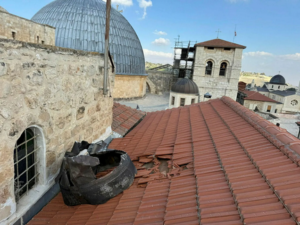
Part of a missile on a rooftop near the Church of the Holy Sepulchre, after Israel’s police said they located missile fragments in several locations in the Old City and holy sites following a missile barrage from Iran amid the US-Israel war with Iran
Prime Minister’s Office issued a statement in response to the backlash, saying, “In light of recent ballistic missile attacks targeting holy sites of all three monotheistic religions in Jerusalem, Israel has temporarily asked worshippers of all faiths to refrain from visiting the holy sites in the Old City to ensure their safety.” It said that the block stemmed from the same reason, adding that there was “no malicious intent – only concern for his safety and that of his party.” “Israeli security forces are actively preparing a plan to allow church leaders to worship at the holy site in the coming days, respecting the significance of this week leading up to Easter,” it added.
The Palm Sunday ceremony is one of the oldest rites of the Church in Jerusalem. This is the first time in at least a hundred years that the Palm Sunday ceremony will not be held inside the Church of the Holy Sepulchre. Christian sources in Jerusalem have added that they could not recall any instance in the last few hundred years in which the Patriarch was prevented from entering the church.
According to Dr. Yisca Harani, an expert on Christianity, there is clear evidence of the ceremony’s existence since the fourth century C.E. The ceremony continued to be held even during periods of Muslim rule inside the Church of the Holy Sepulchre, and according to Harani, she does not recall any instance, at least since the beginning of the 20th century, when the ceremony in the Church of the Holy Sepulchre was canceled. “It’s part of the church’s liturgical protocol; it’s like the Yom Kippur fast,” says Harani.
Arab-Israeli MK Ayman Odeh submitted an urgent inquiry to Israel’s defense minister after the incident. Odeh’s statement condemned Israeli authorities, saying the prevention of the ceremony “constitutes a severe violation of freedom of worship and breaches the status quo at the holy sites in Jerusalem, demanding immediate clarifications from the minister regarding the circumstances of the decision, the authority that issued it, and the legal basis on which it was made.”
Odeh also slammed the Israeli government, which he said is “exploiting the war to impose a new political reality in East Jerusalem and at the holy sites,” and called on Israeli authorities to guarantee free access to holy sites and “prevent policies that infringe on religious rights and exacerbate tensions in the city, especially at such sensitive times.”
Patriarch Pizzaballa is a very well-known Catholic religious leader and was one of the leading candidates to be appointed pope after the death of Pope Francis, who granted Pizzaballa the rank of cardinal, the highest rank in the Catholic Church besides the pope. Pizzaballa has served in Israel for many years and speaks fluent Hebrew; since the start of the war, he has visited Gaza several times and at the beginning of the war even offered himself as a hostage in exchange for the release of Israeli hostages from Hamas captivity.
Since the beginning of Israel’s war with Iran, police have been strictly enforcing the closure of holy sites in Jerusalem’s Old City. Muslim prayers on the Temple Mount have been completely banned, and worshippers are not permitted to enter the Western Wall compound and the Church of the Holy Sepulchre.
The police even enforce the closure of non-food businesses within the Old City walls. A senior police official explained this policy by stating that if a missile were to fall within the Old City, the ability of rescue forces to enter and operate in the alleyways would be very limited, thus increasing the danger there.
The police also claim that Iran does not shy away from firing at holy sites; since the start of the war, several missile fragments have fallen within the Old City and near the Church of the Holy Sepulchre. Last Friday, a warhead fell in the Jewish Quarter, causing damage.
A large Catholic Orthodox event is scheduled for two weeks from now, the Holy Fire, a major ceremony held annually on Holy Saturday at the Church of the Holy Sepulchre in Jerusalem. In a normal year, tens of thousands of worshipers participate in this ceremony.
This article is reproduced in its entirety