

In London, Jewish resilience grows alongside fear after string of antisemitic attacks
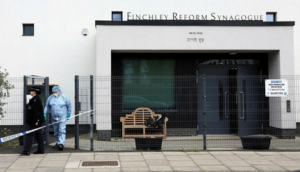
A police forensics officer works during an investigation into an arson attack at the Finchley Reform Synagogue, in north London, on April 15 2026
Daniella Peled reports in Haaretz on 24 April 2026:
Just three days after the attempted firebombing of Finchley Reform Synagogue last week, the north London worship hall was full to bursting for Friday night prayers.
“It was one of the biggest services I’ve ever seen. It was like three bar mitzvahs and an aufruf [when a groom is called to the Torah] combined,” said Raymond Simonson, a synagogue trustee and chief executive of London’s JW3 community center. “People really wanted to be there. My 82-year-old mother, who is on crutches, called up and told me she just had to go.”
It wasn’t just the synagogue members filling the premises. The local Somali Bravanese community – which the synagogue invited to share their building after their own center was firebombed 13 years ago – brought doughnuts and messages of unity. Local council members and politicians turned out; community groups and Christian congregations gathered to sing “We Shall Overcome” before services. But beyond this heart-warming show of resilience and solidarity, Simonson stressed, “People are unquestionably nervous and scared; there isn’t a one-size-fits-all response.”
The arson attack in Finchley was the first in a series of attacks targeting Jewish institutions and synagogues over the last month.
On March 23, four ambulances run by Jewish charity Hatzola were set on fire in Golders Green, a Jewish neighborhood in north London. A further series of firebombing and attempted arson attacks followed on targets including Iranian dissident media outlets and, on April 19, Kenton United synagogue in Harrow, north west London.
Police have made numerous arrests, including over an incident in which a drone was flown near the Israeli embassy. In total, seven people have been charged in connection with the incidents, including a teenager who subsequently pleaded guilty over the Kenton United synagogue attack. A further nine people have been arrested in connection with a conspiracy to commit an arson attack at an unnamed Jewish site.
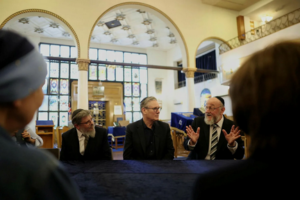
Prime Minister Keir Starmer (C) and Chief Rabbi Ephraim Mirvis (R, sit alongside Kenton Rabbi Yehuda Black, left, during a visit to Kenton United Synagogue, April 2026
The generally hapless nature of some of the attacks – one bungled arson attempt involved the clearly defunct site of a former Jewish charity – has led to the hypothesis by police that the culprits are low-level criminals paid to carry out attacks by Iranian agents or proxies.
Most of the attacks have been claimed online by Harakat Ashab al-Yamin al-Islamia, or the Islamic Movement of the People of the Right Hand.
But British Jews fear that a more deadly incident could become increasingly possible, especially given the rising levels of antisemitism since the October 7 attacks.
Last year, the Community Security Trust, a nonprofit that monitors threats to the U.K.’s some 300,000 Jews, received 3,700 reports of antisemitic incidents, the second-highest annual total ever recorded.
On Yom Kippur 2025, three Jews were killed in a terror attack on a synagogue in the northern England city of Manchester; two months later, two men were sentenced to decades-long prison terms for planning an Islamic State-inspired mass casualty strike on Jewish targets.
Community members report receiving worried calls from family and friends in the United States and Israel, concerned that British Jews cannot walk the streets in safety or practice their religion openly.
The reality, however, is more complex. “We are busier than we’ve ever been, with families, children, Israelis who are slowly and gently connecting with British Jewish life,” said Rabbi Jeremy Gordon of New London synagogue, a Masorti congregation in central London’s St. John’s Wood. “We’ve canceled nothing. Some people engage more because they are looking for a place where they feel safe, but I do have empathy for those who feel they need to back off for a bit.”
The renewed pressure on U.K. Jews since October 7 has also spurred some to identify more strongly with their religion. “Lots of people have turned to us in the last couple of years to affirm their Judaism or explore conversion,” added Rabbi Kamila Koprivova of the progressive Westminster Synagogue in central London. “The situation has prompted them to start engaging with their Jewish heritage.”
Simonson noted that JW3, a purpose-built hub in north London with thousands of visitors each week, was declared by police as a target in an Iranian government-sponsored “hostile surveillance” operation in March. Two men were subsequently charged.
Yet the most noticeable impact, according to Simonson, was a drop in casual visitors to the building’s café; classes carried on, with talks and events such as the recent Memorial Day ceremony fully booked. “Our approach to violence and darkness is to increase the light and turn the volume up,” he said.
“It’s important to have this resilience,” agreed Dave Rich, CST’s policy director, “but at the same time, we are experiencing a really severe security threat, and the police and the CST are doing everything we can to mitigate that.”
The current British government has invested substantially in Jewish security, including a 10-million-pound emergency cash fund following last year’s Yom Kippur attack. The bulk of day-to-day protection of Jewish sites is carried out by commercial security guards paid for with government grants, with extensive volunteering by members of the community, including more than 2,000 trained by CST.
Despite state support, the burden takes a toll, Gordon explained. “One of the things we face is how much money we have to spend on security protocols,” he continued. “Every pound we spend on this means we can dedicate less to enriching life for our members.”
Koprivova explained that pro-Palestine marches had impacted her own community in “very practical terms,” such as when protesters pass directly in front of the synagogue during Saturday services while en route to the Israeli Embassy in West London.
“I can understand the freedom of speech issues around people being allowed to demonstrate, but at the beginning, especially, the marches seemed quite wild,” she said, recounting how some colleagues had to effectively join up with the protestors to be able to get home. “Some of our community definitely feel intimidated and scared, and sometimes people stay away from services.”
“It happens again and again that we get used as a political football and as a photo op.” “This includes Israeli politicians who have used these attacks to say ‘oh, it’s all over for the Diaspora,’ instead of offering love and support and care. Our community is proudly British, fully integrated and just wants to live a secure, open Jewish life.”
Simonson agreed that, despite British Jews holding a wide range of views over events in Israel and Gaza, the rallies had left the community “battered and bruised.” The left largely championed the rallies solely as a freedom of speech issue and the right decried them as “hate marches.”
This political exploitation has continued, most recently with Reform leader Nigel Farage, accusing the Labour government of abandoning British Jews, writing in the Jewish Chronicle, “This is not just incompetence. It is a profound failure of judgement.”
“It happens again and again that we get used as a political football and as a photo op,” Simonson said with clear frustration. “There are plenty of political activists behind the scenes doing incredible work, but others see this as a great excuse to bash Muslims, or immigrants, or whatever their issue of the day is. This includes Israeli politicians who have used these attacks to say ‘oh, it’s all over for the Diaspora,’ instead of offering love and support and care. Our community is proudly British, fully integrated and just wants to live a secure, open Jewish life.”
This article is reproduced in its entirety: