

The mysterious Iran-linked terror group attacking Jewish targets in UK, Europe
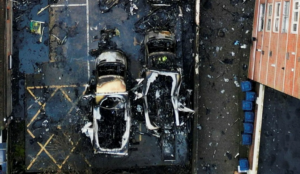
A drone view of four ambulances belonging to Hatzola, a Jewish community organisation, that were set on fire in an incident that the police say is being treated as an antisemitic hate crime, in northwest London, March 2026
Linda Dayan reports in Haaretz on 26 March, updated 29 March 2026:
Editor’s note: On April 19, 2025, a synagogue in north London was the target of an attempted antisemitic arson attack, the third such incident in a week. British Police are investigating the attacks as linked after Harakat Ashab al-Yamin al-Islamia, the subject of this piece, took responsibility. The attacks were described by police as a “concerted campaign against Londoners, and specifically, against British Jews.”
CCTV footage taken in the early morning of Monday shows three men walking toward ambulances belonging to Hatzola, a first responder organization in London. There is a burst of flame – the lighting of Molotov cocktails – and then the flame begins to devour the vehicles. The men run away. The arson is being investigated as an antisemitic hate crime; Hatzola is a Jewish volunteer nonprofit, and though it serves the entire population regardless of religion or ethnicity, it is a symbol of the Jewish community.
The firebombing destroyed four ambulances and caused explosions that broke the windows of nearby apartments, but caused no casualties. An organization called Harakat Ashab al-Yamin al-Islamia, or the Islamic Movement of the People of the Right Hand, claimed responsibility for the attack online. Police have arrested two suspects but have yet to confirm that this group was in fact behind it.
Ashab al-Yamin has taken responsibility for other terrorist attacks against Jewish targets in Europe since the war between Israel and Iran began at the end of February. It identified as the group behind an explosion at a synagogue in the Belgian city of Liege, a fire at the entrance to a synagogue in Rotterdam, and another explosion that damaged a Jewish school in Amsterdam. No one has been harmed in these attacks, but they have shaken Jewish communities around the world.
What is Harakat Ashab al-Yamin al-Islamia?
The organization barely existed before this month; it seems to have emerged on March 9, the day of the Liege bombing, to claim responsibility for the attack. It has since been active on Telegram channels and social media, warning “all the peoples of the world, especially in the European Union,” to immediately distance themselves “from all American and Zionist interests, facilities, and what is affiliated with them,” as one of its Telegram videos states.
Its name refers to the Quranic depiction of Judgement Day: the people of the right hand will go to Paradise, while the people of the left hand will go to Hell. The group’s logo clearly invokes similar logos of Iran-linked Shia militias in Lebanon and Iraq – a hand gripping a rifle against a backdrop of a globe.
Phillip Smyth, a member of the Counterterrorism Advisory Board for Homeland Security Today and a researcher of Shia militarism in the Middle East, describes Ashab al-Yamin as a front group. “It’s not a genuine Shia militia like, let’s say Kataib Hezbollah [in Iraq] or Lebanese Hezbollah,” he says. “It’s essentially an organization manufactured to take credit for what I would argue are disparate cells that either Iran’s Ministry of Intelligence or IRGC [Iran’s Islamic Revolutionary Guard Corps] have recruited over time in Europe.”
Elizabeth Tsurkov, a non-resident fellow at the New Lines Institute, shares Smyth’s assessment. “The group is obviously run by the Iranian Revolutionary Guards Corps, but I believe is linked to militias in Iraq, because of the way the group publishes information, through Telegram channels affiliated with Iraqi militias” she says.
One such channel, Sabereen News, posted a video on March 11 purporting to show the Belgian synagogue attack. In it, a shaky hand films what look like embers from the Synagogue against a backdrop of dramatic music. “A group calling itself Ashab al-Yamin claims responsibility for targeting a Jewish synagogue in Belgium,” reads the Arabic caption.
Who else could be involved in the group?
There are whispers online from the conspiratorially-minded that some of Ashab al-Yamin’s actions – presenting content in Arabic rather than Farsi and calling Israel “the Land of Israel” in Arabic rather than “the Zionist entity” or a similarly derisive construction – point to an Israeli “false flag” operation. Smyth says he investigated these claims, as well as claims that the group is linked to supporters of Reza Pahlavi, the exiled son of Iran’s last shah, but says that these accusations fail to consider the full picture.
The choice of Arabic makes sense, Smyth says, because the group did not market itself as Iranian and has released content on Arabic-language channels linked to Iran, as Hezbollah and Kataib Hezbollah do.
And as far as the group’s use of the Arabic “al-Ard al-Isra’il,” he adds, it isn’t unusual; some Palestinian groups have used this phrase in reference to “Greater Israel,” the idea that the State of Israel is actively striving to lay claim to the entire biblical land, from the Nile to the Euphrates, which is a popular conspiracy theory in the Arab world. He also says it isn’t unusual for such front groups to be shoddily put together on the fly, and that they may have used AI to generate their materials, which would explain the awkward phrasing.
“What’s intriguing is that nobody [pushing the false flag narrative] seems to be concerned that all of those networks that are connected with the Iranians in some way are putting this stuff up first,” says Smyth. “I think people are making a mountain out of a molehill to possibly serve some other goals… and meanwhile, they are negating all the other data that’s around it.”
Tsurkov, who was held hostage by Kataib Hezbollah for 903 days before being released last September, says that Ashab al-Yamin’s targeting patterns line up with what she experienced with the Iraqi militia. “They’re antisemites, which is a surprise to no one,” she says of the group that held her. “They definitely have a hatred of Israel, but they also hate the Jews and believe in all sorts of horrific conspiracy theories about them,” Tsurkov says, adding that some of these conspiracies are rooted in Islamic scripture. “During my interrogation, I was asked not only for places they could target inside Israel, but they wanted a list of prominent Zionists and Jews around the world that they could kill.”
Smyth notes that the group has also declared banks in Europe a target, similar to Iran’s stated targets throughout the Middle East. Iran was “claiming to target banks and financial centers in the United Arab Emirates and Bahrain, so it’s not their first rodeo,” he says.
The fact that the group has not caused more damage is due to law enforcement’s efforts to thwart major attacks, says Tsurkov. “They break down these cells before they’re able to amass any kind of significant capabilities. Of course, something could fall through the cracks, but right now they appear to be operating at a very rudimentary level.”
They cannot procure the large amounts of explosives needed to cause a mass-casualty incident, like Hezbollah’s bombing of the Jewish community center in Argentina that killed 85 people in 1994. Instead, they throw Molotov cocktails, “which any person with an internet connection can make.”
What is the ideology behind Ashab al-Yamin and how does it recruit?
Ideologically speaking, Ashab al-Yamin claims to be a Khomeneist group – that is, it embraces the beliefs of Iran’s Islamic Revolution. “It’s focused on retaliation against American and Israeli targets – and Jewish targets in particular,” says Smyth. “They have said that this is a response to the American and Zionist attacks on Iran.” But the people carrying out the attacks the group claims responsibility for may not be true believers – and may not even know that they are part of Ashab al-Yamin, say both researchers.
“The type of actions that they’re carrying out is kind of reminiscent of those given to Israelis who are recruited on Telegram” to spy for Iran and perform acts of sabotage – setting cars on fire, for instance, says Tsurkov.
“Those types of individuals are quite easy to recruit. They don’t need to be particularly ideological. They don’t necessarily need to be Shia or even supportive of Iran. You can create these cells that are able to carry out these very small attacks quite easily when you are willing to pay them” – particularly gang members and petty criminals. In Sweden, Iran has already used the Foxtrot Network, an organized crime group, to orchestrate an attack on the Israeli Embassy in Stockholm in 2024, and has recruited criminals to assassinate dissidents abroad.
Recruitment for Ashab al-Yamin likely follows this same model, Smyth says. They may share an affinity with the Islamic Republic or loathe Israel, but they might just want cash. “It’s not like they know they’re joining Ashab al-Yamin. They’re tasked with torching something, tasked with blowing up a car, and they just do it. Who knows if there’s money involved? Who knows if it was just for pure ideological reasons?”
Law enforcement has released little information about the motives and backgrounds of the suspects who have been caught. In Belgium, four young men, all of them teenagers, were arrested on suspicion of setting off the blast. They were apprehended outside another synagogue after police identified their car parked nearby, Dutch News reported.
Five men were arrested for the Rotterdam arson, and Dutch Justice Minister David van Weel said authorities were investigating whether Iran may have been involved in the attack. British police arrested two men in connection with the ambulance arson in London, they said on Wednesday, aged 47 and 45, but gave no information on their motives. Police are searching for two suspects in the Amsterdam school explosion.
There is a chance, says Smyth, that Ashab al-Yamin’s antisemitic attacks could attract copycats, whose actions the group would claim as its own. “There’s always the potential that they can get people who want to start burning down synagogues – and I’m pretty sure that’s also a minor hope for the Iranians.”
But this could also have downsides, as Iran would have no control over these lone-wolf attackers. Iran could promise another government that, even though it is of course unaffiliated with these attacks, it will cut back on them – only for a neo-Nazi to undertake their own spate of Ashab al-Yamin-style attacks on synagogues or Jewish schools.
Why has the group only emerged now?
“I’d say the big difference between now and the so-called 12 Day War in June is that then, it wasn’t as existential in nature for the Islamic Republic’s regime,” says Smyth. “Right now, you’ve got the decimation of their leadership, including Supreme Leader Ali Khamenei, and you also have [the new Supreme Leader] Mojtaba either in a coma or just severely injured.”
Because this is such a crisis for the regime, it is asking how to apply as much pressure as possible, as cheaply as possible, while continuing to expand the war globally. “What they’re demonstrating is that they have the reach – and if you don’t respect them, there can be other consequences.”
This article is reproduced in its entirety