

Why has organised crime exploded in Palestinian communities in Israel?
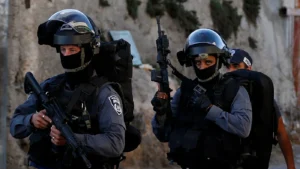
Israeli police patrol a street in Jabel Mukaber, a Palestinian neighbourhood of East Jerusalem, on 18 September 2015
Middle East eye writes on 31 August 2026:
In December 2003, a bomb ripped through the heart of Tel Aviv as part of a brazen attempt to assassinate Israel’s notorious crime boss Zeev Rosenstein. Rosenstein survived what would be the seventh attempt on his life, but three bystanders were killed.
The attack, which occurred during the height of the Second Intifada and exposed the growing power of the criminal underworld, triggered widespread anger across Israel.
Responding to the outrage, the government – led by Ariel Sharon – launched a series of measures that would fundamentally reshape Israel’s approach to organised crime. Organised crime would now be treated as more than a law-and-order problem. It was defined as a strategic threat to Israel’s social and economic resilience.
The government passed Resolution 4618 and established an offensive, multi-agency strategy that brought together the Israeli Police, the Tax Authority, the State Attorney’s Office and the Israel Money Laundering and Terror Financing Prohibition Authority. The aim was not merely to arrest low-level operatives, but to dismantle the financial infrastructure that sustained major criminal organisations.
Alongside substantial investment in elite enforcement units, the government also laid the groundwork for the Witness Protection Authority through a complementary resolution – 4619.
Together, these measures gave law enforcement agencies a broader set of legal, operational and financial tools for tackling organised crime.
At the time, Israel’s most powerful criminal organisations were predominantly Jewish. They operated domestically and internationally, and some were targets of the FBI and Interpol. One of the most prominent was the Abergil organisation, which the FBI described as a major international criminal syndicate.
Through sustained cooperation between Israeli and foreign authorities, four of the six major organisations of that period were eventually dismantled or severely weakened: Rosenstein, Abergil, Abutbul and Shirazi. Two others, associated with Shalom Domrani and the Mosly family, survived in a much weaker form.
During this period, organised crime within Palestinian communities in Israel remained comparatively limited. It was concentrated mainly in historic mixed cities such as Jaffa, Ramla, Lod and Acre, where many Palestinians who remained after the Nakba lived in poorer neighbourhoods and under difficult socioeconomic conditions.
For most Arab towns and villages, large-scale organised crime was still relatively unfamiliar.
The shift of the mid-2010s
As Jewish organised crime groups gradually weakened, a vacuum began to emerge. Organised crime increasingly moved into Palestinian communities in Israel, where it found weak state institutions, limited policing, widespread availability of illegal weapons, economic marginalisation and vulnerable local authorities.
The most dramatic indication of this transformation has been the number of murders. In 2015, 58 people were murdered in Palestinian communities in Israel. By 2019, the number had risen to 89. In 2024 it reached approximately 230, and in 2025 it climbed further to 254.
What had once been perceived as a marginal criminal phenomenon had become one of the central political and social questions facing Palestinian citizens of Israel. The disparity is evident not only in the number of murders, but also in the state’s ability to solve them.