

Israel intensifies apartheid policies against Palestinian citizens of Israel after 7 October
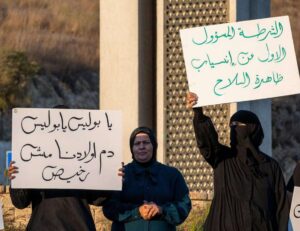
Demonstrators in a protest organised by the Umm al-Fahm Popular Committee in Umm al-Fahm, northern Israel, on 23 August 2026, denouncing government neglect of Arab communities in Israel.
Euro-Med Human Rights Monitor reports on 27 August 2026:
Israel has escalated apartheid policies against Palestinians with Israeli citizenship, since 7 October 2023 extending their reach through new laws, security actions, and administrative procedures. This has worsened their restricted and conditional citizenship status and increased persecution based on their Palestinian identity, Arabic language, and political views.
This escalation has been incorporated into laws, police actions, workplaces, and educational and health systems, reinforcing the dominance of the Jewish Israeli community and ongoing discrimination against Palestinians in their homeland. Moreover, it is taking place within a political and security environment in which Palestinian citizens are racially profiled, and their political views are treated as sources of suspicion, exposing them to increased surveillance, persecution, and discrimination. The application of counter-terrorism provisions to expression has expanded the scope of criminalisation and given discrimination based on national identity legal and institutional cover.
The legislative trajectory after 7 October 2023 has included increasing areas of Palestinian expression within the scope of counter-terrorism. In November 2023, the Knesset adopted, as a temporary measure, the criminalisation of the “systematic and continuous consumption” of publications that call for, praise, or document a terrorist act, where such viewing is considered evidence of identification with a designated terrorist organisation, punishable by up to one year in prison. Although incidental viewing or viewing for a legitimate purpose was excluded, the concepts of “systematic”, “identification”, and “sympathy” remained broad, without requiring intent to incite or a specific and likely risk of violence. The Knesset later extended the measure in November 2025.
In November 2024, additional legislative changes increased the authority of the Minister of Education and other authorised bodies to dismiss teachers, deny employment, revoke licences, or withhold funding from educational institutions, either temporarily or permanently, based on signs of “identification”, “support”, or “endorsement”.
The law does not always require a criminal conviction and permits reliance on police or General Security Service information, while key terms remain unclearly defined. Funding for an entire school can also be cut due to a single incident if the administration knew or should have known about it, risking collective punishment for students and staff over speech attributed to one individual. United Nations experts have cautioned about the vague and broad nature of these provisions, which could lead to discriminatory enforcement against Palestinian citizens.
The issue also relates to the original wording of the 2016 Counter-Terrorism Law. It broadens the scope of a “terrorist act” from merely acts aimed at killing, injuring, or taking hostages to include acts or threats that, when motivated by political, national, religious, or ideological reasons and intended to create fear or influence authorities, could also endanger property, religious sites, infrastructure, services, the economy, or the environment. This definition is accompanied by a system for the administrative designation of organisations that may rely on evidence undisclosed to the organisation or its legal team, or disclosed only in an incomplete summary, thereby undermining their ability to understand the basis of the decision and challenge it effectively.