

From Bethlehem to Gaza, Christmas is overshadowed by harsh reality
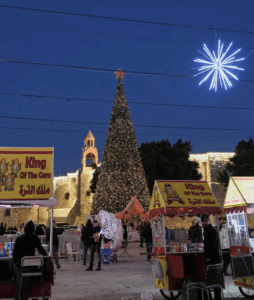
Palestinian vendors waiting for business in an empty Manger Square, in Bethlehem, December 2025
Nagham Zbeedat reports in Haaretz on 23 December 2025:
For many Palestinians across the West Bank, Gaza, Jerusalem and Arab towns inside Israel, Christmas this year arrives burdened by economic hardship, political restrictions and a lingering sense of fragility.
Shop owners struggle to survive month to month, parents calculate every expense and workers lose hours of their time – and their wages – to the IDF checkpoints that slice through daily life. Markets may be full, but livelihoods remain precarious. Religious atmospheres persist, yet they are constricted by permits, closures and the quiet exhaustion of a population trying to endure.
The contrast between celebration and restriction becomes clearest on the road. The journey from Ramallah to Bethlehem – 27 kilometers that should take 45 minutes during rush hour – took us nearly two hours. At the Qalandiyah checkpoint in Kafr Aqab, near Jerusalem, dozens of cars waited bumper to bumper, engines idling, drivers watching the minutes slip away.
In the heart of Bethlehem’s old market, Abu Ibrahim, a 54-year-old father of two, stands in front of piles of colorful carpets on the floor of his small souvenir shop, surrounded by embroidered bags, traditional Palestinian dresses, olive wood figurines and religious icons. The shop has been in his family for generations, passed down from his grandfathers – each item carrying both cultural and economic weight. For nearly two years, the shop stood abandoned. “There were no people here,” Abu Ibrahim recalls. “I had to work other jobs to feed my family and to afford keeping this place.”
Tourism, once Bethlehem’s lifeline, began unraveling with the COVID-19 pandemic, which brought pilgrimages to a standstill and pushed the city to the brink of economic collapse. Shops closed, hotels emptied and longtime business owners, including Abu Ibrahim, were forced to seek work elsewhere to survive. Just as the sector began to show fragile signs of recovery, the war delivered a second blow: Tourist dollars vanished again after October 7, hundreds of businesses shuttered and reopening became possible only by juggling multiple jobs to stay afloat.
Like many shop owners, he was forced to seek work elsewhere, leaving behind a business that had defined his family’s livelihood for decades. Only recently did he manage to reopen, juggling multiple jobs to stay afloat. “I worked in a factory over the past couple of months,” he says. “I would come here, open the shop until the afternoon, then work a night shift – five or six days a week.”
Despite the return of tourists during the holiday season, Abu Ibrahim is cautious. “It’s not the same,” he says. “We are still in the recovery period, and it will take a long time for us to heal. But we don’t want sympathy. For me, I just want a season where I can work one job – not two – and know I can provide for my children.” As he speaks, a customer enters, and he rushes forward to help – hope and urgency mingling in his movements.
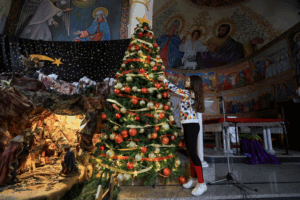
A child decorating the Holy Family Church in Gaza City ahead of Christmas, December 2025
Walking through Bethlehem’s market, the sounds collide: Shopkeepers calling out discounts, footsteps echoing on stone, laughter, church bells in the distance. Above it all rises a deep, rhythmic voice singing old Arabic songs.
The singer is Sami Khamis, a 46-year-old tea vendor balancing a metal tray in one hand, swaying his head from side to side in time with his voice. “I sell the best tea in town,” he announces proudly, drawing smiles from passersby. Khamis is a father of five. He has undergone several life-threatening surgeries, procedures he can barely afford. Yet every morning, despite his illness, he puts on a smile and walks the market, serving tea to tourists and locals alike.
Sami Khamis, a father of five, owns a tea shop in Bethlehem. “This season,” he says, weaving through the crowd, “is only scratching the surface of what Christmas in Bethlehem used to be.”
Yahya has been a taxi driver in Bethlehem for seven years. Like many residents, his income depends almost entirely on people from outside the city, tourists, pilgrims and Palestinian workers traveling to Israel. “Workers from the West Bank who work in Israel have to pass through Bethlehem to reach the checkpoints,” he explains. “They come early in the morning and keep us a little busy. We’re thankful for that – it keeps the business going.”
During the holidays, Palestinians from inside Israel often come to Bethlehem to celebrate Christmas, offering a temporary boost to residents whose livelihoods rely on tourism. “It gives us hope,” Yahya says. “Maybe we’ll still be able to keep our jobs.”
But he is careful not to confuse seasonal movement with real recovery. “Tourism has still not recovered,” he says. “This is just the holiday season giving us false hope that things are back to normal.”
Ali, 27, lives in Bethlehem but commutes to Ramallah for work and M.A. studies. On paper, the journey is short: The cities are only 22 kilometers (13 miles) apart. In reality, it is shaped by checkpoints, delays and exhaustion that begin long before his shift starts.
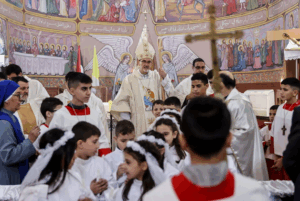
The Latin Patriarch of Jerusalem Pierbattista Pizzaballa, center, leading Christmas Mass at the Holy Family Parish during his visit to Gaza City, 21 December 2025
Coming from a Muslim family, Ali says Christmas has always been part of life, not something separate. “We grew up with Christians and Muslims side by side. For us, Christmas is a holiday for everyone,” he says. As a child, the season meant lights, family visits, crowded streets and a sense that the city was alive. “It was about people being together. You didn’t think so much about politics back then.”
This year, he says, the atmosphere feels heavier. In the Ramallah café where he works, foot traffic remains slow, despite the end of the war. “People thought that once the war stops, things will slowly go back to normal,” he says. “But the tension and fear are still here. It’s like the war ended on the news, but not for us.”
Still, he says Christmas carries a quiet meaning, even now. “People are trying to hold on to something,” Ali says. “They want to feel normal, even if it’s just for this time, whether it was through a cup of coffee, a walk in the streets. You celebrate because you don’t want to let them [the Israeli government] win – if we stop celebrating, then what do we have left?”
Christmas in Nazareth? Cancelled
While Palestinians in the West Bank celebrate despite the crushing burdens, in Israel’s largest Christian population – Jesus’ hometown of Nazareth – this year’s central Christmas celebration never took place.
The annual Christmas tree lighting in the city was effectively cancelled after police imposed last-minute restrictions on the event, including a cap of 1,000 attendees and an order requiring nearby businesses to close during the ceremony. City officials said the limitations were unprecedented and would have dramatically altered the character of an event that, in previous years, drew tens of thousands of residents and visitors.
Rather than proceed under those conditions, the local Orthodox Community Council that organized the event decided to cancel the public ceremony. Instead, the city’s Christmas tree – the largest in the Holy Land – was lit quietly on December 12, during a small, unannounced press gathering, in what organizers described as a protest against the restrictions.
“We were surprised by the extent of the police demands,” said attorney Bassem Asfour, head of the community council. “They go beyond logic. We refuse to discriminate between people. This tree is meant to represent all the residents of Nazareth with its social and human diversity. Preserving that message – and the dignity and right of people to joy and participation – is our responsibility.”
The council said the tree would remain lit throughout the Christmas season, visible to all who pass through the city center. Local leaders say the incident reflects a broader pattern: Over the past three years, police have imposed similar restrictions on Christian religious events, including Palm Sunday and Easter celebrations in Jerusalem and the Feast of the Transfiguration at Mount Tabor in Galilee. In some years, access to Bethlehem itself has been restricted on Christmas Eve.
For many Christians in Nazareth, the cancellation carried symbolic weight. The city, which has long presented itself as a shared space of religious coexistence, found itself marking the holiday quietly, under limitations that residents say underscore a growing sense of pressure on public religious life. As elsewhere, the lights remain on – but the celebrations feel restrained, shaped as much by security decisions and political realities as by tradition and faith.
In other mixed cities, tensions around Christmas celebrations escalated beyond restrictions. A similar scene unfolded in Haifa, where police abruptly moved in on Christmas celebrations in the predominantly Arab Wadi Nisnas neighborhood late Sunday night as families and children gathered in the streets. According to eyewitnesses and the legal advocacy group Mossawa Center, officers ordered the music to stop, dispersed the crowd and interrupted a traditional dabke performance by 12-year-old children.
Police detained three people who had been taking part in the celebrations – a DJ, a street vendor and a performer dressed as Santa Claus – and confiscated sound equipment. The three were held overnight and released the following morning after a court ordered their release. Residents and local officials said the police intervention was disproportionate and transformed a children’s holiday celebration into a scene of arrests.
Holly jolly Jerusalem? Not quite
Christmas celebrations in Jerusalem this year unfold against what Palestinian officials describe as an increasingly suffocating reality of restrictions, closures and political pressure.
Abdullah Kanaan, secretary-general of the Jordan’s Royal Committee for Jerusalem Affairs, said in an interview with the Jordanian radio station Husna FM that the holiday comes as the city faces what he called “a painful reality of siege and repression, imposed by Israeli authorities” in violation of Jerusalem’s religious and historical character.
“Jerusalem today stands between the hammer of occupation and the anvil of displacement,” Kanaan said, pointing to policies of settlement expansion, arrests, repeated incursions and what he described as ongoing efforts to alter the city’s identity. “These policies do not distinguish between Christians and Muslims, nor between their holy sites. All Palestinians are subjected to the same system of pressure and exclusion.”
Beyond political pressure, Christians in Jerusalem face mounting economic burdens. Kanaan pointed to heavy municipal taxes levied on church properties, alongside frozen bank accounts, confiscation of assets and increasing activity by settler organizations seeking to take over Christian endowments and properties in the Old City.
Access to worship remains another central concern. According to Kanaan, Israeli authorities continue to restrict movement during Christian holidays through complex permit systems, often limiting access to older worshippers, erecting military checkpoints and barring West Bank Christians from entering Jerusalem altogether.
“While settlers move freely during their religious holidays, Christians are prevented from reaching their holy sites,” he said, adding that harassment in the Old City has become routine and that freedom of worship remains absent. As churches prepare to mark Christmas, he said, the city’s message to its Christian residents is clear: Celebration is permitted, but only within ever-narrowing limits.
Christmas mass in Gaza
In Gaza City, Christmas unfolded quietly inside the walls of the Holy Family Church, the Strip’s only Catholic church, where faith persists amid widespread destruction. Cardinal Pierbattista Pizzaballa, the top Catholic leader in the Holy Land, entered the Gaza Strip on Friday to mark the holiday and deliver a message of hope as conditions have marginally improved under the cease-fire, now holding into its third month.
A child decorating the Holy Family Church in Gaza City ahead of Christmas, earlier this month. Credit: Dawoud Abu Aklas/Reuters
The church’s compound was attacked three times during the two-year war: In July, fragments from an Israeli shell struck the Holy Family Church compound, killing three people. Israel later said the incident was accidental and apologized. One year earlier, four people sheltering at the church’s school were killed in an IDF air strike targeting Gaza’s labor secretary. In December 2023, two women sheltering at the Holy Family Church compound were killed by IDF sniper fire in an incident the pope described as “terrorism.”
In the church courtyard, children welcomed him wearing Santa hats and kaffiyehs, the black-and-white checkered scarves long associated with Palestinian identity. The compound was decorated with strings of lights and modest Christmas ornaments, creating a fragile sense of festivity against the backdrop of a devastated city. “I know the situation is difficult,” Pizzaballa told the small gathering in English, “but I see with the children, the school, the activities, a little light of hope.”
Pizzaballa stressed that the role of the Christian community extends beyond religious practice. He described it as a “stable, solid reference point in this sea of destruction.” He praised Gaza’s Christian community for what he described as a powerful example of endurance. “You have been a wonderful testimony, not only of resilience, but of faith and hope for many people not just in Gaza, but in many other parts of the world,” he said.
This article is reproduced in its entirety