

We dug up medics in Gaza. A year later, international law remains buried
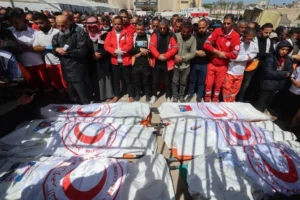
Members of the Palestine Red Crescent Society and other emergency services pray by the bodies of fellow rescue workers killed a week earlier by Israeli forces during a funeral at Nasser Hospital in Khan Younis in the southern Gaza Strip on 31 March 2025
Jonathan Whittall writes in Al Jazeera on 30 March 2026:
I saw a lot of death in Gaza. Not natural death. Brutal, methodical killing. But there is something particularly horrific about digging up medics buried in their uniforms that has stayed with me.
Last year, I was working as a senior United Nations official coordinating humanitarian aid in Palestine when Palestine Red Crescent Society (PRCS) and Civil Defence first responders went missing in southern Gaza. For a week after they were killed, we did not know if they were dead or alive. Every day we tried to reach them. Israeli forces denied us access. We encountered blocked roads and troops firing on people fleeing.
On March 30, my colleagues and I stood over a mass grave in Rafah marked with the light from one of the ambulances that Israeli forces had crushed and dumped nearby.
There was no way that Israeli forces did not know that these were medics. The lights of their ambulance were flashing. It was marked with internationally protected Red Crescent symbols, and they were wearing uniforms and gloves. It made no difference. They were killed, some executed at close range. Forensic analysis of video and audio recordings has reconstructed the last moments of their lives.
After investigating, the Israeli army dismissed the deputy commander of the Golani Brigade for filing an incomplete report. Another commander received a letter of reprimand. No one was charged. That was the accountability for massacring medics.
The PRCS had been targeted before, including during the rescue attempt of Hind Rajab, a six-year-old girl who bled to death in a car riddled with 335 bullet holes, surrounded by the bodies of her family. The medics sent to save her were killed by troops in the area, despite obtaining prior coordination to allow the ambulance to arrive at the scene.
Coordination with Israeli forces did not protect the medics trying to reach Hind. Yet the absence of such coordination was used by Israeli forces in their justification for killing the ambulance crews in Rafah. An evacuation order for Rafah was issued by Israeli forces after we had lost contact with the ambulance crew in Rafah. But even if the ambulances were knowingly driving into an area of military operations, it is the Israeli army’s responsibility not to target civilians.
We had put in place a coordination system – as we do in many places in the world – to help parties to the conflict fulfil their obligations. But in Gaza, the system was twisted by Israeli authorities to control where aid reached and to enable a free-fire approach from Israeli forces, unless it was coordinated otherwise. The humanitarian community was essentially coordinating movements in an effort to opt out of being killed by default.