

Until Trump pushes Israel to ease on Gaza, Hamas’ resignation will remain symbolic
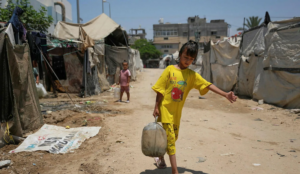
Children in the Gaza Strip, July 2026
Jack Khoury writes in Haaretz on 7 July 2026:
Hamas’ announcement on Monday – that the body administering Gaza on its behalf has resigned to transfer its powers to the Palestinian technocratic committee established under U.S. President Donald Trump’s postwar Gaza plan – isn’t merely a technical matter.
From the perspective of Hamas leadership, the announcement was a political move designed to send both an internal and external message: that the group is prepared, at least on the civilian level, to relinquish its administration of the Strip. However, there’s still a vast gap between the declaration and any actual change on the ground.
Hamas officials see the move as an attempt to break the current deadlock. Its leadership, both inside Gaza and abroad, is under growing pressure from the territory’s population, which is reeling from widespread destruction and poverty, as well as from Egyptian and Turkish mediators.
Monday’s announcement is intended to create the impression that Hamas is no longer clinging to power and is no longer an obstacle to a future political arrangement. The message is clear: “Take over civilian responsibility, govern the Strip, pay salaries, and provide public services.”
At the same time, the statement clearly defines the limits of this apparent concession. Hamas is offering to transfer only civilian governing authority while seeking to keep government employees in their positions.
The difference is that, instead of reporting to the group’s leadership, they’d answer to the technocratic committee. Yet beyond the civilian sphere, the statement offers no answer to the questions of security responsibility, the group’s military wing or disarmament.
Meanwhile, the Trump-led Board of Peace and the technocratic committee, whose members remain stranded in Cairo, stressed in their response that they won’t be satisfied with declarations alone and will judge Hamas by its actions.
From their perspective, the principle remains unequivocal: one government, one law, and one weapon. As long as the weapons remain outside the Palestinian technocratic committee’s authority, there hasn’t been a genuine transfer of full control.
Hamas officials also realize that the regional landscape has changed. While a delegation led by senior official Mousa Abu Marzouk traveled to Tehran to attend former Supreme Leader Ali Khamenei’s funeral, the group understands that, unlike in other arenas such as Lebanon, Iran is unlikely to make Gaza a central bargaining chip in broader regional negotiations.
As a result, Hamas has been left with few sources of leverage. Aside from mediation efforts by Egypt and Turkey, which continue trying to advance a mutually agreed framework for governing the Strip, no one appears willing to take on the political hot potato that is Gaza.
The main obstacle, however, lies in the Prime Minister’s Office in Jerusalem and the White House in Washington. Members of the technocratic committee remain outside the Strip, and there’s no guarantee Israel will allow them to enter. Without Israeli approval, and without meaningful U.S. pressure to secure it, Hamas’ announcement remains little more than an empty declaration.
That reality is also clear to Gaza’s residents, many of whom struggle to see the announcement as a meaningful breakthrough. From their perspective, nothing has changed: reconstruction remains stalled, conditions continue to deteriorate, and most of Gaza remains under Israeli control. No international force has established a meaningful presence, and where one does exist, its mandate remains unclear, as does responsibility for security.
All signs suggest Israel will ignore the announcement and refrain from committing to any significant steps. It’s unlikely to carry out a gradual withdrawal of its forces, due in part to domestic political and electoral considerations, and will continue insisting that Hamas disarm as a precondition for any broader diplomatic process.
The United States, meanwhile, is expected to maintain its hands-off approach, investing little effort in advancing either an Israeli withdrawal or Gaza’s reconstruction.
At the same time, the Palestinian Authority remains largely sidelined and increasingly concerned about its own future, fearing that if the technocratic committee succeeds in Gaza, the model could eventually be replicated in the West Bank.
For these reasons, Hamas’ announcement is likely to be remembered as a largely symbolic move that failed to produce meaningful change. Hamas is seeking to ensure its survival, while Israel remains determined to dismantle the group and retain control over much of the Gaza Strip.
All sides understand that neither a decisive international intervention nor a credible political and economic roadmap is likely to emerge, certainly not under the current political realities in Israel or the broader region.
This article is reproduced in its entirety