

The real question for Gaza is governance and reconstruction – not weapons
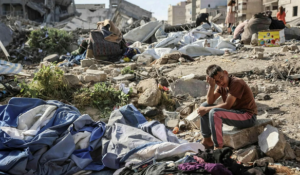
A Palestinian boy sits at the site of an overnight Israeli military strike on structures and tents housing displaced families, killing ten Palestinians in Gaza City, 28 May 2026
Hassan Lafi writes in The Palestine Chronicle on 15 June 2026:
Since the announcement of the political understandings surrounding a ceasefire and the reconstruction of Gaza, public debate has increasingly been reduced to a single issue: the weapons of the Palestinian factions.
It is as if Gaza’s future, its reconstruction, the end of the war, and the administration of its affairs all depend solely on this one question. Yet reducing the entire situation to the issue of weapons obscures a fundamental reality: any discussion of arms remains incomplete as long as the political, administrative, and security frameworks necessary for Gaza’s post-war transition are either absent or obstructed.
Weapons are not surrendered in a vacuum. No actor relinquishes its final source of leverage before knowing who will govern the next phase. From the outset, the natural question has always been: Who will take over Gaza?
If a National Administrative Committee is to govern the Strip, and if an international stabilization force is to oversee the transitional period within the framework of the Peace Council, then discussions regarding security arrangements—including the issue of weapons—can become part of a clearly defined political process.
Demanding that one side surrender all its leverage while no alternative authority is in place, security arrangements remain unfinished, and the future itself is uncertain raises more questions than it answers.
**** ****
The more pressing question concerns the practical foundations required to begin a new phase. How can a National Administrative Committee enter Gaza when the international stabilization force intended to pave the way for its arrival has not yet been established? How can it administer the territory when the Palestinian police force tasked with maintaining security and public order has not yet been formed?
Indeed, how can such a force even be discussed when Israel has yet to allow many of the proposed recruits to leave for training and preparation?