

A world on trial: how lawyers documenting Israeli abuse pay a price
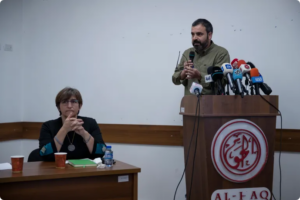
Tahseen Elayyan, from Al-Haq, speaks at a joint news conference in Ramallah, on 8 November 2021, after security researchers said spyware from the Israeli company NSO Group was detected on the cellphones of six Palestinian human rights activists
Awad Joumaa writes in Al Jazeera on 19 June 2026:
The case does not begin in The Hague. It begins in a bombed street in Gaza, where a lawyer kneels to write down a name before the body is buried. It begins with a prison visit, where a detainee cannot yet say what has been done to her body. It begins in a fieldworker’s notebook, a scar photographed, a testimony taken in whispers, a file carried out of a place where everyone knows that evidence itself is dangerous.
Long before the International Criminal Court (ICC) issued arrest warrants in November 2024 against Israeli Prime Minister Benjamin Netanyahu and then Defence Minister Yoav Gallant, Palestinian lawyers and human rights organisations had already built the archive of evidence the world is now being asked to confront.
They documented torture, sexual violence, arbitrary detention, attacks on hospitals, the killing of children and the destruction of entire families. They did this for years while being smeared, raided, surveilled, closed by military order, labelled “terrorists”, threatened, exiled and ignored.
The people trying to make the law speak have had to do so while under attack themselves. Tahseen Elayyan of Al-Haq describes the process. His organisation, one of the oldest Palestinian human rights groups, gathers testimony directly from victims and witnesses, preserves whatever evidence can be saved, and turns those fragments into reports and legal submissions for courts, including the ICC.
That work, he says, is exactly why Al-Haq is targeted. “My organisation has been designated as a terrorist organisation [in 2021] because of the work that we do,” he says. “The organisation is closed by a military order, but we are still working from the office.”
The same pattern runs across Palestinian civil society. In 2021, Israel designated six Palestinian rights groups – Al-Haq, Addameer, Defense for Children International-Palestine, Bisan Center, the Union of Agricultural Work Committees and the Union of Palestinian Women’s Committees – as “terrorist” organisations. In August 2022, Israeli forces raided and sealed their offices in Ramallah in the occupied West Bank. UN experts and major rights groups condemned the move as an assault on the people documenting abuses.
Defense for Children International-Palestine had spent years gathering affidavits from children who had been detained, interrogated, beaten and shot. “Instead of opening an investigation into these allegations, the Israeli authorities raided the DCI office,” says Ayed Abu Eqtaish, its accountability director. “Instead of investigating these allegations, there was pressure on the organisation that revealed this information. In Palestine, documentation itself is an act of resistance.