

The Palestinian farmers whose livelihoods have been destroyed by Israeli settlers
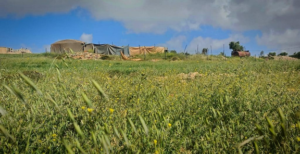
Pea field in the village of Taybeh, east of Ramallah, April 2026
Qassam Muaddi writes in Mondoweiss on 29 April 2026:
Slowly, amidst the high green weeds of April, Eyad Yousef moves forward in a white bee-keeping suit, inclined forward and looking toward the ground. I trail behind him as he goes about his work, picking the peas he and his brother planted earlier in March. “If the price for plowing a dunam of land is around 100 shekels these days, how expensive do you think a jerrycan of olive oil would be? Who would even buy it?” he exclaims.
Eyad Yousef is a Palestinian farmer in the village of Taybeh, east of Ramallah. He is also a car mechanic and a father of three. Every spring, he and his brothers plant peas, lentils, cucumbers, onions, and other seasonal crops. But this year is different.
Yousef is not working his own land anymore, because it has been made inaccessible by the threat of Israeli settlers, who permanently patrol the plain on the eastern edge of the village. All residents who own land in Taybeh are unable to reach it.
“I rented someone else’s land this year, but it’s not really a written contract or anything, it’s a verbal agreement,” Yousef explains. “If at any time the owner decides to sell the land, I will lose my investment.” Despite this, Yousef still needs to keep up his seasonal farming. “It’s my oxygen,” he says.
Since October 2023, attacks from Israeli settler groups on Palestinian farmers in the West Bank have increased exponentially, both in numbers and in levels of violence.
For many farmers, this has represented a severe blow to their livelihood and way of life, but the impact goes beyond farmers themselves: a substantial part of the Palestinian economy and a mainstay of rural families is being disfigured and decimated. At a time when settler pogroms in the countryside have terrorized Palestinians, farmers have been on the frontlines, enduring escalating Israeli violence.
According to the Palestine Information Center, Israeli settler groups have carried out more than 8,000 attacks on Palestinians since October 2023. The UN Office for the Coordination of Humanitarian Affairs (OCHA) says that Israeli forces have demolished more than 1,000 Palestinian farming structures in the West Bank in 2025 alone. But even those who haven’t still feel the cumulative effect of this assault, reflected in the rising price of agricultural produce.
It was not always this way. Farmers were once the backbone of the Palestinian economy. A historically agrarian society, the British traveler Lawrence Oliphant described Palestine in 1887 as “a green lake of waving wheat.” But today, most of the wheat used to make bread consumed by Palestinians is imported. This transformation has been the life story of multiple generations of Palestinian farmers under the pressure of Israeli colonialism.