

Smashing a figure of Jesus is part of Israel’s ongoing erasure of Christians
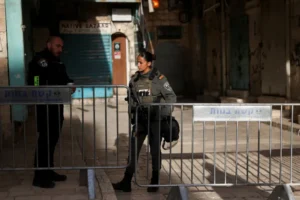
An Israeli security officer stand guard outside the Church of the Holy Sepulchre blocking Christians from attending Easter events inside in occupied East Jerusalem’s Old City on 5 April 2026
Fares Abraham writes in Middle East Eye on 27 April 2026:
An Israeli soldier in southern Lebanon recently took a hammer to a figure of Jesus.
The image was startling, which is why it travelled globally. In a single frame, it captured the kind of desecration many still want to treat as aberrational: crude, visual, undeniable. Israeli military authorities confirmed the incident in the Christian village of Debel, condemned it, and claimed it punished the soldiers involved.
But the deeper problem is not that this happened once. It is that too many still want to treat as exceptional what Christians in this land have long recognised as part of a pattern. What happened in Lebanon did not begin in Lebanon. It exposed a posture already visible in Israel and the occupied Palestinian territories.
The Rossing Center for Education and Dialogue, a Jerusalem-based organisation that monitors attacks on Christians in Israel and East Jerusalem, documented 155 anti-Christian incidents carried out by Israelis in 2025 and described a “continued and expanding pattern of intimidation and aggression.” Physical assaults were the largest category, and clergy were the most frequent targets.
Between ‘smashing’ and ‘squeezing’ incidents
Rossing’s distinction between incidents that “smash” and those that “squeeze” is especially clarifying. The smashing is what makes headlines: a desecrated statue, a vandalised church, a viral image.
The squeeze is quieter: spitting, harassment, intimidation, obstruction, and the low-grade humiliation that makes a community feel less secure and less certain that it has a future.
As a Christian, I read the image from Debel alongside the warnings we have heard for years from Jerusalem, Bethlehem, and Taybeh. Rossing’s report makes clear that Palestinian Christians are vulnerable not only as a religious minority, but also because of their national identity.
In the Occupied West Bank and East Jerusalem, church leaders have repeatedly warned that settler attacks, movement restrictions, and a deepening climate of insecurity are pushing Christians, especially the young, to consider leaving. The threat is not only to Christian symbols. It is to a living Christian presence. That presence has been shrinking for a long time, and for multiple reasons.
The dwindling number of Christians in the land reflects decades of cumulative pressure under Israeli occupation: displacement, emigration, slower population growth, economic hardship, and recurring cycles of violence.