

Israel Prison Service restricts Palestinian inmates’ access to medical equipment
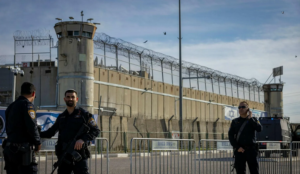
Ofer Prison, January 2026
Hagar Shezaf reports in Haaretz on 26 April 2026:
Israeli prisons have been restricting Palestinian prisoners’ access to essential medical devices, such as hearing aid batteries, eyeglasses and crutches, since October 7, 2023, after Israel’s far-right National Security Minister Itamar Ben-Gvir ordered that families of prisoners be prevented from depositing funds used to purchase such equipment.
As a result, Adam Oweineh, a 24-year-old deaf Palestinian held in administrative detention, is unable to hear, having not received regular batteries for his cochlear implant. He has also not been sent to rehabilitation treatment or follow-up examinations.
According to his family, his inability to hear led to prison guards beating him after he failed to respond to their instructions. Oweineh, from the West Bank village of Battir near Jerusalem, has been held in administrative detention – without charge or trial – since January 2025. He was arrested on suspicion of involvement in the manufacture of explosive devices, and his detention has been extended twice.
Two months before his arrest, Oweineh underwent surgery to receive a cochlear implant that was intended to partially restore his hearing. The device requires specialized batteries and a structured rehabilitation process following implantation. Despite this, the batteries in his possession were confiscated upon his arrest.
Two months later, and after two appeals by Physicians for Human Rights – Israel, the Israel Prison Service said it would not provide the batteries required for the device, and that his family would have to transfer them via a lawyer. Under prewar procedures, medical equipment for prisoners was purchased by the prison service using funds deposited by families into a designated account, which was also used for commissary purchases.
Since Israel’s war in Gaza broke out in October 2023 after the Hamas attacks in southern Israel, National Security Minister Itamar Ben-Gvir has overseen a marked deterioration in conditions for Palestinian prisoners, including a rise in solitary confinement from 3.5 percent of inmates in 2022 to 37 percent in 2024, alongside reported denials of medical care and allegations of mistreatment that rights groups say amount to collective punishment.
There is also mounting evidence of prisoners suffering from malnutrition in Israeli prisons, as part of Ben Gvir’s policy to reduce food portions for Palestinian prisoners. The prison service has also restricted lawyers’ access, sometimes barring visits for weeks or months on vague security grounds.
The IPS has since blocked Palestinian prisoners’ access to the commissary and, with it, families’ ability to deposit funds that was then used by the prison service to purchase and provide the equipment. As a result, families seeking to provide medical equipment must do so through a lawyer, incurring additional costs.
Families also often do not know what equipment is needed or when. Since October 7, direct communication with prisoners has been cut off, and contact is now conducted only through lawyers. Oweineh’s family has managed to provide him with batteries twice through a lawyer, but he continued to complain of headaches and ear pain, saying he could not properly use the implant.
“He can’t hear at all,” his father, Ghassan Oweineh (Olayan), said. “I was very afraid someone would hit him, because that could damage his brain. He needed six months to a year of rehabilitation [after the surgery] for his hearing to become semi-normal.” His father added that even attempts to transfer the batteries via a lawyer were often met with obstacles. For example, the family recently tried to arrange a lawyer’s visit, but the prison service denied the request, and not for the first time.
On March 23, lawyer Hassan Abadi visited another prisoner at Ofer Prison, where Oweineh is being held. “He said Adam [Oweineh] is deaf, and when a guard came to conduct a headcount, he didn’t hear, so he was slapped and severely beaten,” Abadi said, recounting what the prisoner told him. Abadi added that according to the prisoner, after other inmates began warning Oweineh ahead of headcounts, guards punished those in the cell collectively, using tear gas and dogs. “Once, they punished the entire room for three days without food, sheets or mattresses.” Oweineh was taken for a medical examination only in October 2025, after Physicians for Human Rights – Israel made four appeals to the IPS.
In February, the organization filed a petition with Israel’s High Court of Justice demanding that Oweineh be provided with batteries and allowed access to treatment. Only after the petition was filed did the IPS say Oweineh had a supply of batteries and would receive additional ones if needed.
As part of the petition, the organization submitted an expert medical opinion stating that patients who undergo such procedures require intensive follow-up care, including speech therapy and regular examinations by an ear, nose and throat specialist. According to the opinion, Oweineh would not benefit from standard hearing aids and, without batteries or proper rehabilitation after his surgery, would be unable to communicate with his surroundings.
Oweineh’s case highlights the consequences of the prison service’s policy, combining both the denial of necessary medical equipment and the failure to provide adequate follow-up care. Haaretz and several human rights organizations have reported multiple similar cases of medical neglect involving Palestinian prisoners since October 7, 2023. Physicians for Human Rights – Israel said it has contacted the IPS regarding more than 50 cases involving the provision of eyeglasses and six cases related to hearing aid batteries as a result of the IPS’s new policy. In 2024, the organization also filed two petitions with administrative courts seeking to allow families to deposit funds for the purchase of eyeglasses in two separate cases. In both instances, the prison service agreed to permit the deposits only after the petitions were filed, having initially opposed them in court, arguing that updated directives barred such transfers.
In a letter sent to the prison service in February, the organization said it had documented dozens of cases in which prisoners were denied medical equipment due to the policy blocking fund deposits. The letter was addressed to Prison Service Commissioner Kobi Yaakobi; the organization’s chief medical officer, Dr. Liav Goldstein; and the head of the service’s logistics division, Ilan Goldenberg.
Among the cases cited was a 72-year-old prisoner held in Ganot Prison suffering from severe myopia who had not received eyeglasses since April 2025. In another case, a 67-year-old prisoner in Ofer Prison, arrested in September 2025, was examined by an optometrist only in January, when it was determined that he needed reading glasses.
The IPS rejected the allegations. “Detention conditions that were customary before October 7 have been adjusted in accordance with a ‘minimum required by law’ approach, balancing security needs with safeguarding the rights of all detainees,” it said in a statement. “Regarding medical equipment and aids, all detainees receive medical attention according to the professional discretion of medical personnel, and subject to Health Ministry guidelines.”
Regarding Oweineh’s case, the prison service said it could not comment due to privacy concerns, but noted that the matter is currently under review by the Supreme Court. It said the claims outlined in the report “do not reflect reality,” and denied allegations that prisoners were punished through the withholding of food or mattresses.
This article is reproduced in its entirety