

Public condemnation of settler violence hasn’t changed anything on the ground
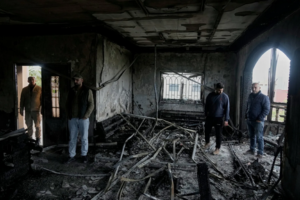
Palestinians inspecting a house torched by settlers during an attack in West Bank village of Deir al-Hatab on 23 March 2026
Rabbi Arik Ascherman writes in Haaretz on 16 April 2026:
Those of us engaged in protective presence in endangered Palestinian communities challenge those here and abroad who are now thankfully speaking up about settler violence to make a real difference by joining us on the ground in the West Bank.
It is truly significant that many rabbis are now speaking up to condemn settler violence, and that former Likud ministers Dan Meridor and Meir Shitrit signed on to a paid advertisement stating that the settler pogroms in the West Bank are war crimes supported by the army. Hardly a day goes by without items about settler violence in the mainstream media, and we hear about new pressure coming from Israel’s best friends in the U.S. administration.
Yet, on the ground, there is a continuation – if not escalation – of the daily violence supported more and more directly and blatantly by Israeli security forces. The collusion is beyond anything I have seen in the 30 years that I have led Israeli human rights NGOs. And those of us who say we oppose settler violence are giving victory on a silver platter to those who are using violence to expel Palestinians from their homes. Settlers have enough commitment to give up their livelihood, education and even their safety for the things they believe in heart and soul. They aren’t just talk; they are present on the ground day and night, while most of us are not.
If one percent of those who say they oppose settler violence and the occupation would volunteer in the field for at least one protective presence shift a month, it would be a game changer. Protective presence is explicitly nonviolent and legal, and we need you to join us.
Right now, the few resources that protective presence activists have are spent searching desperately for two people to be present in some of the endangered communities, leaving communities undercovered or without any protection at all. To meet the demand, we need to have many more people available to take shifts, enabling a protective presence 24/7 in all of the endangered communities that request it. There is also a need for protective presence activists to accompany Palestinians previously displaced by settler violence who wish to return to their homes. The Israeli High Court of Justice consistently rules that expelled communities can return, but they will not order the protection necessary to enable the return.
In a backhanded way, the greatest proof of the value of these shifts is the increased use of closed military areas imposed on the areas where we are engaged in protective presence. The closures are selectively enforced against us, even when outposts fall within the closed zone, and soldiers explicitly tell us that they will not enforce the orders against those employing violence.
Even when soldiers are not actively participating along with settlers in the violence, as they all too often are, the commanders imposing these closure orders know very well that they are imposing a death sentence on Palestinian communities when they prevent our presence but allow settlers in. Those who wish to expel Palestinians and take over their lands want us out of the way in order to enable those acting violently to act unopposed and often not documented. Those issuing the orders believe that our presence makes a difference.
We often hear from Israeli security forces that we are the problem. They say it is not their evil designs but our presence that provokes the settlers into acting violently. Everything would be quiet and peaceful if we did not create the “provocation” of protecting human beings that the security forces do not protect or, in some cases, cannot possibly arrive in time to protect. Most attacks occur when protective presence activists are not present.
They are right: Everything would be quiet and peaceful if we did not create the “provocation” of protecting human beings that the security forces do not protect or, in some cases, cannot possibly arrive in time to protect. There would be deathly silence if we were not present, because there would be many more communities abandoned, in addition to the many dozens that have already disappeared. There would be many more places where we would no longer hear the sound of sheep, or the laughter of children playing, or see any sign of life.
We can talk ad nauseam about the sins of our government, our security forces and the settlers towards Israelis living in poverty, towards our country’s non-Jewish citizens and even more so regarding West Bank Palestinians. But the Jewish text Pirkei Avot teaches us: “It is not talk, but action that is most important.” Rabbi Abraham Joshua Heschel was known to say, “In a free society some are guilty, but all are responsible.”
Jewish Israelis and even non-Jewish Israelis still enjoy some level of democracy, but I would add that the entire Jewish people, and all people and countries of conscience share responsibility. Being “on the right side” because we speak with our friends about how wrong things are or vote or go to protests does not absolve us of that responsibility. Protests may salve our consciences, but we are dealing with a government that pays so little attention to public opinion. Demonstrations alone will not change policy.
Many may feel that nothing we can do can make a difference, but we must challenge ourselves to take concrete action that might make a difference. The Jewish tradition teaches us to look at all of life as perfectly balanced scales. We never know whether the tiny act we take that seems meaningless and ineffective at the time may be the act that tips the scales on both the personal and the cosmic levels.
I certainly cannot make the claim that protective presence always succeeds, but it sometimes does. Moreover, it means a great deal to Palestinians. They often tell us that if we were not present, they would have fled a long time ago. Two neighborhoods in the area in which my NGO Torat Tzedek takes responsibility fled because closure orders issued by the Israeli military prevented us from remaining with them.
When speaking with our Palestinian partners, I have to be honest and say that we must try everything, but I can’t promise that our actions can stop the violence, the theft of land, or the uprooting of trees. The one thing I can say is, “Come what may, you will not be alone.” I promise this thinking about the long, dark centuries in which we Jews were alone as our doors were busted down in the middle of the night. Not leaving Palestinians alone is a thundering command emanating from Jewish history and Jewish tradition.
Given the intense efforts the powers that be are making to prevent protective presence, it cannot be and never has been our only tool in standing up to settler violence and preventing the forced displacement of more Palestinian communities. But it will remain a key tool if we can recruit enough people to maintain and expand our presence.
There are communities where there are no closure orders. If there will be additional orders the real reason behind the orders will become more and more obvious. We will have enhanced ability to challenge orders in court. My understanding of Israel’s “Do not stand idly by when your neighbor bleeds” law, based on the biblical commandment, is that there are situations in which Israeli law actually requires us to go into closed areas when the security forces we have notified are not present or cannot arrive in time to protect fellow human beings and their property.
There are many who don’t see beyond the Jewish people and do not respect the image of God in non-Jews, and they will do everything to block any initiative by those of us who respect the sanctity of human beings and human rights. Now is the time to demonstrate a fighting spirit.
Rabbi Arik Ascherman led Rabbis for Human Rights for 21 years and is the co-founder and executive director of Torat Tzedek (Torah of Justice).
This article is reproduced in its entirety