

Police forcibly disperse anti-Iran war protest in Tel Aviv amid IDF restrictions
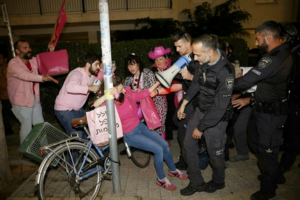
Police disperse an anti-Iran war protest in Tel Aviv on 4 April 2026
Yair Foldes, Josh Breiner, Adi Hashmonai, Bar Peleg, Eden Solomon and Linda Dayan report in Haaretz on 4 April 2026
Around a thousand protesters gathered in Tel Aviv’s Habima Square and hundreds gathered in several locations across the country on Saturday to protest Israel’s ongoing war in Iran, despite the IDF limiting gatherings in public areas to 150 people, after Israel’s High Court of Justice said the state must allow demonstrations in which at least 600 people participate.
Police said 17 people were arrested in Tel Aviv’s Habima Square, after police violently dispersed demonstrators, confiscating megaphones, loudspeakers and other equipment.
Around 500 protesters also gathered in Haifa’s Horev mall to protest against the war, and in Jerusalem, around 300 demonstrators gathered. The clashes come after the IDF’s Home Front Command earlier Saturday refused a request to approve the participation of some 1,000 protesters at Tel Aviv’s Habima Square later in the day, and a senior Israel Police officer said authorities would enforce wartime restrictions on public gatherings.
After the protests had begun, the High Court issued a decision according to which protests with at least 150 people must be permitted, and in Tel Aviv’s Habima Square, protests with at least 600 people are to be allowed. The High Court decision cited selective enforcement of the Home Front Command’s gathering guidelines. “This means the police are enforcing Home Front Command’s instructions on protests but not in other places and events,” the justices said in the decision. Police said they allowed a demonstration with 600 participants, and dispersed the protest since it had violated the guidelines.
During the forcible removal of protesters in Tel Aviv, a missile launched by Yemen’s Houthis triggered a siren. Despite some protesters urging police officers to accompany the detained demonstrators to shelter, they refused to allow the detainees from Habima Square into the underground shelter there, and instead accompanied them into a building’s lobby nearby.
Meanwhile, a protester in his 50s suffered cardiac arrest while taking shelter. Doctors who treated him told Haaretz that a police doctor arrived at the scene and prevented them from continuing care. “The team that began providing medical treatment asked for adrenaline,” said Dr. Udi Baharav. “I got up to take it out of my vest, and the police doctor pulled me back. This is interference during resuscitation.” Dr. Yair Hoffman, a pediatric intensive care physician, added that the police doctor pushed Baharav during the resuscitation. The police said in response: “Magen David Adom reported that this was a cardiac incident, and there is no connection to police handling of the protest. Any publication claiming otherwise is false and misleads the public.”
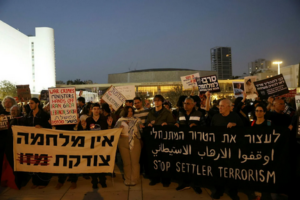
Protesters at Habima Square, Tel Aviv on 4 April 2026. The sign on the left reads ‘No war is just’
Earlier Saturday, police had said over loudspeakers that there were “a lot more [people]” in Habima Square than Home Front Command’s orders allow. Officers requested demonstrators “stay safe and abide by the instructions.” Protesters responded by booing police during each such announcement. Around 7:37 P.M. police said the protest was to be dispersed, adding that “no force will be used to disperse it within the next 5 minutes.”
Shortly thereafter, police officers ordered demonstrators to exit the square in an attempt to limit the protest to 600 people, warning they would “need to disperse the protest by force.” Officers began forcibly removing protesters from the square around an hour after clashes between the sides began, confiscating loudspeakers and other equipment from demonstrators.
The protests in Tel Aviv were organized by a coalition of Israeli protest organizations. Alon-Lee Green, co-director of Standing Together, who was detained by police during the protest, briefed demonstrators ahead of the rally: “Don’t give the police and any excuses. We’re responsible here, and we will demonstrate against the war until we reach victory. The violent assault by Ben-Gvir’s police tonight on the anti-war protest at Habima Square, in blatant disregard of the High Court’s ruling allowing the demonstration, shows that the government is afraid of the protest,” Green said. “At dozens of locations across the country today, thousands of people took to the streets to protest Netanyahu’s endless war, and a government that is dragging us from Gaza to Iran to Lebanon, sacrificing the lives and security of all of us,” he added.
In accordance with the IDF’s request, the protesters in Habima Square divided into two main groups to allow easier evacuation in an emergency. One group chanted, “The government has no solutions – no peace and no security.” The other chanted “from Masafer Yatta to Jenin – Free Palestine.” Protesters are also chanting “Stop the War.”
Meanwhile, additional demonstrations took place across Israel. In Haifa’s Horev center, where hundreds rallied, sirens were sounded after Iran launched a missile at northern Israel. Organizers instructed protesters to take shelter, where they continued to demonstrate. In Jerusalem, approximately 300 protesters were split up by organizers, in accordance with the Home Front Command’s guidelines, which permitted gatherings of up to 50. Protests also took place in southern Israel’s Be’er Sheva, and in intersections in northern and southern Israel.
Israel’s High Court of Justice said earlier Saturday that the Home Front Command’s decision to limit protests to 150 people does not give due weight to the freedom of protest during wartime, and ordered authorities to submit a new framework to permit protests in central locations across Israel by 6:00 P.M. Such a framework was not submitted.
The State Prosecutor’s Office informed the court that the Home Front Command’s position had not been reviewed by it or by the Military Advocate General, and did not take the right to protest into account. In response, the Association for Civil Rights in Israel (ACRI) urged Attorney General Gali Baharav-Miara to instruct police not to use force at protests on Saturday evening. The group said that regardless of the plan, demonstrators would already be at the protest sites when a decision is made.
The ultra-Orthodox Shas party and National Security Minister Itamar Ben-Gvir issued statements criticizing the High Court for issuing a decision during Shabbat. The statements contrasted the fact that the decision allows demonstrators to gather while gatherings for prayer at Israel’s holy sites are barred under the IDF’s instructions.
On Friday, Israeli Supreme Court President Isaac Amit said Israel Police must allow demonstrations during the Iran war, saying that protesters “don’t need to beg to hold a demonstration.” The court ordered the government’s counsel to submit the police’s and the IDF’s position on planned protests against the ongoing war in four locations across the country, setting Saturday at 11 A.M. as the deadline.
The court’s decision came after the Association for Civil Rights in Israel and anti-war activist Itamar Greenberg submitted a petition following the police’s dispersal of a rally against the war in Iran in Tel Aviv’s Habima Square last week.
This article is reproduced in its entirety