

Israel’s Supreme Court looks the other way as patients in Gaza suffer
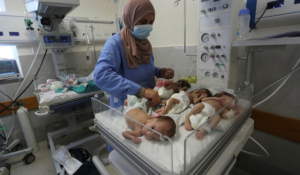
A nurse cares for prematurely born Palestinian babies in the Gaza Strip during the war
Keren Shavit writes in Haaretz on 3 August 2026:
More than 18,000 critically ill patients are trapped in the Gaza Strip without access to the medical care they need. Supplies as basic as needles, syringes, sterile gauze and surgical sutures are running out. I have seen the list of urgently needed medical supplies with my own eyes.
This was the reality behind a petition heard recently by the Israeli Supreme Court. Physicians for Human Rights Israel and four other human rights organizations asked the Court to restore a medical corridor that would allow patients from Gaza to access specialized treatment in Palestinian hospitals in East Jerusalem and the West Bank.
As Israel has systematically destroyed Gaza’s healthcare system and continues to restrict the entry of medical aid, patients must seek treatment elsewhere. Medical evacuations to third countries are limited in scale and unsuitable for many patients who require ongoing treatment.
They cannot be a substitute for access to hospitals in East Jerusalem and the West Bank. These hospitals are an integral part of the Palestinian healthcare system, have long treated patients from Gaza and have the capacity to provide specialized care. This was the access our petition sought to restore.
The judges questioned the government’s blanket ban on patients from Gaza and its refusal to establish a mechanism for reviewing individual cases. But after the State presented classified “security” material behind closed doors, the Court declined to intervene. The discussion instead shifted toward the alleged responsibility of third countries to accept more patients.
Five senior Israeli physicians, representing a group of 32 doctors who had independently sought to join the petition, were denied permission to address the Court. Rather than providing any immediate relief, the judges deferred a meaningful decision, asking the State to provide further updates on security-related issues. Yet for many critically ill patients, waiting is itself a death sentence.
This disappointing decision is part of a pattern that has emerged in PHRI’s legal petitions to protect the fundamental rights of Palestinians in Gaza over the past three years. Although these petitions have raised different legal questions, they have repeatedly exposed the same fundamental problem: Palestinians may be able to bring urgent cases before Israel’s highest court, but that does not necessarily mean the judges will meaningfully scrutinize state policy or provide an effective remedy.
After Israel’s military operation in Rafah and the closure of the Rafah crossing in May 2024, PHRI and its partners petitioned the Supreme Court to require the government and military to establish a systematic medical evacuation procedure for Palestinian patients. Seven months later, the Court accepted the vague mechanism presented by the State, despite its lack of transparency and its inability to provide an effective response to the collapse of Gaza’s healthcare system.
In December 2024, the Court twice denied PHRI’s urgent requests to intervene over the besieged Kamal Adwan Hospital in northern Gaza. Just half an hour after the second refusal, the Israeli military stormed the hospital, shut it down and arrested its director, Dr. Hussam Abu Safiya, who remains in detention without charge to this day.
Taken together, these cases raise a broader question: where can Palestinians turn for an effective remedy when the harm they face is immediate and irreversible?
Again and again, the Court hears urgent petitions, yet the policies being challenged remain in place while proceedings continue or decisions are deferred. For Israel, this creates the appearance of an effective domestic legal system capable of reviewing policy, without providing a real check on the government. The consequences are not merely legal or bureaucratic. They are measured in human lives.
Patients in Gaza are once again left to wait in pain and uncertainty. Many are living in tents, enduring extreme heat and cold while coping with amputations, colostomy bags and untreated cancers. They are waiting for access to medical care that exists only a short distance away.
Meanwhile, we in civil society continue to petition, document and advocate. But each case forces us to confront the same painful reality: A remedy that comes too late to prevent irreversible harm is no remedy at all.
Keren Shavit is a project coordinator for the NGO Physicians for Human Rights Israel (PHRI)
This article is reproduced in its entirety