

Archiving as resistance: The battle to save Gaza’s cultural heritage
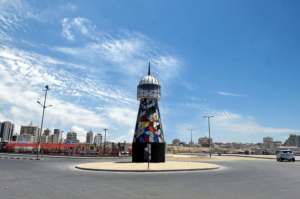
Minarat Gaza by Shareef Sarhan, seen in Gaza City’s port, 2016.
Samah Salaime writes in +972 on 31 July 2026:
In June 2016, the Palestinian artist Shareef Sarhan unveiled “Minarat Gaza” in Gaza’s port. The 15-meter-high, lighthouse-shaped sculpture was built from stone, concrete, and fragments of homes destroyed in successive Israeli assaults on the besieged enclave. The work was an attempt, Sarhan told +972 Magazine, “to transform the debris of war into a symbol of life, memory, resilience, and light.”
Seven years later, shortly after the genocide began, an Israeli airstrike destroyed the sculpture. Following months of displacement, isolation, and grief, Sarhan moved with his family to Marseille, in southern France. There, he began rebuilding not only his life, but the lighthouse itself.
Smaller than the original, the meticulously reconstructed sculpture embodied Sarhan’s refusal to let Gaza disappear. It also affirmed, he said, his determination to return one day and rebuild it once more on the shore of Gaza City.
Sarhan’s story and photographs of the sculpture appear alongside dozens of accounts by Gazan artists, curators, and archaeologists in “Archiving Gaza in the Present: Memory, Culture, and Erasure.” Published late last year by Saqi Books, the volume presents archiving as an act of resistance to the destruction of Palestinian culture and memory — a response to what its editors, Dina Matar and Venetia Porter, describe as an ongoing “memoricide.”
Matar, a professor of media and communication at SOAS University of London, told +972 that the destruction of culture is part of a broader process of Palestinian dehumanization: A people stripped of their culture can be portrayed as having no history — and a people denied their history can be deprived of a moral claim to their land and reduced to a “security problem.”