

Israeli study finds starvation in Gaza was result of deliberate policy
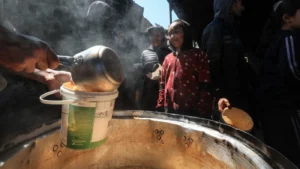
Displaced Palestinian children receive food from a charity kitchen at the Nuseirat refugee camp in central Gaza on 13 April 2026
Nadav Rapaport reports in Middle East Eye on 3 June 2026:
A recent Israeli study has concluded that starvation in Gaza resulted from a premeditated policy, despite sustained public denial by the Israeli government and much of the media.
Titled ‘Data for Denial: The Smokescreen Behind the Starvation of Gaza’, the study was published last month by the Forum for Regional Thinking at the Van Leer Jerusalem Institute [in Hebrew].
Its author, Shmuel Lederman, an Israeli scholar specialising in genocide studies, told Middle East Eye that he was motivated by what he described as widespread denial within Israel over starvation in Gaza during the two-year genocide that began in October 2023.
He said such denial among the public was to be expected, drawing comparisons with historical cases of mass violence.
“There is a thirst for denial,” Lederman said, with many in Israel seeking to portray the army’s conduct in Gaza and elsewhere as entirely justified or unproblematic. A report by the Israeli news site Walla in August 2025 similarly suggested that denial or minimisation of the starvation crisis in Gaza was widespread across mainstream television channels.
According to the study, international warnings were frequently dismissed or reframed to align with official Israeli narratives. Some commentators acknowledged starvation only in mid-2025, attributing it to isolated miscalculations rather than to broader policy decisions.
Lederman’s research argues that such interpretations overlook a central principle in famine studies: that starvation is determined not simply by food availability, but by people’s access to it.
The study documents how restrictions on aid, fuel and cooking gas, alongside the destruction of key infrastructure such as bakeries and disruption to humanitarian operations, severely limited Palestinians’ access to food.
It concludes that the starvation in Gaza resulted from “deliberate planning, experimentation, and manoeuvring around the humanitarian ‘red line’”, aimed in part at managing international pressure on Israel during the war.
The number of trucks
According to Lederman’s report, throughout the war in Gaza the number of trucks carrying food, medicine and other humanitarian aid into the enclave became a central point of public debate on starvation.
COGAT, the Israeli military unit responsible for civil administration in the occupied Palestinian territories, claimed in August 2025 that the entry of 80 aid trucks per day would be sufficient to meet Gaza’s population needs. Israeli researchers and journalists frequently echoed this assessment.
Human rights organisations, UN agencies, and even the US administration of President Joe Biden disagreed with COGAT’s figures. The Biden administration estimated that around 250 aid trucks per day would be required, while international organisations placed the figure at roughly 500 to 600.
Both recently and in the past, COGAT itself has cited significantly higher estimates. In 2008, for example, it stated that Gaza’s then-population of around 1.5 million required approximately 178 aid trucks per day to meet basic needs.
Last month, Israel Hayom reported that COGAT had urged the government to reduce the number of aid trucks entering Gaza after the October 2025 ceasefire, down to 250, arguing that this level was sufficient for basic humanitarian requirements. “In practice, this is an admission of starvation,” Lederman told MEE in response to COGAT’s recent statements, which were issued after his report was published.
Lederman’s report argues that the starvation of Gaza began at the outset of the war in October 2023. Until March 2024, Israel permitted only a fraction of the recommended number of aid trucks into the Strip, contributing to a deepening food crisis. UN agencies, human rights groups and Palestinian testimonies all pointed to severe shortages of food, with women and children disproportionately affected.
In May 2024, following US pressure after the Israeli assault on Rafah, Israel allowed a greater number of commercial trucks into Gaza, while simultaneously restricting humanitarian convoys.