

Israeli military bans Palestinian women activists from higher education
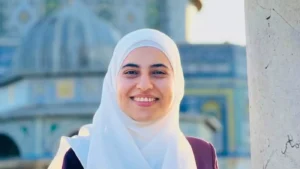
Bara’a Fuqaha who was suspended in June from the faculty of medicine, Al-Quds University
Fayha Shalash reports in Middle East Eye on 30 August 2023:
Two months ago, Palestinian medical student Bara’a Fuqaha was notified of an Israeli decision to suspend her for six months from her university studies. She had been a third-year student at the Faculty of Medicine, Al-Quds University, in the town of Abu Dis east of Jerusalem.
Another woman, Batoul Dar Assi, majoring in medical imaging at the same university, received a similar decision suspending her for four months. Fuqaha, 24, says that on 25 June, she received a call from Israeli police summoning her to the Ma’ale Adumim police station, east of Jerusalem, where she was interrogated about her student activity at the university. “The questions were about my participation in student union activities. After they finished questioning, they handed me a paper containing the suspension order,” she told Middle East Eye.
This Israeli policy is not new. In 2018 and 2019, the Israeli army issued similar decisions to suspend several Palestinian university students in the West Bank for several months, which hindered the completion of their studies and delayed their graduation with their colleagues. Despite Bara’a’s denial of all accusations at the Israeli police station, the suspension decision had already been made before the interrogation, she told MEE.
Bara’a hired a lawyer to challenge the decision with the Israeli Ofer military court, but the appeal was rejected. Then, on 24 August, the court issued another decision confirming the suspension. The lawyer, Salih Mahameed, told MEE that he asked the court to freeze the decision until another session, during which he might be able to reduce the period.
However, Bara’a, who lives in the village of Kafr al-Labad near Tulkarm, says she won’t be able to enter the town of Abu Dis until an annulment of the decision, which is “unlikely”, given the “escalating punitive Israeli policies in the West Bank against the Palestinians”.
Mahameed pointed out that the decision is a military one and is part of a long list of Israeli administrative decisions that devastate the lives of Palestinians, such as administrative detention, administrative deportation, and administrative demolition orders.
According to the laws of the extended state of emergency, Articles 108, 109, and 110 give the Israeli military governor the power to carry out certain measures against any person, such as deportation, preventing entry to a certain place, or requiring the person to appear for questioning two or three times per month at the police headquarters, or determine their place of residence, or deporting them from their place of residence, as explained by the lawyer. “In this case, the charges consist of secret files that no one can see, and there is no legal evidence on them, just as it happens in administrative detention, which is a military decision par excellence and part of the existing Israeli arbitrariness,” he concluded.
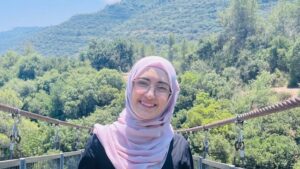
Sa’eda al-Za’arir who was suspended her from the university and banned from entering the town of Birzeit
If the suspension decision is applied for six months, it will end on 25 December, which means depriving Bara’a of an entire term. “I have a fear now that the Israeli army will monitor me to ensure that I don’t enter the university, and that I may be stopped and my identity checked at sudden Israeli barriers if I try to go to the town of Abu Dis during the expulsion period,” she explained.
“The matter is ultimately restricting my movement and trying to impede my entry to the university and the completion of my studies.”
‘Racist policy’
The Jerusalem Governorate issued a statement describing the suspension decision against the two students as a “systematic racist policy” against education and its institutions in Jerusalem.
“This decision is racist, blatant interference and unacceptable in our national universities, where we are proud to practice student union work, guaranteed by the Palestinian constitution, and our national educational institutions are keen on it,” the statement by the governorate said.