

Israeli forces block Palestinian student protest after barring access to school
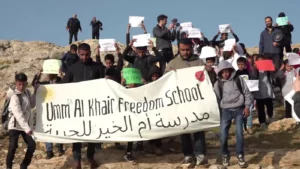
Residents of Umm al-Khair, occupied West Bank, protest Israeli restrictions, 19 April 2026
Sari Jaradat and Mera Aladam report in Middle East Eye on 21 April 2026:
Israeli forces dispersed a student protest in the village of Umm al-Khair on Sunday [19 April], after barring Palestinian residents from accessing schools for over a week. Khalil Hathaleen, a local education official and a parent of two students, told Middle East Eye that his children were among 55 students barred from schools for the second week.
Israeli troops, armed and accompanied by security dogs, were stationed alongside their vehicles at the protests, which were mostly attended by schoolchildren.
The demonstration was sparked after residents were prevented from accessing a vital road between Khirbet Umm al-Khair and the nearby village of Umm al-Khair, south of Hebron in the occupied West Bank. Dozens of students were left unable to attend school.
“Our message is clear, it is that today, they are attempting to take away our rights to education,” Hathaleen said. “Our goal is clear in our demands to the right to education through safe routes to our children, a safe education and the end to demolitions in Khirbet Umm al-Khair.”
The main route connecting the village to external resources was first blocked over 10 days ago by settler leader Nivo, who holds a security role in the neighbouring Carmel settlement. The settler set up a barbed wire fence stretching for at least 50 metres in the middle of the 1.5 metres wide road leading to the school, according to The New Arab citing Hathaleen.
No alternative footpaths exist, except for one that passes through an illegal settlement outpost established after an Israeli settler shot and killed prominent Palestinian activist and English teacher Awdah Hathaleen.
Ahmad Hathaleen, a village resident, told MEE that the issue is “more than just a route closed off by a settler, because these settlers do not stop at a certain point”. “These children are being denied a simple and vital right to education, which children all around the world are entitled to have,” Hathaleen said.