

‘Zionism led to genocide. It must disappear’: Omer Bartov’s new book explores where, exactly, Israel went wrong
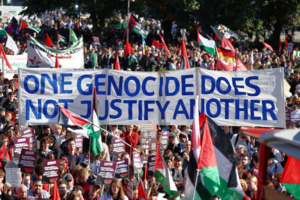
Protesters holding a banner at a mass demonstration in Berlin against Israel’s war in Gaza in September 2025
Etan Nechin writes in Haaretz on 24 April 2026 from Cambridge, Massachusetts:
In May 2024, the Israeli-born historian Omer Bartov concluded that what he was watching in Gaza met the definition of genocide under the 1948 UN Convention. It was not a conclusion he wanted to reach.
He had publicly resisted using the word despite criticism from peers. When he did, it caused a stir not only in academia, but in Jewish communities and Israel.
Bartov was born in Ein HaHoresh, a kibbutz in central Israel, to acclaimed Israeli writer Hanoch Bartov. He fought in the Yom Kippur War and, after earning degrees from Tel Aviv University and Oxford, moved to the United States in 1989. He has taught at Brown University in Providence, Rhode Island, since 2000 and is the Dean’s Professor of Holocaust and Genocide Studies.
Today, Bartov is one of the world’s most cited scholars of the Holocaust. His scholarship debunked the myth of the “clean Wehrmacht,” demonstrating that regular rank-and-file German soldiers extensively participated in the horrors of the Holocaust; it changed German military historiography. He has authored several books on World War II and the genocide perpetuated by German soldiers. His 2018 book Anatomy of a Genocide: The Life and Death of a Town Called Buczacz won the National Jewish Book Award and the Yad Vashem International Book Prize for Holocaust Research.
In his new book, “Israel: What Went Wrong,” which grew from essays written after October 7, Bartov wrestles with how he – and Israel – got here. Haaretz spoke to him at his home in Cambridge, Massachusetts, on the eve of Israel’s Memorial Day – and one day before the release of his new book.
Will your new book be translated to Hebrew?
“The book is coming out in eight languages, even Chinese. In Israel I approached many people I know, who connected me with publishers, including so-called left-wing ones. One wrote to me: ‘I don’t think this is the right moment.’ Others said ‘yes, we’ll check, we’ll read it’ – and then disappeared.
“The same happened in Germany. Two leftist publishers wrote back saying the book was interesting, but they didn’t agree with everything. One suggested doing it alongside another book that would ‘balance it out.'”
That may not be surprising – you were born in Israel, served in the IDF, and the book is personal and scathing. There are growing voices, especially after the war in Gaza in the anti-Zionist left, that the project has been rotten from the start. Is that where you’ve arrived?
“I’m not anti-Zionist. I grew up in a Zionist home. It was self-evident to me that Israel was my place. I’m not opposed to the existence of the State of Israel. But Zionism as an ideology didn’t just run its course. It became something I don’t recognize. It became the ideology of the state. And it became not only militaristic and expansionist but also racist, extremely violent and ultimately an ideology that deeply harms both the individual and the collective. Such an ideology has no place.
I’m not opposed to the existence of the State of Israel. But Zionism as an ideology didn’t just run its course. It became something I don’t recognize.
“It’s ironic and tragic that a movement that began as an attempt to free Jews from persecution, to give them a place of their own – a process of emancipation, liberation, humanitarian aspiration – ends its path as a racist and violent one.”
Do you think it was inevitable?
“I’m not a believer in the kind of history where in the end you say ‘we always knew it would turn out this way.’ Maybe some prophets said it from the first moment. I don’t think it was inevitable.
“The biggest chapter in the book – one that hasn’t appeared anywhere else – is about Israel’s missing constitution. It’s not that in 1948 things moved only in one direction. But it became more and more likely that without a constitution that protects rights for everyone, Zionism, once it became the ideology of a state, would give up on the option of becoming a normal state for its citizens.
“There were reasons, like [David] Ben-Gurion’s pragmatism with the religious and with the Arabs. But the final result was that Zionism became something else. There were attempts to redirect the process. The most important came in the early 1990s with Oslo. That attempt was blocked, very aggressively, with [Benjamin] Netanyahu’s encouragement, with Rabin’s murder. Not enough is said about the fact that [Yitzhak] Rabin’s blood is on Netanyahu’s hands. Netanyahu was the main beneficiary of one of the most successful political murders of the 20th century.
Where does this leave Zionism now?
“Israel cannot exist as a normal state under the ideology of Zionism. Zionism must disappear. The state will remain. It’s not going anywhere. The question is what kind of state it will be. It must change fundamentally. Under the Zionist ideology, it can’t.
“If it doesn’t give it up and become something else, it will be a full apartheid state, an illiberal democracy at best, very violent, eventually losing much of its more educated elite. Most of the population will stay; populations always stay. It will become a pariah state, isolated. It will lose the support of its most important allies – Europe, the United States – and of Jewish communities around the world, who increasingly see it as a danger to themselves rather than a protector.”
It also feels like the word ‘Zionism’ lost its meaning. In 2015, Isaac Herzog, who ran as Rabin’s heir, called his party ‘the Zionist camp.’ Itamar Ben-Gvir calls himself a Zionist, as well as American Jews and others like Joe Biden. Isn’t the ideology you’re describing already dead, absorbed into the machinery of the state?
“Zionism began long before the Holocaust. But the Holocaust was retrospectively cast as the strongest justification for Zionism and for the establishment of the State of Israel. The argument was: If there had been a state, more Jews would have been saved. That’s probably true.
“The Holocaust gradually, from the Eichmann trial onward and especially from the late 1970s into the 1980s, became the glue binding Israeli society. A historical event transformed into an imminent threat: not something that happened in the past, but something always at the threshold. There will be another Holocaust if we don’t meet every threat with full force and destroy it at the root. After October 7, these two things fused. Hamas’s attack was framed as a Holocaust-like act – Hamas are Nazis. Criticizing Israel’s actions is antisemitic.
“Let’s look at it from a different angle: If Zionism could lead to genocide in Gaza, it can no longer hold as an ideology. Other ideologies in history that justified genocide have no place. And if Israel always defined itself as the answer to the Holocaust and used the Holocaust to justify everything, it cannot be that the answer to the Holocaust is another genocide.
“These two pillars have lost their moral justification. When we talk about Israel becoming a pariah state, it’s not a product of antisemitism. It’s a product of Israel’s actions. Those actions pulled the rug out from under the existential arguments Israel had.”
The counter argument is: Look what Hamas did on October 7. The exploding buses in the intifadas. Their own leaders say they’ll do October 7 over and over.
“What Hamas did on October 7 was a war crime. It could easily be defined as a crime against humanity. I would have preferred to see the Hamas leaders captured and put on trial alongside a number of Israeli leaders. That would have been a trial worth watching. Instead, Israel did what Israel does and killed them.
“But there’s another issue. When UN Secretary General Guterres said Hamas’ attack didn’t happen in a vacuum, it was immediately called antisemitic. But there is context. Resistance to occupation, to siege, to the attempt to control a people trying to express national self-determination is legitimate. [The pre-state Zionist militias] Haganah, Etzel and Lehi did it. The French Resistance. The resistance inside Germany. The partisans. The Warsaw Ghetto Uprising. Armed resistance is entirely legitimate, including under international law.
“In Israel, they don’t want to discuss this because no one wants to discuss what will happen to the Palestinians. Every time there’s resistance, the response is: What is this? We need to crush it. The right to resist an occupation doesn’t give you the right to commit massacres. Just as the right to self-defense, which Israel always claims, does not give you the right to commit massacres either.”
Protesters holding a banner at a mass demonstration in Berlin against Israel’s war in Gaza in September 2025. Credit: Christoph Soeder/AP
Resistance to occupation, okay. But was that Hamas’ aim?
“The Hamas leaders are dead, but what they wanted to accomplish succeeded. Israel destroyed Gaza, but it didn’t eliminate Hamas. What the Hamas leadership wanted was to break the siege out of the realm where Netanyahu ‘managed’ the conflict and nobody cared: not the Arab states, not the international community, not Israeli election campaigns.
“Hamas turned it into a regional conflict. Israel is now fighting in Lebanon, Syria, Iran, Yemen, Gaza, the West Bank. From the perspective of Hamas’s extreme wing, which is actually quite similar to the thinking of [Bezalel] Smotrich and Ben-Gvir, they achieved their goal. They knew the price would be terrible. But for messianic actors, the price is acceptable.”
Wrestling with genocide
After October 7, Bartov penned two op-eds for The New York Times more than a year apart.
He wrote in November 2023 that what was happening in Gaza was not yet genocide, though it was heading there. The article received criticism from peers, like fellow Israeli-American Holocaust expert Raz Segal, who thought a genocide was already happening. Others claimed Bartov’s assertion that Israel was on the path to genocide was “inflammatory and dangerous.”
In July 2025, he publicly declared a new position: “I’m a Genocide Scholar. I Know It When I See It.”
Prof. Omer Bartov in Cambridge on Tuesday. Credit: Arthur Mansavage
Genocide is understood by the public on several levels. There’s a historical level, the legal concept and a moral concept. How do you hold those together?
“I begin with the legal level not because I’m a lawyer – I’m not – but because the 1948 Convention on the Prevention and Punishment of the Crime of Genocide is the only definition valid under international law. There’s no comparable convention on crimes against humanity. The Genocide Convention is signed by most countries, including Israel, Germany, France, Britain, the United States. It is the only definition that matters at the International Court of Justice.
“It emerged from the international community’s response to the catastrophe of World War II, not only the Jews. Let’s remember that roughly 26 million Soviet citizens died in that war.
“I taught comparative genocide for 25 years. I began the course in 1904, before the word genocide existed; Raphael Lemkin [the Polish Jewish lawyer who coined the term after World War II] was about 4 years old. Retrospectively, what the Germans did in Southwest Africa, now Namibia, is counted as the first genocide of the 20th century. I think about the subject on all three of those levels.”
A memorial to the victims of Germany’s first genocide in Swakopmund, Namibia, in 2023. Credit: Benny Furst
Take us through your thought process.
“In November 2023 the Times gave my first piece a headline suggesting I was saying this wasn’t genocide. That’s not what I wrote. I wrote that there were already war crimes, probably crimes against humanity, and if this wasn’t stopped it would become genocide.
“I was hoping the Biden administration would do something. Biden and [then-Secretary of State] Antony Blinken did nothing. They could have ended it easily. They could have told Netanyahu: You have two weeks, close this down, or you’re alone. He’d have stopped within hours.
“In May 2024 it became clear: The conduct on the ground was systematic destruction of Gaza, whose logic was ethnic cleansing. But the ethnic cleansing couldn’t occur, unlike in 1948, because there was nowhere to flee.
Palestinian refugees initially displaced to Gaza boarding boats to Lebanon or Egypt in 1949. Credit: Hrant Nakashian/1949 UN Archives
“As in many previous cases – including the Holocaust – when an attempt to remove an ethnic group from territory you control fails because they cannot leave, the solution becomes killing them. That’s genocide.”
People say that Hamas uses human shields, and that’s what causes civilian casualties.
“Genocide has no justification. You can’t say, ‘yes, I committed genocide, but I had no choice because they were hiding.’ It’s not a legal argument, not a moral argument, not a political argument. Even if there were 10 times as many Hamas fighters hiding under every hospital, it wouldn’t justify genocide.
“Hamas is an extremist movement. It used brutal means not only against Israel but against Gaza’s own population. Yes, they built an underground city. The real question is: How do you fight that? Do you do what the Russians did in Grozny, and flatten the whole thing? That’s what the IDF did, which is actually opposed to the IDF’s own ethos.
Even if there were 10 times as many Hamas fighters hiding under every hospital, it wouldn’t justify genocide.
Prof. Omer Bartov
Palestinians displaced by Israel’s war in Gaza returning to Jabalya refugee camp in northern Gaza in January 2025, shortly before a cease-fire deal went into effect between Israel and Hamas. Credit: Omar al-Qattaa/AFP
“And the fighting in Gaza will be recorded as a fiasco, alongside the fiasco of October 7. Militarily, the Gaza campaign was poor. They entered in the north and pushed people south, hoping Egypt would let them leave, hoping Eritrea or Indonesia or Somaliland would take them. It was insane. What it produced was systematic destruction.”
But the counter argument is that the stated objective wasn’t a war against Palestinians, but against Hamas, which could’ve surrendered, given the hostages back and disarmed.
“At the beginning of this war, there were two kinds of statements. One seemed rational: destroy Hamas, free the hostages. The other was genocidal: no water, no food, no electricity, they are human animals, Amalek. The second type were incitements to genocide.
“Even the rational type contained a contradiction: you need Hamas intact to negotiate with. According to reports, 41 hostages were killed by IDF strikes.
“Anyway, by May 2024, it was clear the goal wasn’t destroying Hamas and freeing hostages. The goal was to systematically render Gaza unlivable. The destruction of hospitals, schools, universities, water desalination facilities, energy infrastructure, entire housing blocks – this was an attempt to ensure that the Palestinians of Gaza could not renew their existence as a group.
“People like Ben-Gvir and Smotrich, and very soon Netanyahu, saw this as an opportunity. If the conflict couldn’t be managed, it could be ended. Even Bogie Ya’alon [a former IDF chief of staff and Netanyahu defense minister] has said so, and he is not in my political camp.”
There were those who said it from the start. Raz Segal published ‘A Textbook Case of Genocide’ in Jewish Currents on October 13, 2023. What did you make of it?
“I’ve known Raz for years, but I thought it was too early. People ask me now, why did it take you until July 2025?
“The word ‘genocide’ gets used the way ‘fascism’ does: Someone you dislike is a fascist, a country doing things you disapprove of is committing genocide. Israel did many things that deserved harsh criticism that weren’t genocide.
Students, professors and activists holding a Nakba Day ceremony at Tel Aviv University in May 2025. Credit: Moti Milrod
“Fifteen years ago I argued with the British sociologist Martin Shaw about whether the Nakba was genocide. I said no, it was ethnic cleansing. I still think so, because Gaza could have been a repeat of the Nakba if the borders had been open. They weren’t. I wanted to be careful.
“That’s why I insist on the UN Convention’s specific definition. Raz was right in the sense that it became genocide, and there were already incitements to genocide at the time he wrote. I thought he was ahead of events.”
When a society changes
When did you first sense Israel was heading somewhere it couldn’t come back from?
“I began thinking about this politically during the first intifada. I’d finished my doctorate in 1983, published a book about the German army in 1985, and by December 1987 the intifada began. I was a reserve officer, and Rabin was telling us to break their arms and legs.
I wrote Rabin a note, saying I’ve seen behavior by the IDF I’ve recognized from my research on the Wehrmacht. To my surprise, he answered. He was angry that I would compare the IDF soldiers to German soldiers.
Prof. Omer Bartov
“I wrote Rabin a note, saying I’ve seen behavior by the IDF I’ve recognized from my research on the Wehrmacht [Nazi Germany’s armed forces]. To my surprise, he answered. He was angry that I would compare the IDF soldiers to German soldiers.
“Around the same time, my professor, Yehuda Elkana, published an article called “In Praise of Forgetting” in Haaretz [in 1988].
“Elkana, a Holocaust survivor, argued that the way Israeli youth were taught to remember the Holocaust – obsessively, without actually learning its history – was generating a dynamic of vengeance and violence, visible in the brutalization of Israeli soldiers. He was of course attacked for saying it.
“It has gotten much worse since. I was in Gaza in 1974-75. Even then it was a bad place: 350,000 people, hopeless and sad. Today there are 2 million. The army then and the army now – the command structure – are completely different. A large part of the combat units are now religious. When I was in the IDF, such people existed, but they weren’t in uniform. They weren’t carrying ultra-modern weapons. They weren’t filming themselves.
“The reports I’ve seen from Gaza describe what amounts to militias within the army – units operating on the spirit of the local commander, who gives them messianic daily orders. They pray before battle, and the prayers are not particularly humane: “Destroy Amalek.”
“This is not only a change at the top. It’s a change from below. There has been significant religious radicalization of Israeli society. The same pattern has entered the Shin Bet, certainly the police.”
Israeli soldiers walking through rubble in Khan Yunis in early 2024. Credit: Rami Shllush (taken while embedded with IDF)
It seems like there’s a religious dimension that didn’t exist in other societies
“Nazism and fascism had complex relationships with institutional religion. They wanted a monopoly on authority, didn’t want to share it with the Pope or the Protestant churches. But they became political religions themselves, with a Duce or a Führer at the top, sent by providence, as Hitler liked to say.
“In Israel, something parallel happened: a radical transformation of Judaism itself into a political religion, intertwined with a certain translation of Zionism. Not Ben-Gurion’s version, but a Jewish messianic ideology whose roots go back to Rav [Abraham Isaac] Kook.
I don’t like calling what’s happening in Israel fascism. It’s something else … In Israel the specific version has, in effect, produced divine or rabbinic legitimation for genocide.
Prof. Omer Bartov
“I don’t like calling what’s happening in Israel fascism. It’s something else, just as what happened in Hungary or Poland or Turkey or Russia isn’t exactly fascism. In Israel the specific version has, in effect, produced divine or rabbinic legitimation for genocide.
“This is creating a deep, growing rift with world Jewry, especially American Jewry, which cannot accept it. You cannot be a liberal Jewish minority in the United States and also be on board with what Israel is doing.”
This ideological war isn’t only fought in Gaza or inside Israel, but here, on American campuses in politics, where definitions themselves are changing. You specifically write about the International Holocaust Remembrance Association’s definition of antisemitism. How do you see the concept of antisemitism shifting?
“There are two processes running in opposite directions. The first began well before October 7 but accelerated afterward: The attempt by Israel, and by Israel’s supporters worldwide, to identify any criticism of Israel with antisemitism. That’s what the IHRA definition does.
“It’s less a definition than a list of examples, and it serves the interests of the Israeli right. After October 7 it was deployed heavily to treat protests against the war as antisemitic. Of course some antisemitic expressions appeared at those protests, but that wasn’t the motivation of most people leading them. And part of the framing was pure nonsense, like that ‘from the river to the sea’ is a Palestinian call to destroy the Jews. ‘From the river to the sea’ is actually a Jewish slogan originally. The Revisionists sang ‘Jordan has two banks, this one is ours, the other one too.’
“Still, the effect has been real: silencing on campuses, intimidation of students, faculty, administrators. The trend isn’t what Netanyahu claims to want. It’s the silencing of critical voices, not only about Israel.
The student encampment at Columbia University, set up to protest Israel’s actions in Gaza, as seen in April 2024. Credit: Stefan Jeremiah/AP
“The opposite process is that this weaponization becomes the best possible cover for real antisemitism. Ideological antisemitism has always been on the right, not the left. There are individual antisemitic leftists, but as a politics – the mass slaughter of Jews, whether by Nazis or earlier in Ukraine, was carried out by conservative, racist, nationalist forces.
“Add the MAGA right and its European cousins – the populist, revolutionary right of [Tucker] Carlson and [Nick] Fuentes – which argues that Israel and Jewish representatives in finance and elite academia are at the root of everything wrong with their societies. That’s classic antisemitism. And Israel, by claiming to be the most authentic representative of world Jewry, is making itself the best excuse for that revival.
“This can have great political effects down the line. Trump has no real opinions; he’s a bigot at the basic level. But whoever comes after him from within his movement may be genuinely anti-Israel like Carlson or [vice president JD] Vance. They may sever the tight bond between Israel and the United States. Then the limits of Israel’s power will move back to where they belong – Jerusalem, not Washington.”
This article is reproduced in its entirety