

Israel exploits state of emergency to dismantle Jerusalem’s religious status quo, imposing a discriminatory reality
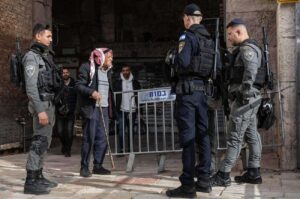
Israeli policemen speak to a Palestinian man at a checkpoint in Jerusalem’s Old City, during the Catholic Christian Good Friday, 3 April 2026.
Euro-Med Human Rights Monitor reports on 5 April 2026:
Israeli authorities’ restrictions on freedom of worship in Jerusalem are not only a grave violation of religious freedom and international law, but also part of a systematic apparatus of repression within a broader structure of settler colonialism and apartheid. These measures are used to subjugate Palestinians and reshape the city’s demography along discriminatory religious and ethnic lines.
These measures reflect a deliberate Israeli policy to consolidate colonial control by excluding Muslim and Christian Palestinians and marginalising their religious and national presence in Jerusalem, while granting privileges to settlers and keeping Jewish places of worship and commercial facilities open without comparable restrictions.
The ongoing Israeli closure of Al-Aqsa Mosque since 28 January 2026, under the pretext of a state of emergency and Home Front Command instructions following the outbreak of the US-Israeli war on Iran, goes beyond a temporary security measure. It marks a new phase in Israel’s ongoing efforts to impose coercive realities in Jerusalem. Israeli authorities are using the war and emergency measures as cover to accelerate policies aimed at reducing the Palestinian presence and erasing the city’s historical and religious identity.
The closure of Jerusalem to Muslim and Christian worshippers, while heavy security is provided for settler incursions and Jewish access and religious practice remain largely unrestricted, demonstrates that these measures are not neutral security policies
Israeli authorities have maintained the full closure of Al-Aqsa Mosque for the 37th consecutive day since 28 February 2026, completely preventing religious rituals, including in enclosed internal facilities such as the underground Marwani Mosque, which can accommodate around 4,000 worshippers. This undermines any claim that the restrictions are based on security needs, “protective arrangements,” or a “state of emergency.”
While Muslims are barred from accessing Al-Aqsa Mosque during the most significant religious periods, including Ramadan and Eid al-Fitr, Israeli police provide heavy protection to tens of thousands of settlers, allowing them to enter the mosque’s courtyards, bring in prayer materials, and perform public Talmudic rituals. This reflects discriminatory enforcement of restrictions and undermines the site’s historical and legal status quo.
The danger of these practices extends beyond the incursions and rituals themselves. They are driven by extremist right-wing groups, including so-called “Temple groups,” which openly declare their political goal of imposing temporal and spatial division at Al-Aqsa Mosque and advocate demolishing the Dome of the Rock to build a “Third Temple” in its place. This is reflected in settler groups’ public celebrations on social media, where they describe the mosque’s closure to Muslims as a “declaration of war” and a “victory” in the effort to impose exclusive Jewish sovereignty over the site.
These restrictions no longer merely raise concerns but rather reflect a systematic Israeli strategy to impose a new reality in Jerusalem aimed at undermining the existing historical and legal status quo, diminishing the authority of the Islamic Waqf Department, and gradually reducing Palestinian presence. Israel recognises that Al-Aqsa Mosque is not only a place of worship, but also a central pillar of Palestinian national, political, and religious identity. Targeting Palestinian presence there, therefore, constitutes a direct attack on that identity and an attempt to weaken it, within a broader context of officially supported efforts to reshape the site’s religious and historical character through practical steps toward imposing temporal and spatial division.
Israeli restrictions have not been limited to Al-Aqsa Mosque but have also affected the Church of the Holy Sepulchre during the same period. Access to the church has been restricted under measures imposed on the Old City since 28 February 2026.