

Identity on trial: Why must Palestinians in Israel keep proving themselves?
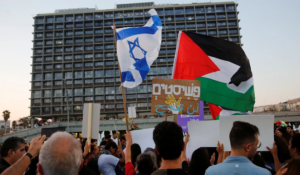
The Israeli flag next to the Palestinian flag at a demonstration against the nation-state law in Tel Aviv, 2018
Hanin Majadli writes in Haaretz on 14 July 2026:
After it became known that Anan Khalaili, a player for Belgium’s Union Saint-Gilloise and the Israel national team, was being considered by Italy’s Inter Milan, an old and familiar debate was rekindled: Are the Palestinians of ’48, Israeli Arabs, Arabs of ’48 heroes or traitors?
In the end, the deal did not go through, but while it still looked imminent several Inter fans, particularly from among the team’s Arab supporters, launched a campaign fiercely opposing Khalaili’s joining the team.
“I have no personal problem with the player or with the Palestinians of ’48,” wrote one fan, “but I can’t cheer for a player who represents Israel.” Another said: “You don’t have a choice about being one of the Arabs of ’48, but you certainly have a choice about whether to play or not to play for the Israeli national team.” Others went further. “He has no connection with the Palestinian people,” wrote one. “Anyone who represents the team of a country that has killed and expelled his people is a traitor.”
Of the hundreds of reactions, the same arguments were raised over and over: Living in Israel is not always a matter of choice, but participation in its institutions, and especially representing it in international events, is a red line in the eyes of many in the Arab world.

Anan Khalaili celebrating a goal against Brazil in San Juan, Argentina in 2023
Questions about the identity of Palestinian citizens of Israel is not the exclusive preserve of Israelis. The state of Israel and its Jewish society is constantly asking us to decide where our loyalty lies and sometimes even making use of our very existence for propaganda purposes.
In the Arab world, by contrast, many are unaware that for decades there have been Palestinians who remained in their homeland after the Nakba and are today Israeli citizens. This has given rise to a multitude of assumptions, images and theories, ranging from romanticization to suspicion, and from admiration to blame.
After the Nakba, some 150,000 Palestinians found themselves cut off from the rest of their people, who were either expelled or fled, and were left isolated from the rest of the Arab world that had once been an inseparable part of their lives. Faced with a new demographic and political reality in which they had become a minority among one million Jews, they were forced time and again to create strategies for survival, for preserving their identity and maintaining sumud (steadfastness), in accordance with the changing circumstances of each passing decade. All of this occurred quietly until the age of the internet.
The debate over the identity of Palestinian citizens of Israel almost always takes place over their heads. Israelis want to know how much we are Israeli; Arabs want to know if we are still Palestinians. Thus the simple question “Who are you?” has turned into an extremely complicated one, and not only vis-a-via the question of Israeliness. More than once we have failed the test of “true Palestinianess,” even among people who had only learned of our existence two minutes earlier.
Inter’s decision to withdraw its offer to Khalaili was officially ascribed to medical reasons, but almost immediately a competing narrative began circulating. In Israel, some claimed that Khalaili was dropped because he was Israeli and even linked the decision to antisemitism.
In the Arab world, by contrast, many saw it as the price he had to pay for representing Israel nationally. Thus, for completely opposite reasons, everyone agreed that Khalaili was Israeli.
So, for Palestinian citizens of Israel, the Khalaili affair was not just another soccer drama. It reminded them once again that their identity is still being tested.
Once again, we find ourselves in the defendant’s seat when it comes to the identity question. Social media was filled with attempts to explain, convince and defend a way of life that seems self-evident to those who live it, but continues to arouse wonder and suspicion among everyone else.
For Palestinian citizens of Israel, the Khalaili affair was not just another soccer drama. It reminded them once again that their identity is still being tested.
This article is reproduced in its entirety