

Arab Israelis aren’t looking for token MKs. They’re looking for genuine change
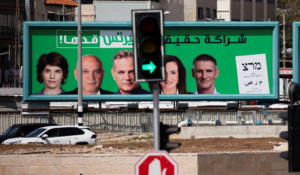
A Meretz campaign poster aimed at Arab voters, 2022
Jack Khoury writes in Haaretz on 6 July 2026:
As the election gets closer, a familiar scene is coming back: Zionist parties are once again courting the “Arab vote.” Suddenly, there’s talk of partnership, representation, integration. Yes, there’s no problem benefiting from the votes of Arab citizens; the Arab vote is desirable.
The problem is the Arab representative – they’re far less desirable. The moment the question becomes one of influence on a coalition, on a government, people begin to have reservations. There’s talk of a “Zionist government,” “security and nationalist considerations,” “the post-October 7 reality.”
In this situation, the old method used by Zionist parties to acquire Arab candidates also comes back. They choose a “correct” figure. One who looks good, speaks well, or has something different that appeals to Jews. And if that figure knows how to publicly criticize the Arab community or its representatives in Arab parties, all the better.
In practice, though, this doesn’t actually deliver results. The Arab public isn’t buying symbols, decorations or social media or movie stars. It also knows how to tell the difference between genuine representation and political decoration – a token.
No significant Arab leadership has emerged from within Zionist parties in decades. This won’t happen, for a simple reason: leadership can’t be imported, or assigned by another. It’s not created by closed lists (party candidates chosen by the party, not primaries). It’s not created by funded election campaigns, or by appearances on mainstream Israeli TV. Leadership is built from within the community itself.
Ask Knesset veterans – they’ll tell you that, in substantive moments of decision, prime ministers and senior ministers don’t involve the party or coalition’s Arab MK in the decision-making process.
In addition, the presence of those Arab candidates in Zionist parties isn’t necessarily an electoral asset. What looks good from the affluent Jewish suburbs of Ramat Aviv, Ra’anana and Herzliya doesn’t look the same from Sakhnin, Umm al-Fahm or Rahat. What’s attractive to the Jewish public, especially its center and left, doesn’t necessarily convince the Arab voter.
Parties will get excited about an Arab candidate – especially if she’s a woman – who looks good in media, speaks the right language, and sometimes has religious or cultural traits that look exotic to a Jewish audience. Only after the election do they realize their blunder.
It’s time to tell the leaders of Zionist parties: enough of this method. It’s old, worn out, and worst of all, unconvincing. The Arab community isn’t looking for a token on their list of candidates. It’s looking for a change in policy. A Zionist party that presents a clear, proven, and consistent agenda for the Arab community, even if it doesn’t have an Arab representative, is dozens of times better than a party that puts in an Arab candidate just to tick off a “representation” box.
Effective influence doesn’t begin or end in Knesset. It also exists in government ministries, planning and development agencies, and offices that make decisions, allocate budgets and shape policy. We need more Arab directors general and deputy directors general with authority; more department heads; more senior professionals; more decision-makers with influence and backbone. Not puppets.
Stop looking for “alternative Arabs” or “convenient Arabs.” Stop treating Arab representation as political background scenery. Invest in building genuine partnerships, empowering professionals, and including Arab citizens in places of power.
This article is reproduced in its entirety