

Backed by the government and army, Israeli settlers gain a foothold in West Bank’s Area B
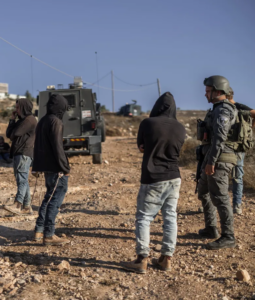
Members of the Border Police alongside settlers from the Tel Talpiot outpost in Area B, August 2026
Matan Golan writes in Haaretz on 30 August 2026:
A few years ago, F. and his family moved away from the village of Qusra in the West Bank. Their previous home was on the border of the West Bank’s Area C, which is under exclusive Israeli control, and they were tired of being harassed by settlers. Uphill, 2 kilometers (1.2 miles) into Area B, which is under Israeli security control, they hoped to find some quiet. But in January, settlers arrived there too.
Now F. stands in his yard watching through binoculars at the Tel Talpiot settler outpost at the top of a hill as settlers in an off-road vehicle descend. “If the settler reaches the utility pole and comes down, that’s the routine patrol. Eventually, he’ll go up toward the houses and return to the top,” F. says, pointing to three houses.
In recent weeks, after settlers besieged a Palestinian family in their home in Qusra, these houses have become known around the world. But the daily harassment of the people of the village began many months ago.
“If the settlers find someone walking alone, they’ll beat him to a pulp. If they come down here masked, we’re in big trouble,” F. says. By “big trouble” he means, for example, what happened in March, when village resident Amir Odeh was shot dead by a settler armed with a military rifle.
The settlers stabbed Odeh’s father in the thigh. Two weeks earlier, three activists from the group Looking the Occupation in the Eye were brutally beaten. One of them wound up in intensive care and a long stretch in rehab. The next day, in the same spot, settlers wounded a Palestinian in the head.
Seven months after the outpost was established, the high ground and its surroundings are still under the full control of the settlers. Occasionally, Israeli security forces, which have been on the high ground for two weeks, move settlers slightly away from the houses but don’t prevent them from returning. The settlers, meanwhile, can often be seen shaking hands or joking around with the soldiers.
In fear of the settlers, F. and his family watch the outpost all day. Some neighbors have already fled. As F. speaks, just as he predicted, the off-road vehicle passes by the houses on the outskirts of the village and goes back up to the outpost. What’s happening in Qusra isn’t unusual.
In the last two and a half years, at least 30 settler outposts have been established in areas under the jurisdiction of the Palestinian Authority, most of them in Area B, and at least one in Area A, which under the Oslo Accords is under full Palestinian control. These outposts were established in strategic locations designed to thwart construction by Palestinians and prevent them from moving around the area.
A month after the Knesset was dissolved in the run-up to the October 27 election, the settlers and their proxies in the government are moving on from Area C and vigorously expanding their efforts into PA areas.
‘Penetrating deep into the area’
Areas A and B comprise about 40 percent of the West Bank, and since the Israelis and Palestinians signed the Oslo Accords in the 1990s, civil authority there has been entrusted to the PA. Until 2024, no settler outposts were established there, and attempts to expand outposts from the Area C border area into Area B were demolished by order of the Israeli military’s Civil Administration in the West Bank.
But this changed after Benjamin Netanyahu formed his latest government at the end of 2022. By the summer of 2025, research organizations had identified about 10 outposts in areas under the PA’s jurisdiction, most in the nature reserve that was transferred to the PA under the 1998 Wye River Accord. It was agreed that no construction would take place there.
In the reserve, Israel also seized enforcement authority for planning and construction from the PA, and this year, it transferred to the Civil Administration enforcement authority in areas A and B for the environment, antiquities and water. The bottom line is 30 outposts without significant interference from the security forces.
For example, north of Qusra near Nablus, on the only road leading to the military outpost near the village of Tell, a sign points to the Magen Yehuda outpost. Soldiers pass there every day. To the south on a nearby hill are the homes of the Tubasi family, who were expelled from the village of Jalud in July after settlers besieged them for about a month.
South of there, the Or Nahman outpost thwarted a Palestinian construction project in the village of Turmusaya – the outpost was established on the village’s land in 2024, half a kilometer deep into Area B. Repeated attacks by the outpost’s residents made the direct route between Turmusaya and the village of al-Mughayir unusable.
Another kilometer into the area, near the village of Abu Falah, the Hameshulash outpost went up this year. On the night of its establishment, three Palestinians were killed; two of them had been shot, though not by soldiers, the army says.
Every few days, settlers stone cars driving on the road between al-Mughayir and Abu Falah. West of there, in the village of Atara, a settler from the Kfar Tarfon outpost held a circumcision ceremony for his son and affixed a mezuzah to a Palestinian home that settlers had taken over.
In May, a member of the “hilltop youth” of radical young settlers was filmed mercilessly beating a dog in Atara. Meanwhile, south of Abu Falah is an Israeli café on the outskirts of the villages of Rammun and Taybeh – “the first in Area B,” the settlers boast. It serves pizza and an elaborate acai bowl,
“The first Israeli café in Area B.”
In the past, such outposts were considered radical and were ostracized, but their rapidly increasing number as enforcement waned, amid regular visits by members of the governing coalition, have normalized them. In April, for example, Diaspora Affairs Minister Amichai Chikli toured Tel Talpiot and even uploaded a video in which he called on Israelis “to completely break free from the perspective of the A, B, C areas.” He called the high ground at Tel Talpiot “a strategic settlement point.”
A few days before the visit, the Border Police and the army again evacuated the outpost, after another settler assault that included arson attacks on chicken coops and severe injuries to a worker, who suffered a brain hemorrhage and was in a coma for weeks. “There were some bad incidents here,” Chikli said, adding that every incident like that “plays against us and harms us severely.” A few days after the visit, the outpost was evacuated again and reestablished within hours. Chikli declared during the tour that “the farms are the spearhead of Zionism.” But he didn’t visit a farm but rather what the settlers call a “hill” – an outpost established without coordination or official approval from the government, like all outposts on land under the PA’s jurisdiction.
“There are people who don’t distinguish between a coordinated farm and a non-coordinated outpost,” Central Command chief Avi Bluth said at a conference in the Gush Etzion settlement bloc, adding that “this runs contrary to the law and the directives of the Israeli government. There are no footholds in areas A and B at this time.” This doesn’t stop Chikli or other government officials from providing their support.
Some outposts in Area B maintain a low profile, hosting young families far from populated areas. Others behave completely differently. In a statement in January, the army reported that 42 outposts established without government approval are responsible for about 90 percent of the “nationalist crime” in the West Bank. According to a report by the group Yesh Din this year, most of this crime occurred in areas A and B.
IDF Chief of Staff Eyal Zamir, left, and Central Command chief Avi Bluth, who is responsible for the West Bank. Credit: IDF Spokesperson’s Unit
In April, it was reported that following U.S. complaints about Jewish terror in the West Bank, the cabinet had decided the previous month to increase enforcement against outposts in Area B. The evacuation of temporary structures was stepped up, but that didn’t stop the settlers.
Attorney Michael Sfard says that for radical settlers and politicians, ‘Every neighborhood for young couples or a road connecting villages is a disaster, because these are Palestinians. This is what an ideology of ethnic cleansing looks like.’
The Hareches outpost was established last year south of the town of Sinjil, the only outpost known so far in Area A. A few weeks after the outpost went up, Sayfollah Musallet, a U.S. citizen visiting his family in a nearby village, was shot dead. Foreign journalists who went there last month to report on the anniversary of his death were attacked by settlers.
For its part, the IDF Spokesperson’s Unit said: “In accordance with the political echelon’s directive, the IDF will not permit the establishment of outposts in Areas A and B.” It said the army discusses its assessments and needs “in the designated forums” and did not reply to other questions from Haaretz.
Support from the heart of the coalition
Outposts in areas under the PA’s jurisdiction are established on roads or on hills, or near new Palestinian construction, despite the claim that outposts go up without the government’s approval or coordination.
At a conference of the Habaita Forum held in the Knesset, titled “Seizing Open Areas,” the activists called for the establishment of another 100 outposts in areas A and B. Lawmakers from the coalition in attendance included Simcha Rothman, Tally Gotliv, Yoav Kisch, Dan Illouz, Shlomo Karhi, Boaz Bismuth, Orit Strock and Tzvi Succot.
“Wherever you go and need me, I will be there with you,” the chairman of the Knesset National Security Committee, Tzvika Foghel, told the forum, “because this is the right way to do it [take over areas under the PA’s jurisdiction], not through legislation or talk here. Through actions. Don’t stop and don’t let others stop you.”
The forum was founded by two bereaved fathers; one is Eliav Libby, a member of the Farms Association’s managing board. His son David was killed last year in Gaza while operating engineering equipment. The other founder is Yehoshua Sherman, whose son Yehuda was killed in March by a Palestinian vehicle at Beit Imrin in Area A during what the settlers call a “land survey.”
“The generation that grew up here doesn’t know what A, B and C are – it knows that all of the Land of Israel is ours,” Sherman said at his son’s funeral, declaring that three new outposts would be established in Yehuda’s memory. A few days later, five such outposts went up, three in Area A. They were evacuated days later, but more outposts have since been established in Sherman’s memory in Area B, including Magen Yehuda and Netzah Yehuda.
According to the forum, the outposts are intended “to prevent the next October 7” by creating a contiguous settlement presence that will “cripple” terror in PA areas, as the forum puts it. The forum notes that the plan was presented to government ministers and associates of Netanyahu, and that it has the support Finance Minister Bezalel Smotrich, who is also a minister at the Defense Ministry, where he has great influence over the settlement project. Smotrich said at an event last month: “We will need a war in Judea and Samaria” – the West Bank.
A map of areas A and B courtesy of a group promoting the seizing of “open areas” in the West Bank.
Locations for future outposts were not disclosed, but according to the Habaita Forum they were “carefully selected” over months based on an analysis showing that 60 percent of areas A and B is undeveloped land. The hill at Qusra is on the forum’s map of such areas.
A presentation at the conference by Likud MK Avichay Buaron reflects the depth of support for the idea. Against the backdrop of satellite images of Palestinian residential construction in Area B, Buaron claimed that this was “political construction,” not a product of natural growth.
‘The settlers would come to the house and say, ‘We will burn you.’ Everything in the refrigerator rotted because they destroyed the power lines. What could I do, starve to death with the children?’
A member of a family who fled their home
“Do you see how they’re seizing the areas?” asked Buaron, who took part in the authorization of 104 new settlements and supported hundreds of outposts. “They’re taking over entire ridges with asphalt roads, and then another house and another house. This is how they control many open areas outside the villages.”
The Magen Yehuda settler outpost. On the only road leading to a military outpost, a sign points to Magen Yehuda. Credit: Tomer Appelbaum
Against the backdrop of a photo of a ridge in PA territory, Buaron said that there are a few isolated houses there, “but thank God a farm has been established there that doesn’t let them expand into the area.”
According to attorney Michael Sfard, who represents the contractors in the construction project thwarted near the Or Nahman outpost in Turmusaya, “MK Buaron and his colleagues probably think Palestinians should live on the moon, because there’s no undeveloped place in the West Bank where they don’t recoil at the idea of Palestinian development. “A, B, C, Jordan Valley … no matter where, there must be no Palestinians there. Every neighborhood for young couples or a road connecting villages is a disaster, because these are Palestinians. This is what an ideology of ethnic cleansing looks like.”
According to Hagit Ofran of Peace Now’s Settlement Watch team, “It must be remembered that since the Oslo Accords, Israel has not allowed any Palestinian development in Area C, and recently it has also violently prevented development in areas A and B.” She says that all halts to construction in PA areas are the result of settler violence. “It’s not that someone formally demanded a stop to construction, it’s simply criminality, but the explicit statement [by elected officials] that the farms don’t allow Palestinian development proves how connected this criminality is to the system,” Ofran says.
In late 2021, during the previous Netanyahu government, the Research Department of the now-defunct Intelligence Ministry published a report claiming that the PA was seizing “open areas” in the West Bank to create territorial contiguity, disrupt Israeli contiguity, establish de facto control, build next to Israeli communities and erode Israeli security.
“The takeover of Area C constitutes for Palestinians a logical continuation of their ‘permitted’ actions in areas A and B,” the report says, recommending that Palestinian activity in areas A and B be monitored and countered.
But while elected officials enthusiastically support the takeover of areas A and B, and an official document links these efforts to Israelis’ security, the government continues to tell the international community that there are only a “handful” of outposts.
And though U.S. Ambassador Mike Huckabee called the rioters in Qusra “Israeli terrorists,” he wrote on social media that they do not represent settlers like Yisrael Gantz, the head of the Yesha Council of settlements. But Gantz has called on the government to cancel the Oslo Accords “and allow legitimate and regulated Jewish settlement in all open areas.”
The expulsion of the Tubasi family from Jalud last month included arson against a house with the people still inside and a siege with the with security forces present. Haaretz journalists who arrived there were blocked by settlers, while members of the Border Police stood by and chatted with settlers. One member of the Border Police told us about a house we wanted to approach: “There is no family.” His colleague added that we had arrived too late and it would be a “provocation” if we went up to the local outpost.
About two hours later, the family fled their home. “The settlers would come to the house and say, ‘We will burn you like we burned Dawabsheh'” one family member said, referring to members of a Palestinian family who were killed in an arson attack in 2015.
“Everything in the refrigerator rotted because they destroyed the power lines. What could I do, starve to death with the children?” Within days, the settlers took over the houses. A soldier was filmed guarding them while they played soccer on the stolen land.
This article is reproduced in its entirety