

At 78, Israel faces its most critical test yet for survival
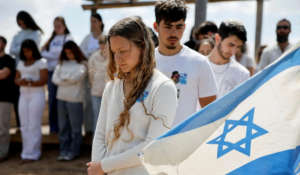
People stand during a two-minute siren, marking Israel’s Memorial Day, at an observation point in Nahal Oz by Israel’s border with Gaza, in southern Israel 21 April 2026
Ehud Barak writes in Haaretz on 21 April 2026:
Memorial Day for Israel’s Fallen Soldiers and Independence Day come one right after the other to remind us of the heavy price we have paid to establish the people of Israel’s sovereignty in our land. This time, the 78th anniversary, once again, memory both inspires pride and demands soul-searching.
The longest war in our history appears to have ended – and, if not, then in another few weeks we will find ourselves entangled in an even more complicated situation. Israel now stands at a critical crossroads. It has accomplished much and has opportunities to open a window to a new diplomatic vision and renewed hope.
But it also has domestic and foreign complications that require a sober reading of reality, strategic thinking and the restoration of truth and trust to political discourse. Without them, a successful modern society cannot be built.
Over the past two-and-a-half years, the Israel Defense Forces have demonstrated exceptional intelligence and operational capabilities. Our enemies have suffered painful blows, and all of them have been left weaker as a result. Israel is now perceived as the strongest military power in the region.
However, none of the war goals have been achieved – Hamas in Gaza and Hezbollah in Lebanon are alive and kicking. The regime in Tehran survived the joint attack of Israel and the United States. The nuclear and ballistic missile threats have not been eliminated, and it is doubtful they will be in any forthcoming agreement.
This is a major strategic-political failure if you look at power relations. Because it was an asymmetric war, Israel and the U.S. had to win while the other side merely had to survive. A bitter enemy that survives may be more determined than ever to pursue nuclear weapons and ballistic missiles. What is worse is that during the war, Israel became a “protectorate” of the U.S., which has imposed critical operational and diplomatic decisions on it as blunt, sometimes humiliating, orders.
At the root of the strategic failure are several profound weaknesses that characterize Israel’s leadership.
The first of these weaknesses is that the leadership peddled hollow rhetoric, fantasies and blatant lies to the public, most significantly, “We removed the threat of immediate annihilation with a nuclear bomb, a victory that will last for generations!” (It lasted for eight months.) Behind these lies are criminal acts to sway public opinion (the leak to the German newspaper Bild) as well as political and personal considerations that have nothing to do with the security of the state.
The second weakness is the complete disregard of the fact that in the 21st century, there is no such thing as total victory in war. In every war, we must prepare in advance a political track that will leverage military achievements to bring about a stable outcome. Hamas will only be disarmed when another force is brought to Gaza that is legitimate in the eyes of the world and the region. A force like this, backed by Egypt, the United Arab Emirates and Saudi Arabia, will inevitably have ties to the Palestinian Authority, but it is preferable to Hamas, which is backed by Turkey and Qatar.
To disarm Hezbollah, we would need to conquer all of Lebanon, and that is not realistic. Therefore, we should have been discussing with the U.S., France and countries of the region a political arrangement in Lebanon (and in Syria). Likewise, the conflict with Iran will only end around the negotiating table – albeit without us and with terms not necessarily to our liking.
The support of U.S. President Donald Trump is not guaranteed forever, and the damage is enormous. We may yet see the price of this if we can no longer count on the automatic American veto on behalf of Israel in the United Nations Security Council.
Israel needs a government that operates not as a hostage to far-right Kahanism, the “power-money-honor” cult and those who destroy the rule of law, but a government in the spirit of the sober realism of David Ben-Gurion and Ze’ev Jabotinsky. The latter’s “Iron Wall” and the former’s Declaration of Independence. This is our path.
We are a democracy in defense. There is no room for compromise between its believers and those who knowingly strive for despotism. Our future is a liberal Athens, strong and confident in its path. Not a messianic, shunned and corrupt Sparta. This year, it will be in our hands to decide. And in that decision lies our test.
This article is reproduced in its entirety