

A new Israeli settler movement ‘strategic’ plan would establish 100 outposts in the heart of Palestinian cities
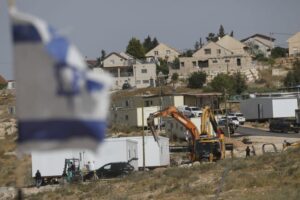
Israeli settlers continue expanding an outpost in the village of Umm al-Khair in the Masafer Yatta community, 20 May 2026
Qassam Muaddi reports in Mondoweiss on 3 July 2026:
Israel’s annexation project in the West Bank is coming to a head as the Israeli settler movement pushes for a new strategic move that stands to render the 1993 Oslo Accords obsolete and further cut Palestinian population centers off from each other. The project surfaced last week when Israeli newspaper Israel Hayom reported that a coalition of Israeli settler groups announced plans to establish 100 new settler outposts in Areas A and B of the West Bank. These areas were created by the Accords, and together they make up about 40% of the West Bank, theoretically falling under the partial control of the Palestinian Authority (PA).
Until recently, the establishment of Israeli settlements and settler outposts in Area A — supposedly under full PA control and making up 18% of the West Bank — was considered inconceivable. Area B, comprising 22% of the territory and falling under joint PA-Israeli administration, has also rarely seen settlement construction. The remaining 60% of the West Bank, Area C, is where the majority of Israel’s settlement enterprise has taken place.
But this new project stands to change the status quo arrangement that has lasted for over 30 years.
Dubbed “the Day of Command,” the project would effectively abrogate these geographic demarcations, accelerating the ongoing Israeli project of eroding Palestinian existence in the West Bank. Given the political ramifications, it isn’t surprising that the move is not being portrayed as a state project, but rather as an initiative of the settler movement. Yet key government figures who are allied with the settler movement are willing to back it.
The precursors to this shift have been several years in the making, characterized by a series of changes in the Israeli political system that have emboldened settler groups to take the initiative in projects much more consequential than legalizing one settlement or another.
The sites of the 100 outposts slated for construction in Areas A and B have not been made public, but according to the Israel Hayom report, they are in “strategic locations” that were “not chosen randomly.” According to the Israeli publication, many of the sites were state property between 1967 and the early 1990s, after which they were transferred to the PA following the Oslo Accords. Today, these sites are considered a part of the PA’s public property.
For Khalil Tafakji, a prominent Palestinian geographer and expert on Israeli settlements, these “strategic locations” aren’t hard to narrow down. “In the Israeli lexicon, the term ‘strategic’ usually means hilltops, crossroads, religious sites, and even locations containing key Palestinian institutions of self-rule,” he explained.
Tafakji told Mondoweiss that “such strategic locations are present in every major Palestinian city, and some of them are already targeted for confiscation by Israeli settlements, like Hebron’s Ibrahimi Mosque, the Zaatara junction south of Nablus, and Jenin’s Jabriyat area, where the Israeli army has established a security zone in the heart of Area A.”