

Israeli settler outposts now control nearly fifth of West Bank, peace NGO says
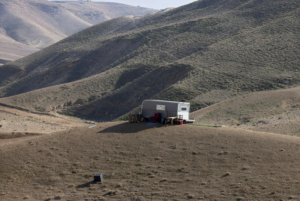
A settler outpost near the settlement of Kfar Eldad in the southern West Bank, 2025
Matan Golan writes in Haaretz on 7 July 2026:
The Israeli government has accelerated the de facto annexation of the West Bank through “a systematic transformation of the control regime,” including settlement expansion, the displacement of Palestinian communities, the retroactive legalization of outposts and increased control over areas previously under Palestinian Authority responsibility, according to a report published by the Peace Now and Kerem Navot nonprofits.
The government has provided extensive and sustained funding, particularly for unauthorized outposts, while retroactively legalizing them and facilitating the takeover of land, the report states, adding that the changes in the West Bank during the current government’s tenure are ‘unprecedented.’
Between 2023 and 2025, 185 new outposts were established in the West Bank, most of them agricultural settlements and so-called hilltop youth outposts. Together, they control more than one million dunams (approximately 250,000 acres), or about 18 percent of the West Bank’s total area.
Only about 40 percent of the land they have taken over is officially classified as “state land.” The Settlement and National Missions Ministry, headed by Minister Orit Strock, has allocated the outposts tens of millions of shekels annually.
According to the report, over the past three years, 118 communities and “shepherding clusters” – residential areas, some of which are part of those same communities – were systematically displaced. The residents left their homes due to settler violence, restrictions on access to water and a lack of protection from authorities.
To prevent Palestinians from returning, settlers erected fences along roads spanning at least 51 kilometers (about 31 miles). The fences were placed mainly in the Jordan Valley and in areas used by these communities, effectively cutting off hundreds of thousands of dunams of land.
The report said settlers have taken control of at least 11,520 dunams (approximately 2,850 acres) of agricultural land, including fields, orchards and vineyards. Until recently, much of this land was cultivated by Palestinians who were either displaced from the area or prevented from accessing their property.
The report also found that 223 kilometers (approximately 139 miles) of new dirt roads have been opened without official authorization. About half of these roads run through privately owned Palestinian land or areas that are not classified as “state land,” including, in some cases, areas in Area B. According to the report, the construction of these roads was funded with tens of millions of shekels from government budgets.
Another method used to restrict Palestinian access to land, according to the report, has been the placement of hundreds of checkpoints and physical barriers, both by the IDF and by settlers acting independently.
The report cites data from the United Nations Office for the Coordination of Humanitarian Affairs (OCHA), according to which demolitions by Israel in Area C due to construction without permits increased by about 80 percent from 2010–2022 to 2023–2025.
Over the past three years, the number of demolitions of Palestinian structures built without permits in Area C has risen by approximately 80 percent, while funding for enforcement units has increased. At the same time, the report adds, the government continues to plan, fund and retroactively authorize Israeli settlements and outposts built in violation of Area C planning and construction laws.
The government has also reduced oversight mechanisms for planning and construction in the West Bank and advanced plans for 40,064 housing units in settlements, according to the report.
It adds that in December 2024, the IDF Central Command chief signed an order extending Israeli urban renewal laws to settlements beyond the Green Line. The order establishes a “Government Authority for Urban Renewal in the Judea and Samaria Area,” which is, in effect, the same authority that operates within Israel, the same personnel and the same budgets.
The significance of this move is that government funding “can be directed to support the planning and implementation of redevelopment and other urban renewal projects in settlements, and to encourage large-scale, high-density construction.”
“The Urban Renewal Authority will be able to designate areas in settlements as redevelopment zones, allowing developers and residents to benefit from substantial tax incentives worth millions of shekels, from VAT exemptions on construction to exemptions from purchase tax and capital gains tax,” the report says.
In an effort to prevent Palestinian development, the report adds, security cabinet decisions have authorized more than 100 new settlements. These include 50 previously unauthorized outposts that were legalized, 15 “neighborhoods” that were upgraded and 37 entirely new settlements. Most of these are located deep inside the West Bank, in areas where there had previously been no Israeli presence.
Additional outposts are currently being regularized as neighborhoods within existing settlements.
In February 2023, the cabinet established a “bypass legalization” track for approximately 70 outposts designated as “sites in the process of regularization.” Most of these outposts are considered centers of settler violence, but Finance Minister Bezalel Smotrich instructed that they receive development funding and that their structures not be demolished, despite their lack of legal status.
The prospects for reaching a future diplomatic agreement were further harmed in August 2025, when Israel approved a construction plan in the E1 area after years of avoiding such a move.
The government also advanced measures to implement its decision to allocate 335 million shekels (about $111 million) for the construction of a “fabric of life” road intended to restrict Palestinian access to the area.
In addition, as part of multi-year development plans, 7 billion shekels (about $2.3 billion) were allocated for roads serving settlements, approximately 1.4 billion shekels annually (about $464 million).
According to the report, these roads are intended to serve only 300,000 settlers, who benefit from 30 percent of the budget allocated for intercity road development. Historically, the construction of bypass roads has contributed to the establishment of additional settlements along their routes.
The report found that the takeover of land has also accelerated through legal and bureaucratic measures. A total of 25,959 dunams (approximately 6,400 acres) were declared “state land,” nearly half of all the land designated as such since the signing of the Oslo Accords.
Another 21,146 dunams were added to the jurisdiction of existing settlements, while 7,200 dunams were incorporated into the Samaria Regional Council in the northern West Bank.
Those areas were evacuated as part of Israel’s 2005 Gaza disengagement, but in recent years Israelis have returned, establishing new settlements and outposts.
Another 964 dunams were expropriated, and Israel announced plans to implement previously approved expropriations covering an additional 857 dunams.
A Palestinian flag is raised in Beita in the West Bank, in 2024. Credit: Jaafar Ashtiyeh/AFP
Some 3,370 dunams were seized through military requisition orders, which are intended to be used solely for security purposes, while approximately 6,350 dunams were removed from IDF firing zones to facilitate the expansion of existing settlements and the legalization of outposts.
According to the report, efforts to undermine the Oslo Accords have expanded the process of land appropriation from Area C into Areas A and B, which fall under the Palestinian Authority’s civilian jurisdiction. By the end of 2025, approximately 20 outposts had been established inside areas under Palestinian Authority control.
At the same time, residents of nearby outposts in Area C have systematically prevented Palestinians from accessing land in Areas A and B through violence, the report said. The authors estimate that settlers are blocking Palestinian access to approximately 100,000 dunams of land under Palestinian Authority jurisdiction.
The report says the fundamental restructuring of governance in the West Bank, and the erosion of the so-called Oslo framework, is also reflected in the transfer of enforcement powers from the Palestinian Authority in Areas A and B.
It further notes that Palestinian planning and construction authority was first curtailed in the “agreed nature reserve,” referring to the area covered by a February 2026 cabinet decision stripping the Palestinian Authority of demolition powers in Areas A and B in cases involving alleged harm to heritage sites, the environment or water resources, while transferring planning and construction authority over the Cave of the Patriarchs and the Hebron settlement enclave to Israel’s Civil Administration.
The move was implemented through a military order signed shortly after Maj. Gen. Avi Bluth assumed command of the IDF’s Central Command. According to the report, his predecessor, Maj. Gen. Yehuda Fuchs, had declined to sign the order because he viewed it as a political, rather than a security measure.
In February 2026, the cabinet decided to assume additional Palestinian enforcement and development powers throughout Areas A and B in cases involving alleged harm to heritage and archaeological sites, the environment or water resources.
The report argues that these definitions are broad enough to allow Israel to block virtually any Palestinian construction or development project in the West Bank.
The report also says the longstanding religious status quo in Hebron has been altered through land expropriations, the transfer of planning authority, and the approval of a construction plan to roof the inner courtyard of the Cave of the Patriarchs.
In addition, in February 2026, the security cabinet decided to transfer planning authority over holy sites in the West Bank, including Hebron’s Old City. The decision was implemented last month, a move the report says violated the 1997 Hebron Protocol.
At the same time, plans are advancing for the construction of an isolated settlement at Givat Hamevaser, north of Kiryat Arba.
According to the report, these far-reaching changes were made possible by structural and administrative reforms in the governance of the West Bank. Among them was the transfer of key powers from the IDF to the political leadership at the Defense Ministry, including responsibility for legal oversight of these issues.
The report also identifies the creation of the Settlement and National Missions Ministry under Minister Orit Strock as a significant institutional change, particularly because it assumed responsibility for the Settlement Division, the body that allocates a substantial share of West Bank land for settlement development.
Finally, the report highlights two major cabinet decisions that have yet to be implemented: resuming the land registration process and changing the legal framework governing land purchases in the West Bank. If enacted, the report argues, these measures would facilitate and legally entrench the large-scale dispossession of Palestinians from their land.
This article is reproduced in its entirety
Full report