

Israel demolishes tent camp on ruins of Israeli Bedouin village without housing alternative
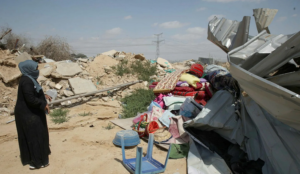
Al-Sir neighborhood in Segev Shalom, southern Israel, on 19 April 2026
Eden Solomon reports in Haaretz on 20 April 2026:
A tent encampment housing displaced residents of an unauthorized Bedouin village was demolished on Sunday by Israeli authorities.
The village, which had been built without government permission, was gradually demolished by authorities over the past year, beginning in May 2025, after which the villagers said they had been living in about a dozen tents and shacks at the site. The authorities have so far failed to provide alternative housing for the residents.
Some of the village’s residents decided to rent apartments elsewhere in the area, which is southeast of Be’er Sheva and adjacent to the Bedouin town of Segev Shalom (Shaqib al-Salam in Arabic), but many others remained at the site of the demolished village.
Residents have said that inspectors from the Israel Land Authority have periodically come and asked them to dismantle their tents.
Sliman Alhawashleh, the director of the nonprofit Regional Council for the Unrecognized Villages in the Negev, which promotes the interests of the residents of the unrecognized villages, said on Sunday that “It will soon be a year since they demolished Al-Sir and there still isn’t a [housing] solution for the residents,” he remarked that “the war with Iran has ended. Now the war against the Bedouin citizens of the Negev has begun. We’ve seen the quantities of tractors and police cruisers that came this morning.”
The battle over the status of Al-Sir actually began in 2021, when residents entered into negotiations over the unauthorized community. The Authority for the Development and Settlement of the Bedouin in the Negev offered to expand a neighborhood of Segev Shalom and extend it to include Al-Sir. The residents objected, saying that it would create a dense urban area that wasn’t compatible with their rural and agricultural lifestyle. Instead, they suggested adapting plans for the neighborhood to their needs.
In January of 2025, after it became clear that a court order had been issued to demolish their unauthorized village, residents relented and agreed to the original plan, but their consent came too late and the village was demolished before they came to agreement with the authorities.
In January of this year, the Authority for the Development and Settlement of the Bedouin announced that contracts had been signed with representatives of the first of the families and that construction of their new neighborhood would proceed. The authority called it a milestone in efforts to regulate the status of their homes, saying that the agreements would enable the families to begin “building homes in accordance with the law, linking them up to services and improving their overall quality of life.”
“The construction of permanent homes requires the issuing of building permits for every resident who is interested in pursuing it,” the development authority said, noting that a large number of building plots had already been prepared. When asked where the residents would live until their permanent housing was ready after the tent encampment was demolished on Sunday, sources at the authority said that the demolition was decided on by law enforcement authorities and was not their responsibility.
Ibrahim al-Gharibi, who heads Al-Sir’s unofficial village committee, said that even those families who signed contracts for future housing have not been provided housing in the interim.
“We’re in the month of April and there’s nothing. It’s just talk. The neighborhood isn’t ready and some of the [plots] haven’t been turned over so they can begin building,” he said. “The families whose tents were demolished [on Sunday] were among those who didn’t sign agreements settling their status due to disagreements with the authority, mainly over the terms that they were offering them to qualify for plots and a fair solution regarding livestock.”
“They even smashed the water tanks and destroyed the lavatories,” said Tawfik Abu Adwan, whose tent was demolished and said that residents feel like there’s no one to talk to. He stressed that he’s staying with his family on this land “until the day I die.”
Ziad al-Omrani’s family’s tent was also dismantled on Sunday. He said he has 11 children and two grandchildren, all of whom live on the site. “We have no other place. I looked to rent an apartment, even in Segev Shalom and didn’t find anything,” he said, adding that the family couldn’t move farther away, to Be’er Sheva, for example, because the children attend school in Segev Shalom.
“Our family has a two-month-old baby and when they demolished the tent, they left him in the sun,” he said. “They come and destroy without speaking with us. A year ago, they said that this neighborhood would be ready within a few months. You can see what kind of neighborhood development there is. There’s nothing.”
In its response to this article on Sunday, the Israel Land Authority said the evictions were of people who had “infiltrated land from which they had been evicted following final court orders.” The authority said that the evictions came after courts have repeatedly found that “they were in illegal possession of state land.” The statement didn’t not say where the residents were to find housing.
This article is reproduced in its entirety