

Palestinian March of Return reshaped by Israeli restrictions
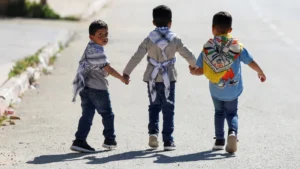
Palestinian children wearing keffiyehs walk along a road in al-Mughayir village near Ramallah on 22 April 2026
Samah Watad reports in Middle East Eye on 22 April 2026:
The annual March of Return, which typically draws tens of thousands of Palestinians inside Israel, was transformed this year into a series of smaller marches across depopulated Palestinian villages.
Despite restrictions imposed by Israeli police, hundreds of Palestinians took part in local tours to their destroyed villages to commemorate the Nakba, or catastrophe, which refers to the ethnic cleansing of Palestine by Zionist militias to make way for the creation of Israel in May 1948.
Through these events, Palestinians say they aim to reaffirm their identity amid what they describe as ongoing Israeli attempts to erase it.
Khaled Awad, spokesperson for the Association for the Defence of the Rights of the Internally Displaced, said discussions with Israeli authorities began around three months before the march.
He noted that police initially refused to engage with the organisers of the event and warned they could break it up if it went ahead.
In response, the association, alongside the rights group Adalah, petitioned the Israeli Supreme Court, which compelled police to formally respond to their requests. Even after negotiations began, Awad described a pattern of delays and shifting conditions. “We are used to this kind of stalling,” he said, referring to similar experiences in previous years.
According to Awad, police agreed to allow the events on the condition that participation would not exceed 1,000 people – a limit he described as “unreasonable”, given that thousands have historically attended. Police also required that no Palestinian flags or national symbols be displayed, claiming such imagery could “provoke unrest”.
Organisers were explicitly warned that the march could be blocked and dispersed if it proceeded in its traditional form, particularly if Palestinian symbols were raised. Given that the march typically includes families, children and elderly participants, organisers said they took these warnings seriously.
“We are talking about a space where people come with their children,” Awad said, noting concerns that participants could be harmed in the event of police intervention. “We want this to remain a safe place,” he added, describing the march as an opportunity for people to reconnect with their villages and affirm their right of return.
By the time approvals were finalised, only days before the planned march, organisers said it was no longer possible to coordinate a large central gathering. Instead, they shifted toward smaller, decentralised events across different locations.
‘We left thinking we would come back’
More than 30 tours were organised to depopulated villages, including al-Damun, Miar, Maalul, al-Lajjun, and Miska, among others in the Galilee and northern areas – sites where Palestinian communities once lived before they were forcibly depopulated. Participation varied from one location to another. Some gatherings drew a few dozen people, while others reached several hundred.
In al-Damun, hundreds attended one of the main events, while turnout elsewhere remained more limited, reflecting both logistical constraints and the dispersed nature of this year’s activities.
In Miska, one of the smaller gatherings brought together around 70 participants, including families and descendants of the village’s original residents.