

Board of Peace envoy says Gaza plan needs quick progress, Hamas talks ‘not easy’
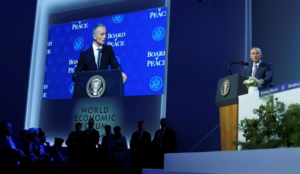
Board member Nickolay Mladenov speaks after the signing of the Board of Peace charter during the Annual Meeting of the World Economic Forum in Davos in January 2026.
Liza Rozovsky and Reuters report in Haaretz on 20 April 20 2026:
The Board of Peace’s lead envoy for Gaza told Reuters on Monday that he was “fairly optimistic” a plan for disarmament of Hamas and other militant groups in Gaza can be agreed but cautioned that it will still take time.
“We’ve had some very serious discussions with Hamas over the last few weeks, they’re not easy,” Nickolay Mladenov said in an interview during a visit to Brussels. “I’m fairly optimistic that we will be able to come up with an arrangement that works for all sides and, most importantly, works for the people in Gaza,” he said.
U.S. President Donald Trump proposed the Board of Peace in September to oversee his plan to end Israel’s war in Gaza, subsequently saying it would tackle other conflicts. The UN Security Council has recognized the board, which is chaired by Trump, though many major powers have not joined. Trump’s Gaza plan, to which Israel and Hamas agreed in October, sees Israeli troops withdrawing from Gaza and reconstruction starting as Hamas lays down its weapons.
But Hamas’ disarmament is a sticking point in talks to implement the plan and cement an October cease-fire that halted two years of full-blown war. Violence has continued in the Palestinian territory, much of which remains in ruins.
Risk of losing momentum
Mladenov said work was underway on an implementation plan that would include disarmament, new governance in Gaza and provisions for an Israeli withdrawal.
“It obviously will take time, but we’re trying to make sure that the arrangements for the implementation of the plan are agreed to as quickly as possible,” Mladenov, a former UN Middle East envoy and Bulgarian politician, said.
When asked about when an agreement could be reached on implementation, Mladenov said: “We have a matter of days, maximum a couple of weeks, that is my assessment, because otherwise we will lose the momentum of what we have and then every decision will become even more difficult”. While declining to comment on the details of ongoing negotiations, the envoy said he believed there was “a good way forward that is being discussed with both sides”.
One of the issues under discussion was the “yellow line” demarcating the territory Israel has occupied since the October cease-fire, Mladenov said. Reuters has reported that Israel has moved the “yellow line” deeper into Gaza. “There’s a whole set of issues that need to be handled on the ground, including the yellow line,” Mladenov said, adding that matters such as access for aid and medicine are also under discussion with Israel.
He also pointed to some changes on the ground. “We’ve been able to, over the last few days, gradually and very carefully increase the number of people that are allowed to cross through the Rafah crossing. We’re looking at increasing the number of trucks of goods that are going into Gaza,” he said. The Rafah crossing connects Gaza to Egypt.
There is also a need to build trust, Mladenov said. “It’s a very complicated process,” he said. “But it is a process that is taking a lot of small steps to get us ultimately to an agreement on the full implementation of the plan”. Trump in February said that U.S. allies have contributed over $7 billion to relief efforts in Gaza and the U.S. will contribute $10 billion to the Board of Peace. Reuters has reported that the Board of Peace has only received a fraction of what was pledged.
“All the monies that were committed in Washington are there for the Board of Peace,” Mladenov said. “We don’t have any financial issues related to the work of the Board of Peace.” Member states can earn permanent membership of the board by paying $1 billion.
This article is reproduced in its entirety