

Iran and Palestine: From Yasser Arafat to Hamas – is the balancing act over?
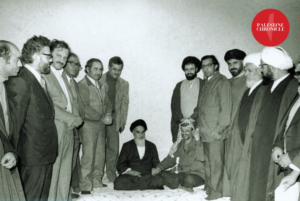
Palestinian leader Yasser Arafat meets Iranian revolutionary leader Ruhollah Khomeini in Tehran following the 1979 Iranian Revolution
Ramzy Baroud writes in The Palestine Chronicle on 10 March 2026:
The relationship between Palestinian resistance movements and Iran has long been shaped by a complex mixture of ideology, geopolitics, and necessity. While Iran remains one of the most consistent backers of Palestinian armed resistance, the political meaning of this alliance has evolved significantly over the decades.
For Palestinian movements, the issue has never been purely ideological. Instead, it has reflected difficult strategic choices in a political landscape largely defined by Western pressure, regional rivalries, and the realities of Israeli military dominance.
Understanding this relationship requires revisiting its historical roots.
From Revolutionary Solidarity to Political Distance
The relationship between Iran and the Palestinian national movement began shortly after the Iranian Revolution of 1979.
That same year, Palestinian leader Yasser Arafat became the first foreign leader to visit Tehran following the fall of Shah Mohammad Reza Pahlavi. During the visit, Iran symbolically handed the Israeli embassy building in Tehran to the Palestine Liberation Organization (PLO), transforming it into the Palestinian embassy.
At the time, the relationship appeared promising. The revolutionary Iranian leadership saw the Palestinian cause as central to its regional vision, framing Israel as a colonial project and Palestine as a symbol of global anti-imperial struggle.
However, this alignment gradually weakened.
As the PLO pursued diplomatic engagement with Western governments and Arab states throughout the 1980s and 1990s, its relationship with Iran became increasingly strained. The shift was particularly evident following the 1993 Oslo Accords between the PLO and Israel, which established the Palestinian Authority and inaugurated a US-backed peace process.