

What part Israel’s Arab parties can play in toppling Netanyahu in the 2026 vote
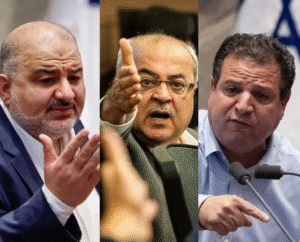
Arab-Israeli members of the Knesset and current party leaders Mansour Abbas, left, Ahmad Tibi and Ayman Odeh.
Linda Dayan writes in Haaretz on 1 February 2026:
With a Knesset election due by October, the centrist opposition parties are looking for ways to unseat Prime Minister Benjamin Netanyahu’s Likud and the junior partners in the far-right governing coalition.
This time, the parties are mulling the lesson they learned from the 2021 election: By joining forces with representatives of the Arab community, they can wrest power from Israel’s longest-serving prime minister. It worked for Naftali Bennett, who led a historic governing coalition that included the Islamist United Arab List party.
Last month, leaders of the Arab parties United Arab List, Hadash, Ta’al, and Balad announced their intention to run in the upcoming Knesset elections on a joint list. That means, in effect, running as one unified party comprised of separate factions, which may or may not splinter off after the election.
Sources familiar with the decision, though, said that this is more of a declarative step, and that the path to realizing a fully unified joint list is still long and complex. The parties will have to overcome divides on such critical topics as joining the governing coalition and the centrality of traditional Islamic values in order to form a lasting alliance.
These issues have shattered this union in the past. The Joint List of UAL, Hadash, Ta’al and Balad ran first in 2015 and again in 2019, and despite the parties’ disparate platforms and backgrounds – some communist, some Islamist, some secular – they ran together to maximize their Knesset showing. Once in parliament, the parties largely voted as a bloc to advance the interests of the Arab community, but they dissolved the union in 2022 amid ideological and policy differences.
This time, in declaring their partnership, the Arab parties are harnessing the momentum of the protests against crime and under-policing in Israel’s Arab society. Their constituents have long been making this call – a poll from last year showed that more than 70 percent of Arab citizens want to see the parties unite, a move that is likely to boost voter turnout in the community.
Even though the move will shore up votes for the current opposition to the Likud-led, far-right government, this doesn’t mean that Netanyahu’s other opponents are on board. In launching its 2026 campaign, Benny Gantz’s centrist party vowed “not to rely” on the Arab outfits to form a governing majority, claiming that an Arab party would undermine Israel’s security during wartime.
This isn’t a fringe position: Polls released last month showed that 71.5 percent of Jewish Israelis oppose including Arab parties in a coalition, though over 75 percent of Arab Israelis support the Arab parties joining the government. According to an Israeli Democracy Institute survey, 84 percent of Jewish respondents who oppose the move vote for right-wing parties, but 43 percent of centrist voters and about 20 percent of left-wingers are also against including Arab parties in the government.
Although the values of some of these parties may align with those of many left-wing and even center-left Israelis, certain political positions have helped push these voters away. These include a commitment to remain in the opposition, and abstentions or votes against key LGBTQ issues like surrogacy for same-sex couples and the ban on “conversion therapy” for minors.
Other contentious positions only put these parties further outside the mainstream. These include Hadash and Balad’s condemnation of the Gulf states’ labeling of Hezbollah as a terror group in 2016, and the Arab parties’ failure to condemn Syrian President Bashar Assad’s chemical attacks on his own people in 2017.
But with anti-Palestinian sentiment growing in Israel in the wake of October 7 and the war in Gaza – and the far-right government striving to disqualify the Arab parties and their politicians – Arab voters are looking to these parties to make change and advance their interests.
Who are these parties, and what do they stand for?
United Arab List
Mansour Abbas’ United Arab List, also known by its Hebrew acronym Ra’am, has long represented the southern branch of the Islamic Movement in Israel. It was born out of a rift in the movement that emerged in the 1970s and champions political Islam, roughly similar ideologically to the Muslim Brotherhood, which put down roots in neighboring countries at the same time. The northern and southern branches split in 1996, with the former adopting a more radical stance, believing that it shouldn’t take part in local and national politics, and the latter opting to run for the Knesset.
The party made history during the short-lived “government of change” of 2021 and 2022, becoming the first Arab-majority party to join a governing coalition since the ’50s. Abbas prioritized day-to-day issues of the Arab minority. He championed a five-year plan for the community – a blueprint to advance employment, education, social welfare, health care, housing and other areas that lag behind Jewish Israel.
Abbas also set his sights on repealing the so-called Kaminitz Law, which cracks down on illegal construction and is often used to demolish houses in Arab areas, where red tape makes it harder for residents to build legally.
United Arab List has no charter, but discerning spectators can piece together its platform from its voting history and leaders’ statements. He has repeatedly condemned the current far-right government and its ministers for neglecting his community.
In 2021, Abbas recognized Israel as a Jewish state, something no politician from an Arab party had done. “Whether we like it or not, Israel is a Jewish state, and my central goal is to define the status of the country’s Arab citizens. I view myself as a citizen in the full sense of the word, who deserves to receive full civil rights,” he told the Kul al-Arab news site.
Abbas drew the ire of other members of the Arab community, including former United Arab List Chairman Masoud Ghanaim, who said the Islamic Movement and the party do not accept or recognize the view that Israel is a Jewish state.
Responding to the controversy, Abbas told a conference in 2021: “We have to decide whether we want to engage in campaigns that have a chance of succeeding, and then we’ll be able to develop as a society and prosper, and be a section of society with influence, or whether we want to be in an isolationist position and continue to talk about all these things for another hundred years.”
He and his party voted against the 2024 parliamentary declaration opposing a Palestinian state west of the Jordan River, suggesting instead a sovereign Palestinian state and a peace agreement with it.
With its deep Islamist roots, the party is staunchly socially conservative. United Arab List lawmaker Waleed Taha said in 2020 that “the gay phenomenon almost doesn’t exist” in Israel’s Arab community, and four of the party’s lawmakers voted against a bill to ban “conversion therapy,” a practice that attempts to change a person’s sexual orientation.
In December, Abbas announced that the United Arab List was splitting from the Islamic Movement and the Shura Council, allowing it to operate independently. He told Haaretz that the party would open to broader audiences in Arab society, beyond the Islamist constituency. He recently announced that Jews will be able to run on the party’s slate – an unprecedented move.
A month earlier, Netanyahu said he intended to “complete” Israel’s ban on the Muslim Brotherhood. In practice, no part of the Brotherhood has been prohibited in Israel; the prime minister was probably referring to the northern branch of the Islamic Movement. Netanyahu also hinted that he might outlaw the southern branch, which is represented by UAL.
Hadash
Hadash is an acronym for the Democratic Front for Peace and Equality, but it also means “new” in Hebrew. It has run in every Knesset election since 1977. It was formed by a merger of the New Communist List party and other factions on the radical left. It is currently run by Ayman Odeh, who said in 2023 that he will not run in the next election. As a mixed Arab-Jewish party, Hadash has long reserved a slot on its electoral slate for a Jewish member, currently the controversial lawmaker Ofer Cassif, who followed Dov Khenin.
The party’s platform calls for “a just peace based on the withdrawal from all occupied territory, and the establishment of a Palestinian state alongside Israel whose capital is East Jerusalem.” It demands an acceptance of the 2002 Arab Peace Initiative and condemns the Abraham Accords, which it says “do not advance peace” and make a diplomatic solution harder to achieve.
Hadash also calls for “a full repeal of the discriminatory and racist Nation-State Law, which is based on perceptions of apartheid,” and, true to the party’s communist roots, it supports a minimum wage of 60 percent of the average wage and a progressive housing program.
Hadash has never joined a governing coalition and has only once supported a coalition from the outside – the government of Yitzhak Rabin in the first half of the ’90s. After the United Arab List joined Bennett’s coalition, Hadash MK Aida Touma-Sliman said that her party would not do the same, because “this government will be controlled mainly by the right [wingers] that want to preserve the occupation of the Palestinian territories, enlarge the settlements and continue oppressing and discriminating against our Palestinian population, citizens of Israel.”
Three out of five of Hadash’s Knesset members voted to ban “conversion therapy”: Odeh, Cassif and Touma-Sliman. They were the only members of majority-Arab parties to vote for the ban, which stoked division among the parties. At the time, Hadash was part of the Joint List, which would vote as a bloc on civil issues. This was one of the factors that caused the Joint List to split in 2021.
Hadash often runs on a joint slate with the Ta’al party, or the Arab Movement for Renewal, as happened in the last election. That faction is led by its co-founder, Ahmad Tibi. It focuses on secular Arab nationalism, championing a Palestinian state within the 1967 borders and civil rights for the Arab community. Alliances like Hadash-Ta’al allow the two parties to cross the 3.25 percent electoral threshold.
Balad
Balad’s name is a Hebrew acronym for the National Democratic Alliance, but in Arabic the word means “country” or “land.” The party has been active since 1996. Balad calls for Israel to become a “state for all its citizens” rather than a Jewish state, and for Israel to withdraw from all territories it has occupied since the 1967 war. Balad supports a Palestinian state with East Jerusalem as its capital, and a right of return for all Palestinian refugees.
The faction’s co-founder, Azmi Bishara, repeatedly came under fire for his support for Hezbollah and Syria in their conflict against Israel in the early 2000s. In 2002, Bishara was indicted for supporting a terrorist organization, but due to his political immunity as a Knesset member, his trial was canceled. He was again charged with supporting terrorism in 2007, after being suspected of aiding Hezbollah during the war with Lebanon a year earlier by passing on classified information. Bishara and Hezbollah have both denied that he acted as an agent for the terror group.
In September 2022, Balad was disqualified from the November election because its platform rejected Israel’s existence as a Jewish and democratic state. But Attorney General Gali Baharav-Miara said that despite her disagreements with the party’s platform, “no evidence has emerged showing that Balad in recent years has acted to turn the most dubious parts of its platform into reality.” Balad won an appeal and ran in the election, but it did not earn enough votes to cross the electoral threshold, leaving it out of the Knesset.
This article is reproduced in its entirety