

‘Why we are here’: IDF campaign encourages West Bank tourism with settler propaganda
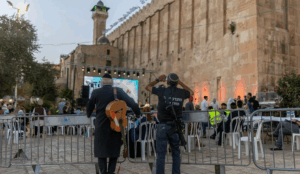
A settlement conference at the Cave of the Patriarchs (Ibrahimi Mosque) in Hebron in September 2025
Noa Shpigel and Nir Hasson report in Haaretz on 2 December 2025:
The IDF is operating an online campaign that urges soldiers and the public to visit archaeological sites and illegal outposts in the West Bank, including in Areas B and A under Palestinian Authority control. The project, called “Beshvil Yehuda” (“In the Path of Judea”), operates through WhatsApp and Telegram groups and Instagram and YouTube pages, and even published a book last July.
Alongside information about locations where soldiers were killed and memorial sites, the project also serves as a channel for settler propaganda.
The videos include recommendations for visiting various sites, advertisements for private businesses, political messaging, and religious and archaeological narratives, some lacking scientific basis. Content is presented by IDF officers, soldiers, civilian tour guides and archaeologists, as well as political figures from the settlements.
The project was founded by a soldier from the area who served in the Judea Regional Brigade. He continued to lead it during his reserve service with full backing from senior commanders. A recently uploaded YouTube video features the commander of the Judea Regional Brigade, Shahar Barkai; the commander of the Samaria Regional Brigade, Ariel Gonen; and their deputies. In the video, the head of the IDF spokesperson’s unit in the West Bank says: “After the tours, I see how the bond tightens and the ability to carry out the mission is strengthened through a broad understanding of what this place is.”
Another officer adds: “We are here because these are the glorious landmarks of the people of Israel.”
A July 2024 article on the IDF Spokesperson’s website described the project, noting that “Master Sgt. Elia had a great dream – to connect every combatant, civilian, and tourist in the Judea Regional Brigade to the heritage and history of the sector.” The website says the goal was “to map a route passing through special landmarks in the area – from historical events from the biblical period, through stories that predate Israel’s establishment, and up to battles fought after the establishment of the State of Israel – that would connect as many soldiers as possible to the essence of the mission and answer the question: Why are we here?”
Across the project’s channels, dozens of videos invite soldiers and the public to visit sites including the “Samaritan Mausoleum” in central Nablus. In one video, a guide explains that the location is “80-100 meters from Joseph’s Tomb.” Another recommends visiting a reservoir in the village of al-Karmil in Area A. The guide says it dates to the Mandate period but claims it was built atop an earlier pool, linking that earlier pool to the biblical story of Nabal of Carmel – without any archaeological evidence. Other videos promote visits to illegal outposts, springs formerly used by Palestinians before settlers took them over, synagogues located inside Palestinian villages and more.
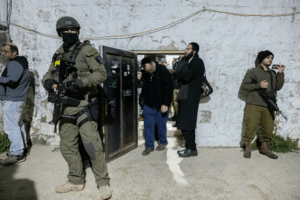
Soldiers securing worshippers at Joseph’s Tomb in Nablus in 2024
The channel, which is run by the Judea Brigade, also gives a platform to settler leadership. In one video, Eyal Gelman, head of the Har Hevron Regional Council, recounts a miracle story claiming that Abraham came to complete a prayer quorum in a synagogue in central Hebron a few hundred years ago.
Another video, shared by the Facebook page of the Hebron Visitors’ Center, features Noam Arnon, spokesman for the Jewish community in Hebron, explaining the marking of Jacob’s burial site in the Cave of the Patriarchs. Against footage of soldiers touring the site, Arnon says: “Jacob’s name was changed to Israel. The name Israel is the source of all historical development of the people of Israel, the land of Israel, the Torah of Israel, and in our time – the State of Israel, the Government of Israel, the Israel Defense Forces and the Knesset.” In another video he opens with: “Greetings, residents and soldiers of the land of Judea.”
One video includes recommendations for date spots and marriage-proposal locations. The presenter, in uniform and introduced as a member of the “Beshvil Yehuda” team, recommends sites including Negohot Farm in the South Hebron Hills – an outpost built in 2018 – along with several other locations, some of them built on privately owned Palestinian land.
Another video shows an armed guide in uniform explaining the Bar Kochba revolt. “Was it worth rebelling?” he asks, then talks about the hundreds of thousands who died. “I believe everything was worth it to be a free people in our land – for freedom, for liberty,” he concludes as an Israeli flag waves above a Palestinian village.
The channel also includes advertisements for private businesses, such as a coffee cart at the Susya archaeological site in the South Hebron Hills. “If you visit ancient Susya today, you’ll find an impressive historic site – an amazingly preserved synagogue, audiovisual videos, crawl-through caves, and of course a delightful coffee cart!” one video states. Another advertises the Har Bracha tahini factory on Mount Gerizim.
A paintball site in the settlement of Kedumim. The channel also features advertisements for private businesses. Credit: Daniel Tchetchik
One video memorializes Ze’ev (Jabo) Erlich, who was killed alongside soldier Gur Kehati in a controversial incident at an archaeological site in Lebanon. Another calls on residents and soldiers to attend a Hanukkah candle lighting in his memory at the ancient synagogue in the village of Samu’, located in Area B in the South Hebron Hills.
In yet another, the deputy commander of the Samaria Brigade says he is in the village of Nisf Jubeil in the Nablus Governorate and suggests it may be one of the places where the prophet Elijah operated. He recounts a Muslim story about a sheikh who lived there and says: “What’s true? I don’t know. Okay, it doesn’t matter – this tells a story that fits ours for the purpose at hand. And regardless, as Jabo used to say: Even if it’s not true, many people have been coming here for many years, so it’s also part of the history here.”
The Samaria Brigade operates a similar channel called “Beshvil Shomron.” One of its videos, filmed at the archaeological site in Sebastia, features a uniformed guide claiming that bath installations adjacent to a Roman temple were actually Jewish ritual baths.
The project gained momentum during the war, but Neta Caspin, a reservist officer who served in the brigade, told Haaretz that as early as 2022, videos from the project were already being distributed in the battalion’s WhatsApp group. “It’s strange to call it ‘normalized,’ because no one even bothered to criticize it,” she said, describing how casually it was accepted.
“There’s a settler who serves as a reservist in the brigade and he’s in charge of the tourism project,” she says. According to Caspin: “Every week they send us an education plan, and the soldiers can choose to go on a tour in the sector while on reserve duty. Even if you didn’t choose to go, you might still find yourself at a battalion or brigade event at one of the heritage sites, or your battalion commanders might be sent to secure a (Jewish) prayer in a Palestinian village. It’s really hard to call it ‘normalized’ because it’s simply a complete blindness to the heavy price this project’s ideology exacts from Palestinians in the area.”
Emek Shaveh, an NGO of archaeologists focusing on the role of archaeology in the Israeli-Palestinian conflict, said: “The connection between uniforms and settler ideology is already familiar; what’s new is the overt and blatant way settlers are using it to influence a captive audience – young soldiers who, through heritage sites, are receiving right-wing and religious indoctrination from authoritative figures they are subordinate to.”
The organization added: “Let every Jewish mother know that the takeover is complete and the Israeli army has become a tool serving a single political sector. From now on, she is not only sending her sons to guard (the likes of) Jabo or the Breslovers at Joseph’s Tomb, but also to personally connect to those same ideological positions.”
The IDF Spokesperson said: “The purpose of the videos is solely to present historical information about the archaeological sites in the region, to strengthen knowledge and connection to the history of Judea and Samaria. We stress that policy is clear: There is no encouragement or guidance to visit places where presence is prohibited without authorization from the relevant authorities and without IDF security.”
The spokesperson did not address why political and religious agendas were included in the videos or why political figures were allowed to participate.
This article is reproduced in its entirety