

By revealing sexual assaults in Hamas captivity, brave male Israeli hostages help other victims
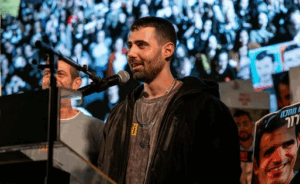
Guy Gilboa-Dalal at Tel Aviv’s Hostage Square during a Saturday rally in November 2025
Eran Hahn writes in Haaretz on 3 December 2025:
Captivity survivor Guy Gilboa-Dalal was interviewed last week on Channel 12 News, providing grim descriptions of the physical and sexual abuse he endured. His interview comes after the one by Rom Braslavsky, who talked about the horrific conditions of captivity, including sexual assault, and Keith Segal’s testimony to the UN about being sexually assaulted in Hamas captivity.
The courage demanded of these three men in sharing with the public intimate details of the assault they underwent is not self-evident and deserves special respect. As a rule, men rarely speak about sexual violence they experience. Even though at a later age, when they are sexually mature, men are less likely to be victims than are women or girls, there are still attacks on men, and it’s important we allow them to feel safe enough to talk about what happened to them without their masculinity being impugned, and without people wondering why they didn’t fight their assailants back.
For a long time after November 2023, Israeli society was occupied with returning women and children from Hamas captivity. We were witness to testimonies describing their harsh experiences and were aware of the significance of the women being kidnapped, worried they would be victims of sexual assault. Few people expressed concerns that male hostages were facing similar risks, since they were men, combatants, heroes, supposedly immune to such attacks.
The testimonies released recently are unequivocal. The three survivors of captivity mentioned here described a deliberate use of their bodies as a means of humiliation, as a way of dominating them in a way that was injurious to their identities as human beings. We as a society are obligated to look them in the eyes boldly, expressing our compassion.
Ever since these testimonies came to light, we at the hotline (male responders) at the Association of Rape Crisis Center have been receiving a growing number of reports of assault, even from people who were assaulted many years ago. Some of them have never told anyone about what happened to them. Men tend to express the trauma in different ways, sometimes by closing themselves off and avoiding social contact, or by using dangerous substances or adopting risky behaviors. Direct talk is less common.
The reason for this is profound. It is grounded in a deep-rooted conception of “Israeli machismo,” according to which a man – certainly if he has served in the army – is by necessity, physically and emotionally tough. He’s a survivor who doesn’t break. Sexual assault, which is first and foremost a matter of a power differential, of domination and humiliation of one person by another, undermines this myth.
Many of the men who have gone through such experiences report having feelings of guilt, shame and a sense of personal failure. They perceive themselves as flawed, as lacking power. Breaking the code of silence around sexual assaults on men following the testimonies of returning hostages will be a test for us as a society. Will we know how to recognize such harm even it challenges our concept of masculinity, our national images and what is convenient for us to see?
Studies show that the paucity of reports by males who have been assaulted stems, among other things, from outdated societal notions of men and masculinity. Shame and guilt are more common among assaulted men than among women, not because the harm is different, but because it undermines the masculine identity society expects them to have. Studies also show that unwanted arousal during a traumatic event, a recognized phenomenon among men, intensifies the sense of the body’s betrayal and the confusion around the event, enhancing the difficulty of talking about it.
There is one center in Israel that operates a hotline for helping men who have been sexually assaulted. The center receives thousands of calls a year, with the numbers rising in the last two years. Some of the callers have never told anyone; others can’t even define what they went through as a sexual assault, since they lack the language for saying so. We’ve achieved a lot as a society in stopping to cast the blame on victims, while transferring the sense of shame from the victim to the assailant when the victim is a woman. There is much more work to do in this area when the victims are men. As a start, we must afford them a safe and non-judgmental space where they can talk about the assault they underwent. We also have to train professionals and expand our perspective regarding sexual assault.
The testimonies of returning hostages could be our turning point. Not because they are exceptional in their intensity and descriptions, but because these men dared talk about what many men fear to. Such testimonies enable us, as a society, to examine ourselves and our ability to also see men as vulnerable.
The writer is a director of the national hotline for men who have been sexually assaulted.
This article is reproduced in its entirety