

Why Israel’s legal system defence in ICJ genocide case has disintegrated
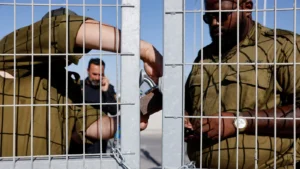
Soldiers lock a gate at Sde Teiman detention facility after Israeli military police arrived as part of an investigation into the abuse of a Palestinian detainee, on 29 July 2024
Peter Oborne and Irfan Chowdhury write in Middle East Eye on 20 March 2026:
Last week, Israel suddenly dropped charges against five soldiers accused of the sexual abuse and rape of a male Palestinian prisoner.
This development was grotesque – all the more so, since there is no shortage of evidence.
The soldiers were filmed as the atrocity was allegedly committed. As for the victim, the Israeli newspaper Haaretz has cited medical records showing that his injuries included a ruptured bowel, a severe injury to his anus, lung damage and broken ribs.
In this article, however, we will not dwell on the moral squalor of the decision by Military Advocate General Itai Ofir to abandon the case. We will examine instead the consequences for Israel’s ongoing defence against genocide charges at the Hague.
At the heart of the Israeli position is the claim that the country already boasts a robust and non-partisan legal system, and that there is thus no need for a body such as the International Court of Justice (ICJ) to interfere in its domestic affairs.
British lawyer Malcolm Shaw set out this argument with admirable clarity when he defended Israel against South Africa’s charges of genocide at the Hague in January 2024.
He told the ICJ: “Were it the case – which we deny – that Israeli forces have transgressed some of the rules of conflict, then the matter would be tackled at the appropriate time by Israel’s robust and independent legal system.”
The implications of this statement from one of Britain’s most eminent lawyers are straightforward. If Israel possesses a “robust and independent” judicial framework, then there is no need for South Africa to ask the ICJ to uphold international law and redress the injustice of Israel’s persecution of the Palestinian people; Israel can be trusted to take matters into its own hands.
If the claim is false, on the other hand, then such an international intervention is required as a matter of urgency.