

Who is behind settler violence in the occupied West Bank?
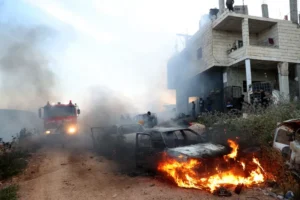
A view of damaged houses and burning vehicles after a raid by Jewish settlers on the town of al-Mughayyir near Ramallah on 12 April 2024
Mohammed Watad reports inAl Jazeera on 4 August 2026:
As illegal Israeli settlement activity expands across the occupied West Bank, violent settler groups have emerged at the forefront of escalating attacks on Palestinians and their property with the aim of creating new realities on the ground.
These groups are driven by hard-line religious and nationalist ideology that advocates the expansion of settlements, the expulsion of Palestinians, and the assertion of dominance over what they call “Judea and Samaria”, referring to the West Bank.
Despite differences in their structure and methods of operation, they share the goal of entrenching settler presence, forcing Palestinians from their land, and thwarting any political process that could curb the growth of settlements, which are considered illegal under international law.
A number of their leaders are linked to networks of rabbis and right-wing activists who serve as their ideological and religious authorities. Some settlements and outposts have also become bases from which attacks against Palestinians are launched.
These groups do not operate independently of settlement expansion. Rather, they benefit from a political, legal and on-the-ground environment that strengthens their presence, reflected in the growing number of settlement outposts and plans aimed at expanding settlements.
Below, Al Jazeera highlights the main settler groups driving the escalation in the West Bank, along with information about their leaders, ideological and religious influences, areas of activity, and the major attacks and crimes attributed to them.
Hilltop Youth
The Hilltop Youth is among the most prominent violent settler groups active in the West Bank. It is a decentralised network made up mostly of Jewish youths aged between 15 and 20 who live in settlement outposts and pastoral farms scattered across hilltops.
Some of the group’s members have been expelled from educational institutions, while others come from well-known religious families, including those of rabbis and settler leaders. The group’s emergence is politically linked to a speech delivered by former Israeli Prime Minister Ariel Sharon – and then foreign minister – on November 16, 1998, in which he urged settlers to “seize the hilltops” and expand their control over the land, in what was widely viewed at the time as an attempt to undermine the peace process and the implementation of the Wye River Agreement that promised Palestinians faster and further autonomy.
“Everyone there should move, run, grab more hills and expand the area. Whatever is seized will be in our hands, and whatever we do not seize will be in their hands,” said Sharon.
The group takes its name from a strategy of establishing settlement outposts on hilltops. The term “hilltops” refers not only to the terrain itself, but also to a settlement model based on creating new outposts outside existing settlements and later imposing a fait accompli to pave the way for their legalisation.
Members of the group subscribe to a hard-line religious and nationalist ideology that advocates Jewish control over the West Bank. They are influenced by currents such as Neo-Hasidism and elements of New Age spirituality. They are also known for distinctive religious appearance, including wearing long sidelocks and large knitted kippahs or yarmulkes and openly displaying their tzitzit fringes.