

‘We are history’: Baroud on memory, resistance, Palestinian narrative in Belfast
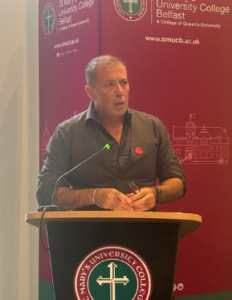
Ramzy Baroud speaking in the Belfast Palestine Day, 6 August 2026
Romana Rubeo reports in The Palestine Chronicle on 9 August 20226:
Key Takeaways
- Baroud described storytelling and memory as essential tools of Palestinian survival and resistance.
- He challenged histories that portray Palestinians as passive subjects rather than historical actors.
- He presented sumud and resistance as part of a long Palestinian historical continuum.
- Baroud linked his family’s losses in Gaza to the struggle against historical erasure.
- He called for solidarity rooted in Palestinian history, agency and the right to resist.
Palestine Day
Speaking in Belfast on Palestine Day, on August 6, Palestinian author and journalist Dr. Ramzy Baroud delivered a deeply personal examination of memory, colonialism, resistance and the struggle over who possesses the authority to write history.
The keynote address and presentation of his latest book, Before the Flood: A Gaza Family Memoir Across Three Generations of Colonial Invasion, moved between Palestinian history, Baroud’s childhood in a Gaza refugee camp, the destruction of his ancestral village of Beit Daras, the ongoing Israeli genocide in Gaza, and the killing of members of his own family.
But Baroud’s central argument extended beyond the story of one Palestinian family. Palestinian history, he argued, cannot be understood through the political and military milestones established by colonial powers, nor can Palestinians be reduced to victims appearing only when they enter Western archives, diplomatic documents or news reports.
For Baroud, Belfast itself provided a particularly meaningful place from which to make that argument.
“I believe that, to stand in Belfast, is to stand in a city whose very walls speak,” he began. “It is a place that understands with profound historical clarity, that stories are never merely words. They are battlegrounds.”
Drawing a connection between Irish and Palestinian experiences of colonialism, Baroud said Ireland understood “the weight of carrying an unbroken identity through centuries” and the importance of memory when sovereignty itself is denied.
“It is precisely within this shared geography of struggle, from the streets of Belfast to the refugee camps of Gaza, and I was born and raised in a refugee camp in Gaza, that we must confront the central question of our work,” he said.
“Why do we write books? Why do we insist on telling our stories, even when the dominant media machinery seems willfully blind or worse? When imperial institutions have already constructed a narrative, designed to render us invisible,” Baroud added.
Memory as a Defense against Colonial Erasure
For Palestinians, Baroud argued, such questions cannot be reduced to literary or intellectual debates. They concern the very survival of a people whose history has repeatedly been subjected to political and physical erasure.
See also: