

Tone deaf constitution? Palestinian Authority tries to give a sign of life amid debt and political crisis
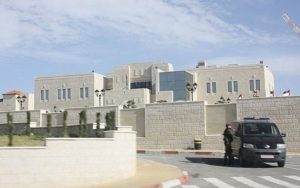
The Muqata’a in Ramallah, HQ of the Palestinian Authority
Jack Khoury writes in Haaretz on 15 February 2026:
The Palestinian Authority published a draft interim constitution last week, amid a worsening economic crisis and Israel’s security cabinet decision to entrench far-reaching Israeli control deep inside West Bank areas under Palestinian Authority rule.
However, as the political and economic ground continues to crumble beneath the Palestinian Authority, the future feasibility of the document is enshrouded in doubt.
The draft was published at the initiative of Palestinian President Mahmoud Abbas, and includes over 160 articles, which map out commitments to the 1988 Palestinian Declaration of Independence, international law and human rights conventions. It enshrines the freedoms of expression, press, assembly and religion as fundamental rights, and emphasizes the principles of equality before the law and the separation of powers.
However, most of the public debate on the matter revolves around the articles concerning the president and his broad powers – including the authority to declare a state of emergency, the identity of his vice president, and the mechanism set in place for replacing the president in the event of incapacity.
The issue of succession was foregrounded by last year’s appointment of Hussein al-Sheikh as vice president. According to the draft constitution, should the presidency become vacant, the Palestinian Authority must hold elections within 90 days. The interim president during that period would be the speaker of the Palestinian Legislative Council, or the president of the constitutional court, if the Palestinian parliament has no speaker. This would mean al-Sheikh would not become acting president should Abbas be incapacitated. At the same time, it remains unclear what would happen if the Palestinian leadership is forced to decide on a successor to Abbas before the constitution is approved.
The draft’s publication comes as the Palestinian finance minister warned Thursday of the extreme fiscal difficulties the Palestinian Authority will face throughout 2026.
Speaking at a press conference in Ramallah, Palestinian Finance and Planning Minister Estephan Salameh said that the PA’s most dire financial situation since its establishment is a result of Israeli authorities’ continued refusal to transfer tax revenues and customs duties collected on their behalf. These funds are vital for paying PA employees’ wages.
Salameh said that on Monday, the Authority will pay 60 percent of the owed wages of public sector employees, at a minimum of 2,000 shekels (about $640). The figures presented by Salameh illustrate the financial abyss: The PA’s monthly revenue does not exceed 400 million shekels ($130 million), while one billion shekels ($320 million) are needed to cover minimal operating expenses. The partial payment of salaries requires approximately 720 million shekels ($230 million), in addition to around 200-250 million shekels ($64-$81 million) set aside for other essential payments. The PA’s debt total has soared to roughly $15.4 billion, while hundreds of compensation lawsuits have been filed against the PA in Israeli courts.
Officials in Ramallah describe the crisis as political in nature, not technical. Palestinian officials estimate that the economic pressure is part of a wider Israeli policy, including last week’s security cabinet decision, to weaken the PA and undermine its representative role.
Declaration of sovereignty
Putting the legal debate aside, the fundamental question remains whether it is possible to draft such a constitution as the Authority’s economic and political foundations continue to erode.
A constitution is written as a declaration of sovereignty, but the reality on the ground – from the expansion of Israeli control over the West Bank and cabinet decisions enabling de facto annexation, as well as the deepening economic crisis – casts serious doubt on the viability of such a step.
If the PA continues to struggle to pay wages, provide basic services, or maintain institutional stability, how will it ensure the constitution’s promised freedoms and rights?
Palestinian officials increasingly view this as a two-pronged effort: internally, to formalize the succession process and move towards the establishment of a Palestinian state; externally, to convey sincerity and a willingness to reform in the hope of halting unilateral moves and garnering renewed international support.
However, critics warn that without a shift in the balance of power or fiscal matters, the constitution may remain a purely declarative document, particularly as the United States and other international actors intervene. Will constitutional reform arrive before economic collapse? Will political pressure collapse the institutional framework before it can stabilize? Or might the very existential threat accelerate internal unity and strengthen the demand for a full constitutional framework?
There is no clear answer. What is clear is that a quiet confrontation over the future of the entire system is unfolding, buried within the constitution’s many articles and the red ink spilling from the Palestinian Finance Ministry’s accounts
Without striking a balance between the need for political reform and economic stability, the question asked will not be which constitution is adopted, but rather which, if any, Palestinian Authority will remain to implement it.
This article is reproduced in its entirety