

‘They are afraid to talk. For Palestinians, it’s hard to open up in front of Israelis’

Shani Goldman, the founder of the fellowship, speaking at the culminating Studio Al-Karma exhibition in Haifa on 12 February 2026
Nagham Zbeedat reports in Haaretz on 23 February 2026:
On a Thursday evening in early February, people slowly filled the exhibition space in downtown Haifa. Art hung carefully on the walls, speakers hummed somewhere in the background, and conversations shifted between Hebrew and Arabic.
The “Haifawiya” exhibition at Cafe al-Karma is the culmination of more than five months of an intense and intimate fellowship. The program – run by Studio Al-Karma at Beit Hagefen, a Jewish-Arab cultural center – brought together creatives from different backgrounds to meet regularly and to learn from established artists – and each other.
Participants had been asked to express their pain, past and present emotions, though not everyone seemed certain, at least at first, how much of it could safely be shown in the room. The final exhibition showcased the collective outcomes of those sessions – embroidery, illustration, writing, ceramics, collaging and even choir singing – marking the conclusion of the studio’s second workshop cycle.
The exhibition’s opening featured brief reflections from artists, participants and organizers, focusing on their work and the process. Instead of formal panels or structured discussion, the project centered on a collective creative space, where months of workshops placed participants side by side, letting conversations and connections develop gradually through shared artistic practice.
Shani Goldman, who has worked at Beit Hagefen for several years and founded the Studio al-Karma program two years ago, said the idea behind the arts fellowship grew from the understanding that younger residents in Haifa – Palestinians, Jews and Russian-speaking immigrants – often lacked meaningful shared spaces.
“It was important to build a place where they could come and create. We live here together,” she said. “And to create something shared, we need more tools than just sitting and talking. We need a real shared daily life. We try to build that through art and culture.”
The premise was: If Haifa’s residents usually encounter one another through headlines, protests or political arguments, what might happen if they met instead through art?
“We live in a reality where there aren’t really natural meeting points. It’s never simple,” said Zeina Abu Zarqa, a 25-year-old master’s student at the University of Haifa from the city of Ar’ara who took part in the fellowship. “The studio provides a space for people who may not have another place to talk and interact with people different from them. Just the fact that people use art as a tool to express themselves and the places they come from, things that might not be understood through normal language, gives another possibility for communication, and a more peaceful one.”
Alongside the studio itself, Goldman pointed to the adjoining café as part of the same community-building infrastructure – a space designed to be accessible for young residents who may feel isolated or excluded elsewhere in the city. “The community here is very mixed,” she said. “Young Palestinians who don’t want to live in the village anymore; students; young Jewish residents who find Jerusalem too hard and Tel Aviv too much, they come to live in Haifa.”
In that environment, she said, linguistic and cultural differences are constant but accepted. “Not everyone understands everything all the time,” she said. “And that’s OK.”
Cultural transmission
For Marihan Khoury, the workshops leading up to the exhibition were never simply about teaching embroidery or pottery skills. It was, from the beginning, about meaning and cultural continuity.
A Palestinian artist from Haifa and owner of the Darnah Gallery in the city’s Wadi Nisnas neighborhood, Khoury has exhibited internationally in Jordan, Switzerland, the United Arab Emirates and elsewhere. “This time I took it as an opportunity in Haifa, in my hometown, to present art that reflects the Palestinian identity,” she said. “It was important for me that what I show here talks about our culture, our heritage, and who we are.”
“When we worked on tatreez,” traditional Palestinian hand-embroidery, “it was essential for me to explain that we are working on something that goes back to our heritage. I couldn’t introduce this art without talking about its background, what it means, where it comes from, the places connected to it.”Tatreez functions not only as ornamentation but as a form of cultural record, with distinctive motifs historically tied to particular towns and regions and transmitted across generations as part of women’s communal and domestic life.

A close-up of Marihan Khoury’s tatreez, on display at the exhibition
The stitching patterns themselves were selected deliberately. Khoury chose models distinct to multiple regions – Jenin, Ramallah, Bethlehem, Gaza and others – not simply as aesthetic references, but as geographic memory stitched into the work. The finished pieces were eventually mounted onto a traditional Palestinian thoub, the embroidered dress historically worn by women in rural communities.
Even the clay sculpting followed the same conceptual thread, Khoury said. Participants incorporated tatreez-inspired patterns into ceramic forms, and at the center of the project they sculpted a Palestinian woman holding a wheat stalk – a symbol, Khoury explained, of life and continuity.
“It was important for me that the origin of tatreez be understood,” she said. “We even showed a presentation explaining why we chose this art and why it matters.”
The writing teacher’s rule: No political talk
Not all artists involved in the broader exhibition approached their sessions in this way. Raji Bathish, a writer, screenwriter and cultural activist from Nazareth, led a creative writing workshop that placed participants from different linguistic and personal backgrounds into a shared emotional exercise.
Bathish has spent more than three decades working in literature and cultural criticism and has published six books in Arabic, including “A Room in Tel Aviv and The Apartment in Passy Street.” The participants in his workshop were asked to write about heavy themes – grief, betrayal, sadness – in their own languages. Some wrote in Arabic, others in Hebrew or English. Translation, when needed, was assisted by AI tools, Bathish said, which were imperfect but sufficient to convey the general meaning.
“The experience in this workshop was hard. Beautiful, but hard,” he said. “It was meant to touch the agony of people. Many couldn’t bear that weight and dropped out.” Bathish described maintaining professional distance during the sessions, even as the atmosphere intensified. “I protect myself in these settings,” he said. “I can’t cry in front of someone who is crying. I have to protect myself. I used to go home tired, but I enjoyed it.”
Unlike some of the visual workshops, Bathish’s sessions also operated under a strict guideline: Participants were asked to avoid direct political debate and instead focus inward on personal emotional experience. The rule itself proved contentious. “This is the first time for me to have a direct dialogue between Palestinians and Jewish Israelis in one room,” he said. “And it was an important rule not to talk about politics. A lot of people did not agree with this rule and did not join the workshop.”
At times, participants pushed back. Some wanted to address current events directly. Bathish recalled responding by redirecting the discussion inward. “Some said, ‘We want to talk about Gaza,'” Bathish said. “And I would tell them: Look for the Gaza within you. What is your pain? What is your wrath? You can find Gaza inside. “We were able to find a shared language, a humane one, among participants who come from different backgrounds and speak different languages. They talked in grief and agony.”
For Yaniv, a 49-year-old freelance medical translator, Bathish’s workshop “wasn’t simple, but something inside me was burning to try.” “I came here to discover and to write, and I left feeling very blessed by this workshop. There’s something very intimate about these meetings,” he explains. You write about something painful, and then you read it in front of people. I felt very good just sitting there with them, showing what I wrote, giving them something and receiving something from them – I really loved that.” For Yaniv, language itself played a central role in that experience. Although Hebrew is his native language, he often chose to write in Arabic – a language tied to family history.
“My grandfather spoke Arabic,” he said. “When I write in Arabic, I’m writing to him. He passed away years ago. There’s something in Arabic that allows you to be very precise. It lets you express things in a very unique way.” “For me, culture is no less important than eating and drinking,” he said. “It’s very important that there are places where you can come and do these things, because it’s not always accessible.”
Bathish, his writing instructor, says that participation itself remains uneven. He said he would like to see more Arab participants join future workshops, noting that for many, speaking openly remains difficult.
“They are afraid to talk,” he said. “Some keep their feelings inside, or whisper them only to each other. To open up in front of Israelis, it’s hard. But it is important to take this step – to feel secure enough to express your emotions, for everyone.”
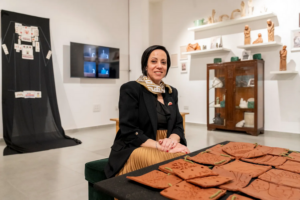
Palestinian artist and gallery owner Marihan Khoury who taught workshops on embroidery and clay sculpting
Through art, ‘I don’t need to translate myself’
Abu Zarqa, the University of Haifa student, has facilitated events and developed content for Studio Al-Karma and Beit Hagefen for years, but this was her first time participating in workshops.
She took part in a workshop led by Rachel Anyo that focused on visual analysis – learning to break down images and reconstruct them in new and unexpected ways through collaging. Beyond the technical process, what stood out to her most was the atmosphere created among the participants themselves.
“The bigger picture for me was seeing the people, the conversations between participants, guests and artists, was joyful,” she said. “There were people from different religions, cultures and places in Haifa, all coming to be in the same place and share something connected to art. For me, that was a dream that came true.”
Abu Zarqa and Khoury, the embroidery instructor, both pointed to the centrality of art as a shared language in the workshops. For Palestinians in particular, Khoury said, artistic expression can also become a kind of protected emotional space. “Palestinian art for me is a safe space to express yourself, your feelings, especially when you feel there are limitations or restrictions in other ways,” she said. “Even when we use art to express sadness and sorrow, it is still a breath. An escape.”
One picture can deliver a message stronger than all languages. I don’t need to translate myself in order to be understood – Zeina Abu Zarqa, a workshop participant. The sense of connection, Abu Zarqa added, was built not only through the artistic work itself but through conversing over coffee and tea about their lives before diving into the technical part of each three-hour workshop.
“In the end, what matters most is the shared encounter,” she said. “That there is a space where people can come, stay and feel it’s equal. A place where things that are unequal can also be present and spoken about.”
The program’s current structure, Abu Zaqra said, was shaped in part by the disruptions that followed the outbreak of the war in October 2023. A major exhibition marking the gallery’s 60-year anniversary that December was cancelled; the gallery space was left empty and artists were invited to hold workshops instead.
“The workshops were initially meant to be one-time sessions,” Goldman said. “But it turned out people really needed this, a place to release, to breathe, to talk, but not in a way that forces them to choose sides.”
From that response, the longer workshop framework developed. The participants were at very different starting points – technically, emotionally and politically, Khoury said. Agreement was never the expectation. Influence, she suggested, works more quietly.
“I feel like even if someone does not agree with me entirely, talking about this will plant a seed in them that they will carry for years,” she said.
For Bathish, the writing instructor, the urgency of such encounters is tied to the broader social atmosphere post-October 7. “People have turned their backs to each other,” he said. “They refuse to see or hear each other. It’s hard to live here like that.” Literature, he argued, offers one of the few spaces where common human themes can still be expressed across boundaries: “The topics were meaningful to everyone. Arabs, Jewish people, even French participants. Literature is an international language. Even if people spoke different languages, they shared the same stories.”
This article is reproduced in its entirety