

Israel must stop using water as a weapon of collective punishment in Gaza
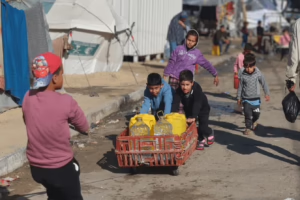
Children bring water back to their tents in the Al-Shaboura neighborhood of Rafah in January 2024 before the Israeli Rafah invasion
Doctors Without Borders/Médecins Sans Frontières (MSF) introduces its new report Water as a Weapon on 28 April 2026:
Israeli authorities are using access to water as a weapon against Palestinians, including by systematically depriving people in Gaza of water in a campaign of collective punishment, according to a report released today by Doctors Without Borders/Médecins Sans Frontières (MSF).
MSF calls on Israeli authorities to immediately restore unhindered access to water, sanitation, and hygiene for Gaza’s 2.1 million residents. Israel’s allies, including the United States, must use their leverage to pressure Israel to do so.
Deliberately denying Palestinians access to water is an integral part of Israel’s genocide. Through data and medical testimonies, the MSF report, “Water as a Weapon: Israel’s Destruction and Deprivation of Water and Sanitation in Gaza,” documents how the weaponization of water by Israeli authorities is not an isolated act, but part of a recurrent, systematic, and cumulative pattern. The denial of access to water is occurring alongside the direct and continued killing of civilians, the devastation of health facilities, and the flattening of homes, which has caused mass displacement. Together, these actions constitute a deliberate infliction of destructive and inhumane conditions on Palestinians in Gaza.
“Getting water is not supposed to be dangerous”
Israel has destroyed or damaged nearly 90 percent of water and sanitation infrastructure in Gaza, including desalination plants, boreholes, pipelines, and sewage systems, according to the United Nations, the European Union, and the World Bank. MSF teams have documented Israeli military shooting at clearly identified water trucks, and destroying boreholes that were a lifeline for tens of thousands of people. Violent incidents have often occurred while water was being distributed to people, injuring Palestinians and aid workers and damaging equipment.
“My grandson went to get some drinking water [in Nuseirat in July 2025],” said Hanan, a Palestinian woman in Gaza City. “He was standing in line with other kids, and [Israeli forces] killed him. He was 10 years old. Getting water is not supposed to be dangerous.”