

‘There’s another way:’ Israelis, Palestinians team up to protest death penalty
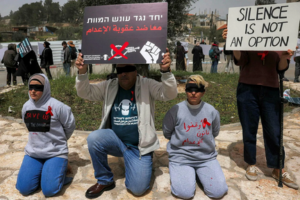
Protesters at the entrance to Bethlehem in demonstration against the death penalty law, 3 April 2026
Matan Golan reports in Haaretz on 5 April 2026:
Despite the relative calm at last Friday’s protest at the entrance square between Bethlehem and Beit Jala, the tension in the air was palpable. About 30 protesters, Israeli citizens alongside Palestinians, gathered to demonstrate against the death penalty law for Palestinians convicted of deadly acts of terrorism passed by the Knesset.
The law stipulates capital punishment for a terrorist who killed “with the intent to deny the existence of the State of Israel,” wording that effectively targets Palestinian attacks while setting an ideological burden of proof unlikely to be applied to Jewish nationalist violence.
Many in the small gathering carried signs reading “Nonviolent Protest,” alongside slogans such as “Together Against the Death Penalty” and “Freedom for Political Prisoners.”
Over the past two and a half years, since October 7, political protests in the West Bank have become rare. Those that do take place are usually dispersed quickly by the IDF. This protest, despite its quiet nature, ended in much the same way. An army vehicle arrived at the junction and closed it off, and the crowd’s shouts against the law and the occupation grew louder. The protesters were then shown an order declaring the junction a closed military zone. They dispersed without the use of force or arrests.
One of the demonstrators, Sulaiman Khatib, a former inmate in an Israeli prison and co-founder of Combatants for Peace, the movement that organized the protest, spoke to Haaretz about what he sees as the dangers of the newly approved law.
“This is a process – it’s not just the death penalty law. We are going in the opposite direction of a solution to the conflict,” he said. “There are intentions to encourage Palestinian migration and steps being taken to accelerate it.” He added that settler violence contradicts international law as well as the values of Judaism and Islam. “We are protesting here together to send a message to both peoples that there is another way.”
Combatants for Peace was founded in 2006 by Israelis who served in the West Bank and Palestinians who had participated in armed struggle. “The movement was founded by Palestinians who were in Israeli prisons and took part in the first or second intifada. After being released, they concluded that there are other ways to resist the occupation, nonviolent ways,” explained Jamil Kassas, a veteran activist in the organization
Israelis who were part of the military, he said, “understood that the occupation is untenable and oppresses an entire people, and refused to continue serving. Both sides, Israelis and Palestinians, joined hands out of a belief that there is a way other than the way of weapons.”
“As an Israeli, I am appalled to see how the government is taking us toward an extreme interpretation of what a Jewish state means, celebrating death instead of life,” said Yael Vergen, the organization’s Israeli community coordinator, noting that the law represents the opposite of Jewish values.
“I am also shocked by the way the Israeli public silently accepts this law and does not oppose it,” she added. “I call on Israelis to come out against this racist law that distinguishes between one group’s blood and another’s. This law must be seen within the broader context of the moral deterioration of the State of Israel.”
Among the protesters were also former IDF soldiers. “After a fire consumes an entire forest, there are acorns left underground, and they are what will regrow the forest,” said Ido, one of them, referring to the joint protest. “In my experience, that’s exactly what we’re doing here. Something that ensures that while everything burns, something new can grow in the future. I know it also preserves that part of my soul that feels deep guilt about what we’re seeing happening today.”
This article is reproduced in its entirety