

There is no Israeli settlement without violence – even the ‘mainstream’ ones
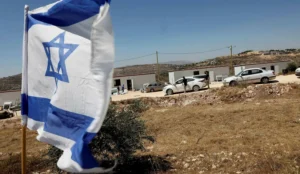
A settler outpost near the settlement of Eli in the West Bank.
Yonatan Kanonich writes in Haaretz on 17 August 2026:
Suddenly, there’s a feeling that something is changing, that a growing number of Israelis are shocked by the phenomenon known as “settler violence.” This process is encouraging, but there is a paradox here. That’s because while settlers with rifles or Molotov cocktails indeed rouse disgust, this isn’t the only type of violence – or even the worst or the most influential type – that the settlement enterprise entails.
Their very existence generates inherent violence. Yet there is no opposition to this among Israel’s Jewish population.
This attitude, which could be called “settlerism,” is actually the largest and most significant political current in Israel. All the Jewish parties support settlement, whether directly or indirectly.
Effectively, there isn’t any relevant Jewish party today that challenges the very idea of the settlements’ existence in occupied territory. And the vast majority of Jewish Israelis will vote in the upcoming election (as they did in previous elections) for parties that support settlers and settlements through development, funding and legitimacy.
Clearly, settlerism isn’t only expressed via the ballot box. It also takes the form of direct or indirect support for the settlement enterprise through countless routine actions: buying products made in the settlements, attending cultural events in occupied territory, studying at Ariel University. And then there’s the one that is considered the greatest taboo of all: opposing service in the army that controls millions of Palestinians in the West Bank.
There is no settlement without violence, and that includes the settlements that are already considered mainstream, like Ofra, Efrat and Ma’aleh Adumim. The reestablishment of Sa-Nur – a settlement in the northern West Bank that had been evacuated as part of the 2005 Disengagement Plan – could serve as a test case.
In May 2025, the security cabinet approved its reestablishment. The government funded this decision to the tune of hundreds of millions of shekels. And less than a year later, the first Israeli settlers moved in, in a ceremony attended by ministers and Knesset members.
In late 2025, a large contingent of soldiers was stationed on the territory earmarked for the settlement. And two months after that, the mayor of the nearby Palestinian town of Jaba told me that during the two decades in which there were no settlers at Sa-Nur, the army had very rarely entered his village, but “since the end of December, soldiers come in almost every day.
“Over the course of three or four straight nights, the army arrested some 200 people, including me,” he continued. “They took us for ‘conversations’ with the Shin Bet. Since then, soldiers have entered 70 percent of our homes.”
No suspects have been arrested during these nightly incursions. They were merely a violent show of force by the army, accompanied by intimidating conversations with Shin Bet security service agents, all meant to prepare the area for the settlers’ entry.
Sa-Nur was rebuilt on 65 dunams (16.1 acres) defined as state land. It is surrounded by thousands of dunams belonging to residents of nearby Palestinian communities that they use for homes, businesses and agriculture.
Even before the settlers arrived, the army issued two expropriation orders for 650 dunams of privately owned Palestinian land (10 times the size of the settlement) in order to build a fence around the settlement and pave a road that would bypass Palestinian communities. These orders effectively increased the size of the settlement and prevented the Palestinian landowners from accessing thousands of additional dunams of agricultural land.
In February 2026, Jaba’s mayor predicted that “all our agricultural land is in danger. It won’t be possible to enter it, work it, plant it. The businesses along the road are also in danger.” He added that “at the moment, there is no settler violence yet, but we see what is happening in other places. We’ve lost our hope of living in peace and quiet. We know we’re going to suffer.”
The reestablishment of Sa-Nur shows how even before “settler violence” arrives, the settlements severely harm Palestinians’ human rights. The settlements depend on the large-scale theft of privately owned land and lead to an increase in the military forces stationed in the area. The soldiers’ “routine” operations, which are meant to ensure the settlements’ existence, intensify the mechanisms of control and oppression, come at the expense of Palestinian freedom of movement and deprive Palestinians of sovereignty over the area as well as control over their own time.
All of these are acts of violence. And if you multiply them by hundreds of settlements and settlement outposts, you get daily, inherent violence against millions of people.
The settlerism that is spreading in Israel is the opposite of democracy. It preserves and intensifies violent, oppressive military rule over people who don’t have control over their own lives and aren’t allowed to vote and shape their own future.
Thanks to the Israeli public’s support for settlerism, the government has advanced a comprehensive policy of settlement, violence and the fragmentation of Palestinian space in the West Bank. It seeks to limit the space in which Palestinians can live, take over their lands and push them into small enclaves that are disconnected from each other.
The upcoming Israeli election is critical for the “anyone but Bibi” bloc. But settlerism is a broad Jewish-Israeli consensus that is shared even by those who pretend to be an alternative to the current government.
Consequently, it isn’t enough to seek to replace the government and the prime minister or to click your tongue at the sight of a settler with a club. A real political alternative requires accepting responsibility for the impact of the settlement movement, for the brutal mechanism that operates in its service, and for the continued subjugation of an entire people to military rule.
Yonatan Kanonich is head of research at Yesh Din and co-author of the report “Maximum Territory, Minimum Population.”
This article is reproduced in its entirety