

The truth about Israel’s violent expulsion of Palestinians in 1948 is nothing new
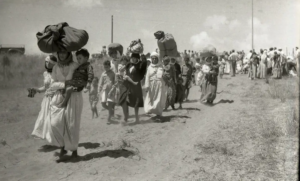
Tantura residents flee their village, May 1948.
Amira Hass writes in Haaretz on 3 March 2026:
“Thousands of newly discovered documents now make it possible to tell the true story of Israel’s expulsion of Palestinians in 1948,” declares the subheadline of another unsettling article by historian Adam Raz, published recently.
The headline misses the mark. Palestinians told the “true story” of ’48 long before these documents surfaced. The essence of that story has always been clear: the Hebrew army expelled them intentionally, and one of the means it employed was acts of murder and massacre.
The subheadline does not fully align with the article itself: Raz mentions Palestinian prose literature and studies – by Saleh Abd al-Jawad and Adel Manna – based on oral testimonies. Those studies and literary works, even if published after the Nakba, drew on firsthand knowledge of what had occurred. That knowledge came from hundreds of thousands of people who experienced the events as they unfolded.
Even if this knowledge was not immediately transcribed, cross-referenced by conventional historical methods, or translated into Hebrew, it conveyed the true story from the very beginning. It was the knowledge of the expelled, the survivors, the “present absentees,” the bereaved sisters, and the villagers who tried to reach – “infiltrate,” in our parlance – their vineyards to harvest fruit from trees their parents had planted. It belonged to the young people who sought revenge with weapons, the students who sang of return to their homeland, and the founders of the liberation organizations.
To present such documents as if they alone reveal the truth – or as if truth exists only once they surface – is to grant the perpetrator the exclusive first and last word in determining what the true story is. The researchers’ assumptions – and often their explicit conclusions – drawn from these testimonies and from the clear pattern that emerged across them, proved more accurate than the claims of those who prioritized written documents above all else. For example: that the expulsion was planned rather than spontaneous, and that acts of massacre were more numerous than initially reported.
Raz notes that of 17 million files in the Israel State Archives and the IDF and Defense Establishment Archives, more than 16 million are inaccessible to the public. Their concealment is deliberate. One can reasonably assume that, had these documents contradicted the oral testimonies about the Nakba and the Jewish War of Independence, the state would have rushed to make them public.
A more accurate subheadline, then, might have read: “Thousands of documents discovered by chance and revealed thanks to the tenacious efforts of the Akevot Institute confirm the true story Palestinians told about ’48 – one that Israeli society refused to hear.”
“The history of all hitherto existing society is the history of class struggles … oppressor and oppressed … in constant opposition to one another,” Karl Marx and Friedrich Engels wrote in “The Communist Manifesto.” We may expand this formulation to include gender, interethnic and national struggles. The truth of exploitation, oppression and profit at the expense of others exists with or without documentation.
Documents – especially those produced by the exploiting and profiting party, by the expeller and the massacre – add crucial detail. They allow for precision: the sequence of events, dates, types of weapons and ammunition, the names of those who gave orders, and the motives and objectives as defined by their authors. But to present such documents as if they alone reveal the truth – or as if truth exists only once they surface – is to grant the perpetrator the exclusive first and last word in determining what the true story is.
This absurd hierarchy is familiar to any journalist who covers Palestinian affairs and does not see their role as reinforcing the Israeli security narrative. Palestinian testimonies are typically regarded by Israelis as inferior journalistic raw material. An incriminating video or photo – for example, of a settler attack, abuse by a soldier or prison guard, or a detainee released from Israel Prison Service custody looking as if he had just emerged from a concentration camp – is more likely to be accepted as credible evidence.
At the top of this hierarchy of “truth” stands the leaked classified Israeli document or the statement by an Israeli official. Securing such material is considered investigative journalism. It usually confirms – often not in real time and only after severe damage has already been done – the accumulating Palestinian testimonies previously dismissed as inferior.
For example, the dispossession motive behind the declaration of “firing zones”; the disproportionately lethal force used to suppress demonstrations in the early weeks of the second intifada; IDF fire at Gazans fleeing with white flags during the 2008-2009 war; the prohibited use of white phosphorus against civilians; and the designation of entire families as legitimate targets in the 2014 war. These practices did not begin on October 7, 2023. Yet reporting grounded in Palestinian testimony gains value only once it is confirmed by a security authority or a written Israeli document.
Because of this distorted journalistic hierarchy, when oral testimonies accumulate – one by one, revealing the same pattern across different places and times, such as the killing of Palestinians, including children who posed no threat to any soldier – a single denial from the IDF spokesperson is enough to push them into the sub-basement of Israeli public attentiveness.
But no matter how deep that sub-basement may be, the true story – of our destructive, lethal, dispossessing and expelling power – remains intact and valid, and is to be found outside of it.
This article is reproduced in its entirety